


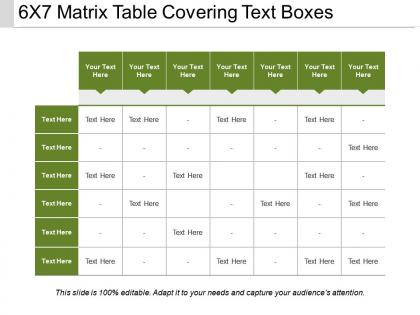
6x7 matrix table covering text boxes




Try Before you Buy Download Free Sample Product
 Impress Your
 Audience
 100%
100% Editable
 Save Hours
 of Time


Indulge in gluttony with our 6x7 Matrix Table Covering Text Boxes. Binge on a buffet of brilliant ideas.
People who downloaded this PowerPoint presentation also viewed the following :
6x7 matrix table covering text boxes with all 5 slides:
Our 6x7 Matrix Table Covering Text Boxes assure efficient choices. Easily avoid feeling hamstrung.




FAQs for 6x7 matrix table
So you want complete coverage without doing extra work, right? Start by mapping out all your dimensions - like rows and columns. Then use covering techniques (greedy algorithms work great, or try set partitioning). Don't overthink it though. Greedy approaches are honestly your best bet when you're starting out - way less headache than jumping into complex optimization stuff right away. The whole point is hitting every combination without wasting time on redundant coverage. It's like doing a puzzle where you don't want gaps but also don't want to double up on pieces unnecessarily.
So matrix covering is basically the opposite of normal optimization. You're not hunting for one perfect solution - you want a bunch that work together to hit all your requirements. Like needing different keys for different locks instead of some magical master key that probably doesn't exist anyway. Regular optimization methods obsess over finding that single best point, but this approach is more realistic honestly. You just accept that sometimes you need multiple solutions covering each other's gaps. The goal shifts to finding the smallest set of these covering pieces rather than maxing out one function. First step? Map out everything that actually needs covering.
Matrix covering is clutch for sparse datasets - basically helps you find the smallest representation of your data. I see it everywhere in recommendation systems where you're hunting for minimal user/item sets that capture broader patterns. Feature selection too, though I didn't expect to use it this much when I first learned it tbh. Works really well for market basket analysis and social network stuff when you need minimal node sets covering specific relationships. Oh and next time you've got a huge sparse matrix? Try this before diving into complex dimensionality reduction. Trust me on that one.
So matrix covering works great in manufacturing - they use it for production scheduling and quality control stuff. Logistics companies do route optimization and warehouse management with it too. Telecom is probably the biggest user though, for network coverage and capacity planning. Financial services also rely on it heavily for risk management and portfolio strategies. Oh, and basically any industry where you've got overlapping requirements that need systematic coverage instead of just winging it. The trick is spotting where you have multiple constraints happening at once. Makes way more sense than trying to solve everything piece by piece.
Honestly, it's all about what your matrix looks like and how perfect you need the results. Greedy's probably your best bet to start - runs in O(n²) and gets decent results fast. Won't be optimal but who cares if you're just prototyping? Dynamic programming will give you the perfect answer but good luck waiting around if your matrix is huge. ILP is weird though - technically exponential worst case but I've seen it work surprisingly well on real problems. Definitely try greedy first, see how it feels, then maybe test ILP if the coverage isn't good enough.
Scalability's gonna be your biggest headache - these problems blow up fast as your dataset grows. Real-world data is messy too, nothing like those clean textbook examples. Defining what makes a "good" covering is harder than you'd think. I watched my coworker bang his head against this for like three weeks straight, poor guy. You'll need solid approximation algorithms since exact solutions become impossible pretty quick. Start by nailing down your constraints first - what trade-offs can you actually live with? That'll save you tons of time later.
Oh man, matrix covering is super useful for cutting down dimensions and picking the right features in ML. So you're trying to find the smallest set of features that still represents your whole dataset well. PCA uses this concept, and it's huge when compressing neural networks too. The math gets pretty intense honestly, but the basic idea? Find the tiniest representation that keeps the most variance. I always tell people to check out how it works in recommendation systems first - way easier to wrap your head around with actual examples. Once you see it working on real data, everything just makes sense.
So basically you set it up like a matrix - rows are your resources, columns are tasks. Each cell shows if that resource can handle that specific task. Then you're just finding the minimum resources that cover everything you need done. Honestly, it's way more elegant than it sounds! Works amazing for server allocation, staff scheduling, that kind of stuff. The constraints make sure every task gets covered while keeping costs low. I used this approach last month for our facility placement problem and found some optimization wins we totally missed before. Worth trying on your next allocation headache.
So you can turn these matrix covering problems into integer linear programming - basically you're hunting for the smallest set of rows/columns that hit all the 1s in your binary matrix. Here's what I'd do: solve the LP relaxation first (just drop those pesky integer constraints). Way faster and gives you a decent lower bound. The gap between that solution and your actual integer optimum? That tells you if you're dealing with a nightmare problem or something manageable. Honestly, I always start with the relaxation - saves you from jumping into the full ILP headfirst when it might be brutal.
Honestly, matrix covering is a game changer for messy decisions. You basically map out all your variables and options in a grid instead of juggling everything in your head. What's cool is how it forces you to see connections between things - like suddenly you'll spot a risk or solution that wasn't obvious before. Way better than those chaotic spreadsheets we all hate. Plus when you need to explain your thinking to someone else, having it all laid out visually makes you look way more organized than you actually are. Start simple with a 2x2 next time you're stuck.
So there's been some cool progress lately with approximation algorithms and ML approaches for matrix covering. Researchers figured out better polynomial-time schemes, especially for sparse matrices where old methods kinda sucked. The neural network stuff is honestly pretty wild - they're training models to predict optimal covering patterns. These new algorithms can handle way bigger matrices than before and get near-optimal solutions much faster. Oh, and if you're working with structured matrices (which I think you mentioned?), definitely look into the recent spectral methods papers. They're game-changers.
Dude, seriously get yourself some visualization tools for matrix covering problems. Heatmaps are perfect - you can actually see which rows/columns you're selecting instead of squinting at numbers all day. I use matplotlib mostly, but there's other graph libraries too. The colored grids make gaps super obvious, and honestly? It's way easier to explain your solution to your boss when there's pretty colors involved lol. You'll catch bugs immediately that would've taken forever to find otherwise. Even just a basic colored grid setup will save you tons of headache. Trust me on this one.
Ugh, matrix covering is brutal once you scale up. The complexity just explodes - you're suddenly evaluating massive numbers of potential combinations and your memory usage goes through the roof. Short sentences become your enemy here. What looks simple on paper turns into a computational nightmare real quick. You'll definitely need approximation algorithms or maybe try sampling techniques to keep things manageable. Oh, and dimensionality reduction can help too - though that's kinda obvious I guess. Start small with test samples first. Trust me, don't jump straight into the full dataset or you'll be waiting forever.
So matrix covering is pretty handy for network problems where you're trying to figure out the minimum routers, switches, or links needed to cover all your communication paths. It's like figuring out where to put the fewest monitoring devices while still watching every network segment. You set up a matrix - rows are your requirements (traffic flows and stuff), columns are your potential network elements. Then the covering algorithm tells you which ones to turn on so everything's covered. Honestly works great for redundancy planning, though I'd start small with simple topologies first to wrap your head around it.
So matrix covering pops up everywhere, but the coolest cases are probably in telecom - they use it to figure out optimal network routing, which honestly sounds way more boring than it actually is. Image compression is huge too, basically how your photos get squeezed down without looking terrible. Gene expression analysis in bioinformatics gets super complex fast though. Oh, and supply chains - companies minimize warehouse costs with this stuff. Start with the telecom papers if you're diving in, they're way more readable than the bio ones.
-
Much better than the original! Thanks for the quick turnaround.
-
Attractive design and informative presentation.