


Achievements And Challenges Powerpoint Presentation Slides





Try Before you Buy Download Free Sample Product
 Impress Your
 Audience
 100%
100% Editable
 Save Hours
 of Time


To oversee or screen the business condition which helps in its smooth working then you should utilize our achievement and challenges PowerPoint presentation slides which will helps in portraying the idea for your audiences. You should utilize this PPT image to expound the hugeness of overseeing and depicting the business achievements and challenges as it will help in inspiring your employees and groups to work productivity. This PowerPoint slides will understand your business objectives or points with in this organized and controlled business condition. While our PowerPoint design will assist you in achieving your business goals with controlled methods. With our achievement and challenges Presentation template, clarify your administration to r persuades your work power to perform enthusiastically to build up the overall profitability of your business. In this way essentially begin starting with our PowerPoint image. Give yourself a break with our Achievements And Challenges Powerpoint Presentation Slides. They allow you to breathe easy.
People who downloaded this PowerPoint presentation also viewed the following :
Content of this Powerpoint Presentation
Description:
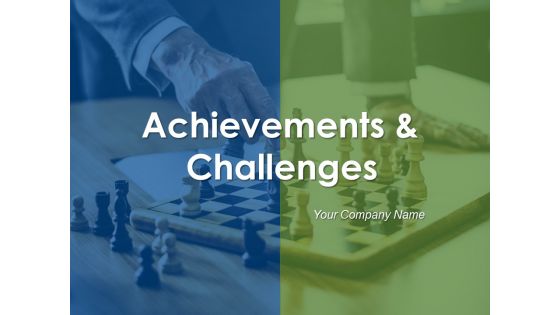
The image features a PowerPoint slide with the title "Achievements & Challenges". The slide is bisected into two colored halves, each featuring an image related to chess, a game that requires strategic thinking and skill.
On the left side, under a blue overlay, there's an image showing a close-up of a person's hand making a move on a chessboard, symbolizing the action and strategy behind achievements. On the right side, under a green overlay, is an image of chess pieces on a board, possibly alluding to the planning and tactical challenges that one might face.
The text "Your Company Name" suggests a placeholder for the presenter to customize with their own company's name. The design of the slide implies its use for a corporate or organizational setting where achievements and challenges are to be discussed, such as an annual meeting, strategy session, or motivational seminar. The chess imagery reinforces themes of intelligence, planning, and overcoming obstacles in pursuit of success.
Use Cases:
Slides with themes of strategy, like chess, are versatile for discussions on overcoming challenges and celebrating achievements across various sectors.
1. Consulting
Use: Strategic planning and problem-solving methods
Presenter: Senior Consultant
Audience: Corporate Clients
2. Education
Use: Setting and achieving educational goals
Presenter: School Administrator
Audience: Teachers and Educators
3. Technology
Use: Navigating product launch challenges
Presenter: Product Manager
Audience: Tech Team and Stakeholders
4. Healthcare
Use: Discussing patient care improvements
Presenter: Healthcare Administrator
Audience: Medical Professionals
5. Finance
Use: Outlining financial goals and overcoming market challenges
Presenter: Financial Planner
Audience: Investors
6. Manufacturing
Use: Optimizing production processes
Presenter: Operations Manager
Audience: Production Staff
7. Marketing
Use: Creating and executing campaign strategies
Presenter: Marketing Director
Audience: Marketing Team
Achievements And Challenges Powerpoint Presentation Slides with all 12 slides:
Our Achievements And Challenges Powerpoint Presentation Slides ensure that the focus doesn't get diverted. It caters for intrusions.

FAQs for Achievements And Challenges
Honestly, three things matter most right now: getting customers who actually stick around, being quick to pivot when stuff changes, and building something that lasts instead of just grabbing fast cash. Those rigid five-year plans? Pretty much useless at this point. The companies crushing it are the ones balancing innovation with actually getting things done - and their teams can shift direction without falling apart. Track customer lifetime value and how long people stay on your team, not just the quarterly stuff. Those numbers tell the real story about whether you're winning or just looking good on paper.
Yeah, this stuff varies wildly depending on where you're working. American tech companies go crazy for individual coding wins, but Japanese firms? They're all about team effort and playing the long game. Wall Street loves flashy, aggressive deals while German finance is way more methodical - honestly such different vibes. Chinese manufacturing focuses on collective output gains, whereas Western companies highlight innovation breakthroughs. It shows up everywhere too - performance reviews, marketing, you name it. My advice? Always figure out what "success" actually means to your specific audience before diving in.
Honestly, tech is like having a Swiss Army knife for work problems. It handles all the boring stuff automatically and gives you data to actually make good choices. Remember those insane email chains for projects? Thank god we moved past that mess. Now you can spot problems early, speed up workflows that used to drag on forever, and keep remote teams connected. The trick is finding tools that fix YOUR specific headaches - not whatever's trending on ProductHunt this week. Just figure out what's slowing you down most, then grab the simplest solution that tackles it head-on.
Honestly, you gotta make your goals measurable if you want to actually feel good about hitting them. Like instead of "get better at guitar," say "learn 5 new songs by March." Way more satisfying when you can point to exactly what you accomplished. I learned this the hard way - used to set these vague goals and never knew if I was winning or not. Numbers and deadlines are your friend here. You'll actually notice the smaller wins too, which keeps you motivated. Without something concrete to measure against, you just end up downplaying everything you do.
Honestly, when teams actually work together instead of just doing their own thing, everyone starts caring more about the results. You get this shared ownership vibe going. People push each other to do better work because they're all invested in the same outcome. The momentum thing is real too - once you start celebrating wins as a group, it gets kinda addictive. What really happens is you break down those annoying silos where everyone's just focused on their slice of the project. Your team begins thinking collectively about problems and solutions. Try doing some shared goals this quarter instead of only individual ones. Makes a huge difference.
Think of resilience like having good shock absorbers - you'll bounce back from work drama instead of getting totally derailed. Setbacks become learning moments rather than personal attacks on your soul (okay maybe that's dramatic but you know what I mean). The cool part? You can actually build this skill up. Try reframing crappy situations, make solid connections with coworkers, and don't forget to celebrate the small stuff. Resilient people stress way less. They solve problems better too. It's honestly one of those things that makes everything at work feel more manageable.
Dude, hitting those personal and professional goals just hits different, you know? There's something about crushing a tough project or finally nailing that promotion that makes all the effort worth it. Honestly, I think we're all just seeking that validation deep down. Even small wins matter though - like when you learn something new or solve a tricky problem. I started writing down my accomplishments in this random notebook (sounds cheesy but whatever) and it's wild seeing how much you actually get done. Having concrete stuff to show for your time feels incredible.
Honestly, most of this comes down to talking to people before things blow up - I can't tell you how many disasters I've seen that could've been avoided with better communication. Set up regular check-ins where your team actually feels safe bringing up problems early. Cross-functional teams are clutch for catching issues before they spiral. Oh, and definitely invest in training your people so they're not totally lost when weird stuff happens. Start simple though - figure out your top 3 recurring headaches and build some actual protocols around those. Being proactive beats scrambling every time.
Honestly, failing teaches you way more than succeeding sometimes. You get to see exactly what doesn't work, which is weirdly more valuable than you'd think. When I mess up, I always try to figure out why - like what skill am I missing or what blind spot did I have? It builds up your resilience too. You start realizing that screwing up isn't actually the end of the world. Each failure makes you better at spotting problems early and taking smarter risks. The trick is actually sitting down and thinking about what went wrong instead of just pretending it didn't happen.
Dude, so many huge companies basically failed their way to success. Netflix ditched DVDs right when streaming was about to kill them - now look at them. Apple was literally broke in the 90s before iPod saved everything. Airbnb launched during the 2008 crash when everyone needed side money (honestly genius timing). Tesla almost went under multiple times but stuck with it and now they're everywhere. Here's the thing though - there's usually some weird opportunity buried in whatever mess you're dealing with right now. You just gotta dig for it.
Track both wins and upcoming problems - that's what saved my butt last year. Celebrate the stuff you've already crushed (keeps everyone sane), but also watch for bottlenecks and risks ahead. We got burned once only focusing on successes while everything was falling apart behind the scenes. The trick is making your problem-spotting metrics helpful, not scary - nobody wants to get blamed for surfacing issues. Do a quick weekly check on both. Honestly, it sounds like extra work but you'll catch disasters way earlier.
Honestly, it comes down to your brain's reward system - you get that dopamine rush from making progress, even small stuff. If what you're doing connects to who you are as a person, you'll stick with it way longer. There's also this mindset thing where you see challenges as chances to grow instead of just roadblocks (sounds cheesy but it actually works). Oh, and celebrating those tiny wins keeps the momentum going. Bottom line - tie your goals to what you actually care about and don't ignore the small victories along the way.
Okay so here's what I've noticed - when you crush it at work, you usually feel pumped to handle other stuff too, like relationship drama or whatever personal goal you've been putting off. But sometimes (and this is weird) success can actually psych you out in other areas because you don't want to break your winning streak. Each part of your life moves at its own pace though. Short wins don't guarantee long-term happiness, but they're still proof you can figure shit out. Don't let doing well in one thing make you freeze up everywhere else - that's backwards thinking.
Dude, leadership makes or breaks this stuff. Good leaders actually notice when people do great work - they'll shout out wins in meetings and make sure everyone knows who crushed it. I've watched so many talented people get demoralized because their boss never acknowledged anything they did. The best managers also create that safe space where you can take risks without getting your head bitten off. They'll clear roadblocks for you and give you what you need to succeed. Quick test though - when's the last time you publicly celebrated someone on your team?
Honestly, feedback loops are a game changer - you catch stuff before it explodes and actually notice when things go right. Set up regular check-ins where people can say "hey, this is broken" before it becomes a mess. Make it go both ways though, not just your boss telling you what's up. I swear you miss so much without these systems. Try starting with simple weekly meetings - ask what's blocking people and what actually worked that week. You'd be shocked what comes up. Also peer feedback hits different than just manager stuff, way more honest usually.
-
thank u
-
Graphics are very appealing to eyes.
-
Great designs, really helpful.