

Acquisition Due Diligence Checklist Service Delivery Operating Model Framework




Try Before you Buy Download Free Sample Product
 Impress Your
 Audience
 100%
100% Editable
 Save Hours
 of Time


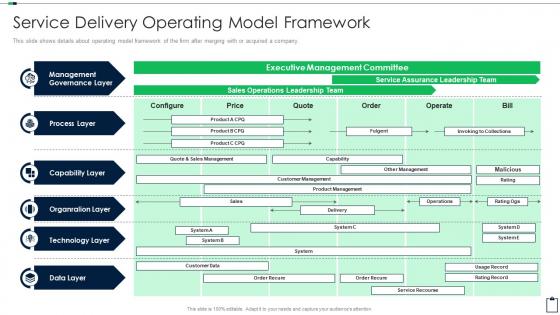
This slide shows details about operating model framework of the firm after merging with or acquired a company.
People who downloaded this PowerPoint presentation also viewed the following :
Acquisition Due Diligence Checklist Service Delivery Operating Model Framework with all 6 slides:
Use our Acquisition Due Diligence Checklist Service Delivery Operating Model Framework to effectively help you save your valuable time. They are readymade to fit into any presentation structure.





FAQs for Acquisition Due Diligence Checklist Service Delivery
Key financial metrics include revenue growth trends, EBITDA margins, cash flow patterns, debt-to-equity ratios, and working capital requirements. These indicators streamline valuation accuracy by revealing operational efficiency, financial stability, and growth sustainability, with many acquirers finding that comprehensive metric analysis ultimately delivers better integration outcomes and minimizes post-acquisition surprises.
Cultural fit assessment involves evaluating leadership styles, communication patterns, decision-making processes, employee engagement levels, and organizational values through surveys, interviews, and workplace observations. Many acquiring companies utilize cultural assessment tools, conduct cross-team workshops, and analyze retention rates to identify potential integration challenges, ultimately ensuring smoother transitions and preserving talent retention.
Legal due diligence serves as the foundation for acquisition decisions by identifying regulatory compliance issues, contract obligations, intellectual property rights, litigation risks, and potential liabilities that could impact deal valuation. Through comprehensive legal review, acquiring companies can negotiate better terms, structure appropriate protections, and avoid costly surprises post-acquisition, ultimately ensuring smoother integration and protecting shareholder value.
Due diligence for mergers and acquisitions should identify financial risks, operational vulnerabilities, legal liabilities, regulatory compliance issues, and market positioning challenges. Through comprehensive risk assessment, organizations can evaluate potential integration complexities, uncover hidden liabilities, and assess cultural compatibility, ultimately enabling more informed decision-making and strategic deal structuring.
Due diligence systematically examines financial records, legal documents, operational processes, and regulatory compliance to identify hidden debts, pending litigation, tax obligations, and contractual risks. Through comprehensive audits, document reviews, and stakeholder interviews, acquiring companies can uncover environmental liabilities, employment disputes, and intellectual property issues, ultimately enabling informed decision-making and accurate valuation adjustments.
Common pitfalls include insufficient financial analysis, overlooking cultural mismatches, inadequate technology assessment, underestimating integration costs, and rushing timeline pressures. These challenges often arise when organizations focus heavily on financial metrics while neglecting operational realities, with many companies finding that thorough cultural and technical evaluations ultimately prevent costly post-acquisition surprises and integration failures.
Technology revolutionizes due diligence by enabling virtual data rooms, AI-powered document analysis, automated financial modeling, and real-time collaboration platforms. These tools streamline information access, enhance accuracy through predictive analytics, and accelerate timeline compression, with investment firms and corporate development teams finding that digital workflows reduce due diligence cycles by weeks while improving risk assessment quality.
Operational due diligence should review organizational charts, standard operating procedures, quality control documentation, vendor contracts, and customer service metrics. These documents reveal operational efficiency, scalability potential, and integration challenges, with many acquiring companies finding that comprehensive operational reviews identify cost synergies, process improvements, and competitive advantages that significantly impact deal valuation.
Stakeholder communication significantly impacts due diligence by ensuring transparency, managing expectations, and facilitating information flow between buyers, sellers, and advisors. Clear communication protocols streamline data collection, minimize delays, and build trust, while poor communication can create information gaps, regulatory concerns, and deal uncertainties, ultimately affecting valuation accuracy and transaction success.
Due diligence findings inform negotiation strategies by revealing valuation adjustments, identifying risk mitigation requirements, and uncovering leverage opportunities through financial, operational, and legal insights. These discoveries enable buyers to negotiate price reductions for identified liabilities, structure earnouts based on performance uncertainties, and demand warranties covering specific risks, ultimately delivering more favorable deal terms and strategic protection.
Customer data analysis during acquisition due diligence reveals critical insights into revenue sustainability, customer loyalty patterns, market positioning, and growth potential that directly impact valuation accuracy. Through comprehensive data examination, acquiring companies can identify retention risks, cross-selling opportunities, and integration challenges, while uncovering hidden value drivers, ultimately enabling more informed investment decisions and smoother post-acquisition transitions.
Intellectual property evaluation requires assessing patent portfolios, trademark strength, copyright assets, trade secrets, and licensing agreements for both value potential and infringement risks. Through comprehensive IP audits, organizations can identify revenue opportunities, defensive positioning, and competitive advantages, while mitigating litigation exposure, ultimately enabling informed acquisition decisions and strategic asset optimization.
Environmental due diligence in manufacturing acquisitions assesses regulatory compliance, contamination risks, cleanup liabilities, permit status, and potential environmental costs that could impact valuation. This evaluation helps acquirers identify hidden liabilities, negotiate appropriate warranties and indemnifications, and ensure regulatory compliance, with many firms finding that thorough environmental assessment prevents costly post-acquisition surprises and regulatory penalties.
**INPUT**: How can one effectively manage the timeline for due diligence to avoid delays in the acquisition process? **OUTPUT**: Effective due diligence timeline management requires establishing clear milestones, assembling cross-functional teams early, and implementing structured data rooms with standardized documentation requirements. Strategic preparation involves conducting preliminary assessments, coordinating legal and financial reviews simultaneously, and maintaining regular stakeholder communication, with many organizations finding that dedicated project management and contingency planning ultimately accelerates deal closure while minimizing integration risks. [Word count: 60 words]
Cross-functional due diligence strategies include establishing integrated teams with finance, legal, operations, IT, and HR expertise, implementing standardized communication protocols, and creating shared data repositories for seamless information exchange. These approaches streamline assessment processes by eliminating silos, accelerating decision-making timelines, and ensuring comprehensive risk evaluation, with many organizations finding that coordinated workflows ultimately deliver more accurate valuations and smoother post-acquisition integration.
-
Definitely recommend SlideTeam to all who need help with PowerPoint presentations. Their design team can create anything you need.
-
“Love it! I was able to grab an exciting proposal because of SlideTeam.”