


Agile methodology powerpoint presentation slides




Try Before you Buy Download Free Sample Product
 Impress Your
 Audience
 100%
100% Editable
 Save Hours
 of Time


Agile management refers to software development methodologies that are based on the concept of iterative development. Here is an efficiently designed Agile Methodology template that showcases a way of project management that divides a project into stages. The template includes continuing cooperation with stakeholders and continuous development at each point. The proposal covers the collaboration of self-organizing cross-functional teams, which leads to the evolution of criteria and solutions. Scrum and Kanban are two of the most common Agile methodologies used in this template. Further, the proposal provides information on Agile Methodologys phases and goals. Additionally, our template covers details on Agile techniques and scaling agile transformation model along with Agile Diagram- IT Design Thinking and Lean Startup Phases, etc. Our IT proposal also covers information on the Agile-driven approach for IT development. Further, this module provides details on the Agile lifecycle, the role of the Agile team, and learning-oriented techniques for the Agile Team. It also highlights Agile performance evaluation metrics and Agile enterprise developed architecture-Post Implementation attributes. Get access to this 100 percent editable and insightful template now.
People who downloaded this PowerPoint presentation also viewed the following :
Content of this Powerpoint Presentation
Slide 1: This slide introduces Agile Methodology. State Your Company Name and begin.
Slide 2: This slide shows Agenda for Agile Methodology.
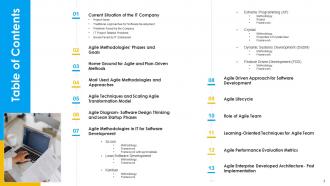
Slide 3: This slide exhibits table of contents.
Slide 4: This slide shows title for 'Current situation of the IT company'.
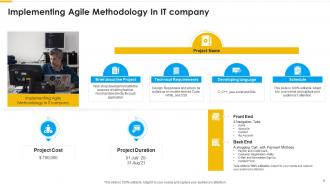
Slide 5: This slide depicts Implementation of agile methodology in IT company.
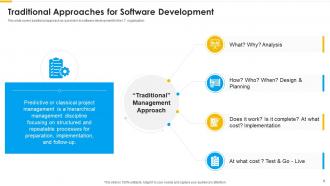
Slide 6: This slide covers traditional approach as a problem to software development for the I.T organization
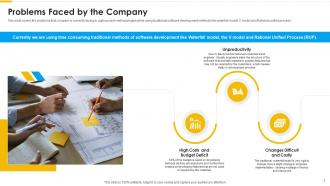
Slide 7: This slide covers the problems that company is currently facing in agile project methodologies.
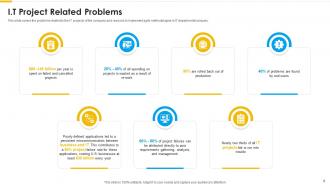
Slide 8: This slide covers the problems related to the IT projects of the company and reasons to implement agile methodologies in IT department/company.
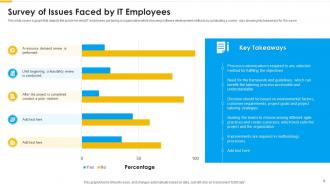
Slide 9: This slide covers a graph that depicts the problems what IT employees are facing in organisation.
Slide 10: This slide depicts title for 'Agile Methodologies phases & goals'.
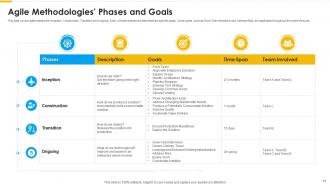
Slide 11: This slide covers agile phases like Inception, Construction, Transition and ongoing.
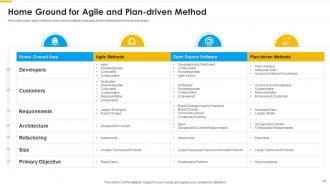
Slide 12: This slide covers agile methods open source software and plan driven methods for home ground areas.
Slide 13: This slide displays title for 'Most used agile methodologies and approaches.
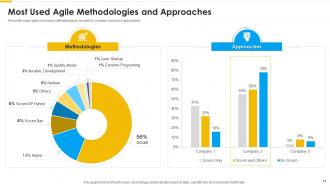
Slide 14: This slide covers agile most used methodologies to be used by company and scrum approaches.
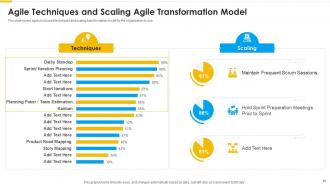
Slide 15: This slide covers agile most used techniques and scaling transformation model for the organization to use.
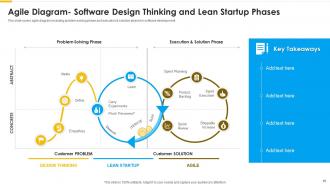
Slide 16: This slide covers agile diagram including problem solving phase and execution & solution phase for software development.
Slide 17: This slide presents title for 'Agile methodologies in IT for software development'.
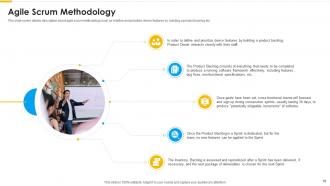
Slide 18: This slide covers details description about agile scrum methodology.
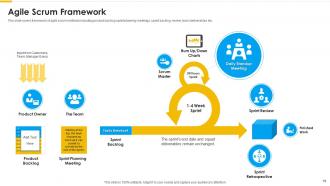
Slide 19: This slide covers framework of agile scrum methods including product backlog sprint planning meetings, etc.
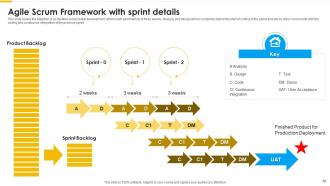
Slide 20: This slide covers the adaption of an Iterative-Incremental development, where each sprint will be of three weeks.
Slide 21: This slide exhibits title for 'Lean software development'.
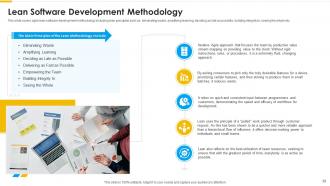
Slide 22: This slide covers agile lean software development methodology including lean principles.
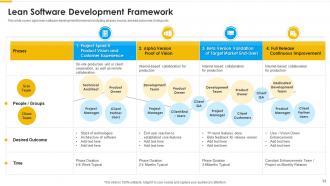
Slide 23: This slide covers agile lean software development framework including phases, teams, desired outcomes, timings etc.
Slide 24: This slide shows title for 'Lean software development framework'.
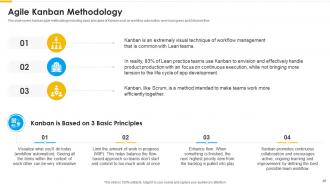
Slide 25: This slide covers Kanban agile methodology including basic principles of Kanban.
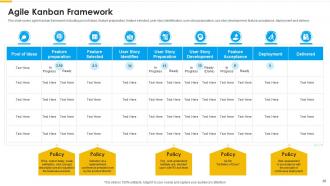
Slide 26: This slide covers agile Kanban framework including pool of ideas, feature preparation, etc.
Slide 27: This slide depicts title for 'Extreme programming'.
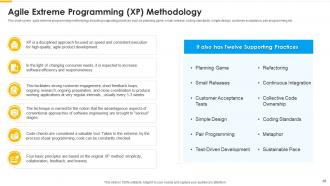
Slide 28: This slide covers agile extreme programming methodology including supporting practices.
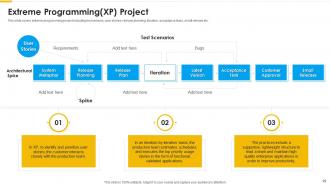
Slide 29: This slide covers extreme programming project including test sensors, user stories, etc.
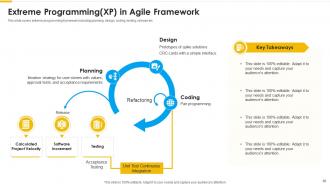
Slide 30: This slide covers extreme programming framework including planning, design, coding, testing, release etc.
Slide 31: This slide displays title for 'Crystal'.
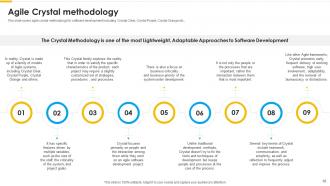
Slide 32: This slide covers agile crystal methodology for software development.
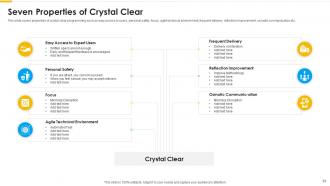
Slide 33: This slide covers properties of crystal clear programming.
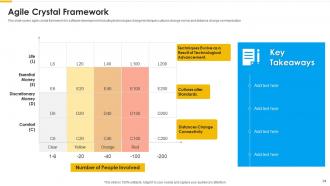
Slide 34: This slide covers agile crystal framework for software development.
Slide 35: This slide presents title for 'Dynamic systems development'.
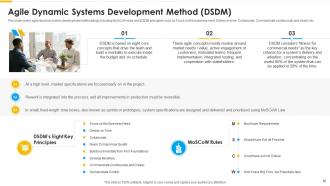
Slide 36: This slide covers agile dynamic system development methodology.
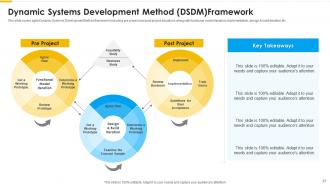
Slide 37: This slide covers agile Dynamic Systems Development Method framework.
Slide 38: This slide exhibits title for 'Feature driven development'.
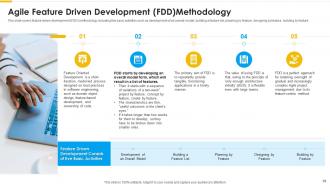
Slide 39: This slide covers feature driven development (FDD) methodology.
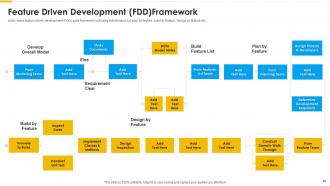
Slide 40: This slide covers feature driven development (FDD) agile framework.
Slide 41: This slide shows title for 'Agile lifecycle'.
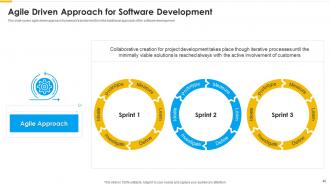
Slide 42: This slide covers agile driven approach framework transformed from the traditional approach of the software development.
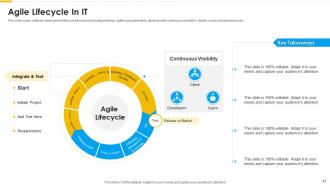
Slide 43: This slide covers software development lifecycle framework.
Slide 44: This slide depicts title for 'Role of agile team'.
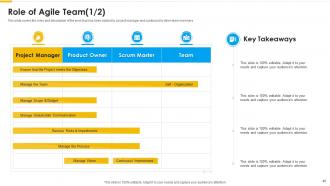
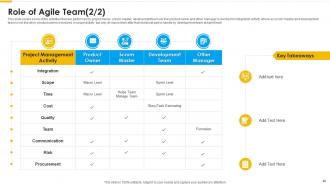
Slide 45: This slide covers the roles and description of the work that has been started by project manager and continued by other team members.
Slide 46: This slide covers some of the activities that are performed by project owner.
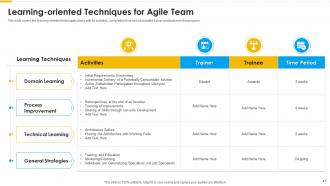
Slide 47: This slide covers the learning-oriented techniques.
Slide 48: This slide displays title for 'Agile performance evaluation metrics'.
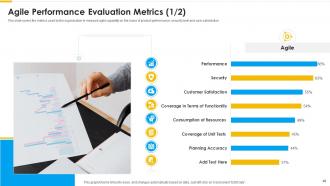
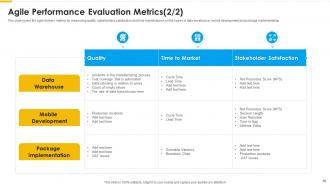
Slide 49: This slide covers the metrics used by the organisation to measure agile capability.
Slide 50: This slide covers the agile delivery metrics for measuring quality.
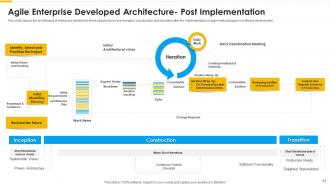
Slide 51: This slide depicts the architecture of enterprise divided into three phases.
Slide 52: This slide shows Icons for Agile Methodology.
Slide 53: This slide is titled as Additional Slides for moving forward.
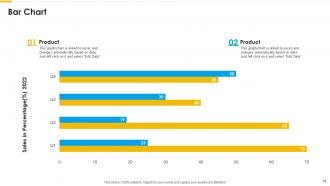
Slide 54: This slide presents Bar chart with two products comparison.
Slide 55: This is Our Mission slide with related imagery and text.
Slide 56: This is About Us slide to show company specifications etc.
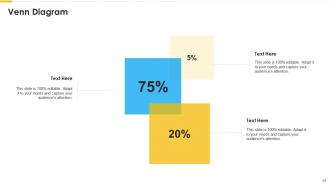
Slide 57: This slide depicts Venn diagram with text boxes.
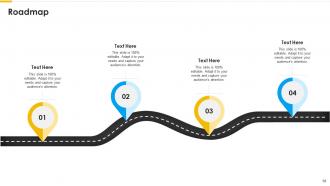
Slide 58: This slide presents Roadmap with additional textboxes.
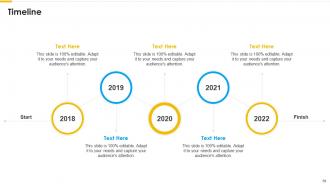
Slide 59: This is a Timeline slide. Show data related to time intervals here.
Slide 60: This is an Idea Generation slide to state a new idea or highlight information, specifications etc.
Slide 61: This is a Thank You slide with address, contact numbers and email address.
Agile methodology powerpoint presentation slides with all 69 slides:
Use our Agile Methodology Powerpoint Presentation Slides to effectively help you save your valuable time. They are readymade to fit into any presentation structure.












FAQs for Agile methodology
So Agile has four main values - putting people before rigid processes, actual working software over tons of documentation, collaborating with customers instead of just sticking to contracts, and being flexible when things change rather than following some strict plan. It's way better than traditional project management (which can be such a nightmare tbh). You work in short bursts, get feedback constantly, and pivot when needed. My advice? Start with just one project. Focus on regular team check-ins and delivering pieces as you go instead of trying to map out every single detail from day one.
So basically, traditional project management maps out everything upfront - timeline, budget, requirements - then you just execute that plan. Agile is totally different. You work in short 2-4 week sprints instead. Build something, test it, get feedback, then pivot if needed. Way less stressful honestly! You're fixing problems as you go rather than finding out everything's broken at the end (been there, not fun). If your projects change a lot or requirements are fuzzy, just start small - try daily check-ins and show demos every couple weeks to see how it feels.
So basically there are three main roles you'll see. Product Owners decide what actually gets built - they handle the backlog and figure out priorities. Development teams do the building (coders, testers, designers, whoever). Then there's the Scrum Master who keeps everything flowing and deals with blockers. Honestly, the Scrum Master role is kinda like being a professional problem-solver. Everyone stays in their lane but talks constantly. If you're new to this, try sitting in on different meetings during a sprint. You'll pick up how they all work together way faster than reading about it.
Honestly, the daily standups alone make such a difference - everyone knows what's happening and where people are stuck. Sprint planning gets messy in a good way because the whole team's breaking down work together instead of someone just assigning tasks. I'm probably biased but retrospectives are where the magic happens for actually fixing how you work together. Short sprints mean you can't just vanish for weeks working solo. Your developers and designers end up chatting constantly rather than that weird handoff thing. Start small though - maybe just try those 15-minute daily check-ins first and see how it feels.
Dude, iterative development is seriously the way to go. You're shipping actual working stuff every couple weeks instead of disappearing for months hoping you built the right thing. Feedback comes in constantly so you catch issues before they become disasters. Requirements always change anyway - might as well build something that can roll with it. Your users see progress happening instead of wondering if you fell off the planet. Each sprint becomes its own little project with clear goals. Way better than the old school approach where you'd build everything then cross your fingers it didn't suck.
So basically Scrum is super structured - you get these 1-4 week sprints with set meetings like standups and retros. Kanban's the opposite, just continuous flow on a board where you limit work in progress. Honestly, I've seen teams get lost with Kanban if they don't have good habits already. Scrum works great when your team wants that predictable rhythm and clear roles. But if work just randomly drops on you all the time? Kanban's probably your best bet. Really depends on whether you need structure or flexibility more.
Honestly, the hardest part is getting people to stop planning everything to death upfront. Your team will probably freak out about not knowing exactly what's happening three months from now - I've seen it happen so many times. Sprint estimation becomes this whole thing too, especially coming from waterfall. Daily collaboration sounds great in theory but feels weird when everyone's used to working alone. Oh, and if leadership isn't actually bought in? Good luck getting quick feedback from stakeholders. You'll be waiting weeks for simple decisions. Get everyone trained on the basics first though, seriously.
Focus on metrics that actually show value, not just busy work. Sprint velocity and story points are useful for tracking trends. Customer satisfaction scores matter way more though - are people actually happy with what you're shipping? Also track how often you're getting working software into users' hands. Honestly, velocity can be misleading if you obsess over it too much. What counts is whether each release gives customers something worthwhile. Set up maybe 3-4 key metrics on a simple dashboard. Review them weekly with your team so you can catch issues before they blow up. Retrospectives are gold for checking team health too.
So user stories are just short descriptions of features, but written from your user's point of view. They follow this format: "As a [user type], I want [goal] so that [benefit]." Pretty straightforward once you get the hang of it. These become your building blocks for the product backlog in Agile development. I like to think of them as conversation starters more than detailed requirements - you're not writing a technical manual here. Your team uses them to plan sprints and figure out what to prioritize next. Honestly, they're way better than getting bogged down in specs because they keep everyone focused on what actually matters to users.
So with Agile, you're basically showing customers stuff every 1-3 weeks instead of disappearing for months. Short sprints mean they can actually test features early and tell you what sucks before you build too much of it. The constant demos after each sprint keep everyone talking - though honestly, some clients give way too much feedback and it gets overwhelming lol. But that's better than finding out you built the wrong thing entirely. Those daily standups help too. Just make sure you're actually scheduling those demo sessions with stakeholders regularly or the whole thing falls apart.
Jira's pretty much the standard for tracking stories and sprints - you'll see it everywhere. Most teams pair it with Confluence for docs. For daily chat, Slack or Teams obviously. Smaller teams love Trello or Azure DevOps though. Honestly? Some teams get way too fancy when a basic Kanban board does the trick. You'll need something for retros too - Miro's solid, or just throw up a shared Google doc. My take: stick with what your team already uses first. Don't make picking tools into its own massive project lol. Add the fancy stuff later when you're actually hitting walls.
Yeah, totally doable! Just focus on the main ideas instead of all the techy stuff. I'd break everything into short chunks - maybe 2-week sprints or whatever makes sense. Marketing teams actually crush it with this approach for campaigns, and I've even seen construction crews make it work somehow. The trick is figuring out what counts as a "finished thing" in your field first. Then you can build your timeline around those wins. Regular check-ins are huge too - keeps everyone honest and lets you pivot when things inevitably change. Honestly beats traditional project management by miles once you get the hang of it.
Oh, the Product Owner? They're like the middleman between business folks and your dev team. Basically they decide what gets built and why - managing the backlog, writing user stories, all that stuff. They're supposed to be the "customer voice" prioritizing features by business value. During sprint reviews, they'll either accept your work or send it back. Honestly, bug them with questions early and often. I know it feels annoying but trust me - better to clarify stuff upfront than deal with confused requirements later. Those always turn into a mess.
So retrospectives are where your team stops and actually talks about what's working vs. what's making people want to quit. After each sprint, you sit down and hash out the good stuff, the disasters, and - here's the crucial part - what you'll actually DO differently. Think of it as productive complaining, I guess? But you can't just vent and walk away. You need real action items with someone's name attached, otherwise you'll just keep hitting the same walls over and over. Honestly, skipping retros is how teams stay stuck in their dysfunction forever.
Start small, seriously. Pick a couple pilot teams instead of going all-out from day one - that's where most companies mess up. Get your communication sorted between teams first, then work on shared standards for user stories and that whole "definition of done" thing. SAFe and LeSS are decent frameworks, though SAFe feels pretty bloated honestly. Training your Scrum Masters and Product Owners is huge. Oh, and don't kill team autonomy while you're aligning everyone on goals and metrics. Learn what actually works with your people before scaling it everywhere else.
-
Good research work and creative work done on every template.
-
Wonderful templates design to use in business meetings.