

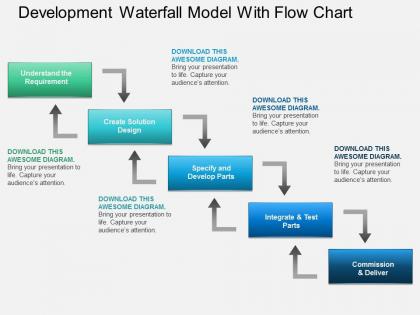
Al development waterfall model with flow chart powerpoint template




Try Before you Buy Download Free Sample Product
 Impress Your
 Audience
 100%
100% Editable
 Save Hours
 of Time


Our Al Development Waterfall Model With Flow Chart Powerpoint Template force hassles to go away. Say goodbye to them forever.
People who downloaded this PowerPoint presentation also viewed the following :
Al development waterfall model with flow chart powerpoint template with all 4 slides:
Our Al Development Waterfall Model With Flow Chart Powerpoint Template are essentially elegant. They embody it in their approach.

FAQs for Al development waterfall model with flow
So there's this six-stage process you follow: problem definition, data collection, preprocessing, model development, testing, then deployment. First you figure out what you're actually trying to solve. Then comes the fun part - gathering and cleaning data (seriously, this step is such a time sink). Build your model next, test the hell out of it, and push it live. Oh, and unlike regular software projects, you'll probably loop back through stages more often since AI stuff is way more experimental. The data basically controls everything, which can be frustrating but also kind of cool.
So basically, Waterfall makes you plan everything upfront - requirements, design, build, test, deploy. Done. But AI projects? They're messy and unpredictable. You'll discover your assumptions were totally off halfway through (trust me, it happens constantly). Iterative approaches let you run small experiments and pivot when things don't work. Way more realistic for AI stuff. With Waterfall you're gambling that you nailed the requirements from day one, which... good luck with that. Most AI problems are too uncertain for that rigid approach anyway. Go iterative unless you have zero choice.
Okay so the biggest win is having everything documented at each step - super important for AI stuff where you need to track model choices and where your data came from. Stakeholders eat up the upfront planning because they know what's happening when. Works well in regulated industries too since you've got that paper trail. It's pretty old school honestly, but sometimes that's what works! You're not trying to manage multiple phases at once either, which makes resource planning way easier. I'd go with it if your AI requirements are solid and won't shift halfway through - learned that the hard way on my last project.
Ugh, AI projects are basically chaos - your model will perform differently than expected, data will be messier than you thought, and you'll constantly realize your features suck. Waterfall wants you to nail down requirements from day one, but that's impossible with AI stuff. You'll figure out halfway through that your assumptions about the data were completely wrong. Going back to fix things in Waterfall is a nightmare though. If you're stuck with it, pad your timeline like crazy and write down every assumption you make (trust me on this one). At least then you can track what went sideways.
Start with documentation baked into your requirements - don't wait until the end when everything's chaos. Each phase needs clear standards, like architecture diagrams during design or test cases in development. Honestly, I've watched so many teams skip this step and then hate themselves later. Gate your approvals so people literally can't advance without proper docs. Oh, and pick someone to own documentation for each phase - keeps everyone honest. Templates help too since your team won't have to guess what you want. Trust me, future you will thank present you for being this anal about it upfront.
Oh man, requirement analysis is HUGE in waterfall - like, you mess this up and you're toast. There's no going back to fix things like you can with agile. So for AI stuff, you gotta lock down your data needs, performance targets, model limits, all that business stuff first. I've watched teams build these amazing models for literally months, then realize they solved the wrong problem entirely. Honestly painful to watch. Spend the extra time validating with stakeholders and writing down those weird edge cases. Trust me, it'll save you so much pain later.
Yeah, Waterfall's pretty brutal for AI projects tbh. The whole sequential thing means you're stuck with tech decisions from like 6 months ago - which is ancient history in AI time. What some teams do is throw in extra "tech assessment" checkpoints between phases, so you can actually pivot when new frameworks drop. But honestly? It's still not great since the model's inherently rigid. If you're working with fast-moving AI stuff, you'll probably want some kind of hybrid approach. Keep the waterfall structure for the boring parts but build in flexibility for the actual development work. Not perfect, but way better than being locked into outdated choices.
So model validation happens right after training in Waterfall - it's your quality checkpoint before deployment. You'll test against that holdout dataset you defined back in requirements (if you actually followed your original plan lol). Here's the thing though - if validation tanks, you can't just quickly loop back and retrain like in Agile. You either pass and move to deployment, or you're stuck restarting earlier phases which honestly sucks. That's why nailing your validation criteria upfront is super critical. No room for "we'll figure it out later" here.
Build checkpoints after each phase so stakeholders can review before you move on - trust me, catching problems early saves your sanity. Get super detailed with requirements upfront because waterfall makes changes crazy expensive later (I've been burned by this before). Document everything as you go, and definitely pull in end users during requirements and testing. Oh, and run small proof-of-concepts for the risky AI stuff first - don't dive into full development blind. Front-load your risk assessment. Be crystal clear about what success looks like from the start or you'll regret it.
So you run integration testing right after finishing your individual component tests. Basically you're seeing if your ML models, data pipelines, and system interfaces actually play nice together. Most people do this in a staging environment that looks like production - you feed semi-real data through everything to catch the weird stuff that only happens when it's all connected. With waterfall you're kinda stuck until this passes, which honestly sucks if you find big problems. Oh and budget way more time than you think - AI integration is messier than regular software.
Honestly, you gotta tackle the ethics stuff right in the Requirements Analysis phase - like, day one of your waterfall project. That's where you figure out what your AI should do AND what it definitely shouldn't do. Trust me, trying to add ethical considerations later is such a pain... it's like retrofitting seatbelts after the car's already rolling off the assembly line. During requirements gathering, you can spot potential biases and fairness problems before they're hardcoded into everything. Then just carry those ethical requirements through each stage. Don't wait til testing - that's when you'll discover your AI's totally problematic.
Okay so with Waterfall you really need to nail your metrics upfront since pivoting later is a nightmare. Track the usual ML stuff - accuracy, precision, recall, F1-score - during testing. But honestly? Business metrics are equally crucial here. ROI, user adoption, whether you're actually fixing what you set out to fix. Also keep an eye on timeline adherence and requirement stability since you can't just change direction halfway through like with Agile. Oh and definitely set these measurement criteria during planning, not after you've already deployed everything. That's when it gets messy.
Set up check-ins at every waterfall phase, not just handoffs. Regular reviews where people can see your actual work - prototypes, early results, whatever you've got. Yeah, documentation sucks but you'll thank yourself later when things get messy. Get clear sign-offs on requirements and have a real process for change requests. Scope creep will kill your timeline otherwise. Here's the thing though - you've got to translate your tech stuff into business speak during reviews. Stakeholders don't care about your model architecture, they want to know what it means for them. Start booking those meetings now.
Ugh, Waterfall feedback timing is honestly the worst part. You collect requirements upfront, build everything, then pray users actually like it - super risky with AI stuff since requirements are usually pretty vague at first. Getting good feedback early in those user interviews is clutch because you won't get many do-overs. When feedback does come in later, it's gold for your next project though. Document everything obsessively (I learned this the hard way). Short story: you're basically flying blind until the end, which is why I personally hate this approach for AI work.
Yeah, Waterfall can actually work for AI stuff in those super regulated spaces - healthcare, finance, aerospace. FDA approvals? You're gonna need mountains of documentation anyway. Government contracts eat this stuff up too, they're obsessed with checkboxes and milestones. Works best when you know exactly what you're building upfront and requirements won't shift much. Though honestly, even these industries are starting to mix in some agile elements because pure Waterfall can be brutal. You still get your compliance paperwork but with a bit more wiggle room to adapt things.
-
Great designs, really helpful.
-
Great quality product.