


Aon hewitt employee engagement model example of ppt presentation




Try Before you Buy Download Free Sample Product
 Impress Your
 Audience
 100%
100% Editable
 Save Hours
 of Time


Our Aon Hewitt Employee Engagement Model Example Of Ppt Presentation contain ideal images. All designed to create the best impression.
People who downloaded this PowerPoint presentation also viewed the following :
Aon hewitt employee engagement model example of ppt presentation with all 5 slides:
Get the graph to bounce back with our Aon Hewitt Employee Engagement Model Example Of Ppt Presentation. They will help you halt any decline.
FAQs for Aon hewitt employee engagement model example
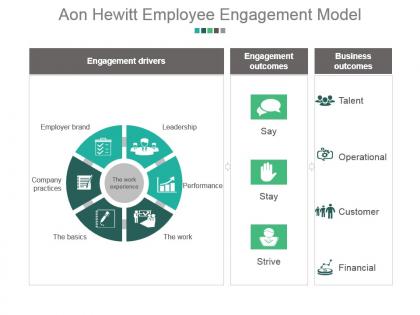
So Aon Hewitt has this engagement model with three parts: Say, Stay, and Strive. Say is whether employees talk positively about your company. Stay tracks if people actually want to stick around (retention stuff). Then Strive looks at whether they're motivated to do more than just the bare minimum. Pretty simple framework, honestly. They also identify six drivers that push these behaviors - leadership quality, career opportunities, recognition, that kind of thing. Oh, and if you're trying to figure out engagement on your team, these three buckets give you a decent starting point to work from.
So Aon Hewitt basically breaks engagement down into three things: Say, Stay, and Strive. They survey employees to see if people talk positively about the company, actually want to stick around, and put in extra effort beyond the bare minimum. Honestly, it's pretty smart how they set it up. Based on survey responses, they'll label employees as engaged, moderately engaged, or disengaged. The questions focus on stuff like whether you'd recommend the company and how motivated you feel day-to-day. You can compare your scores against industry benchmarks too, which helps figure out where you're really falling behind.
So Aon Hewitt's thing is those three drivers - Say, Stay, Strive. Do people talk up your company? Will they actually stay? Are they putting in real effort? Way cleaner than other surveys that just dump 20 random factors on you. Here's what I find clever though - they don't just assume engaged people perform better. They actually measure if that's happening, which honestly seems obvious but most companies skip that part. You should definitely compare your current survey to their framework. Might show you what you're missing. The whole outcomes piece is probably worth stealing even if you don't use their exact model.
So Aon Hewitt basically tracks their engagement index - it's this combo of "Say," "Stay," and "Strive" behaviors that shows if people actually advocate for your company, want to stick around, and put in extra effort. Pretty smart framework honestly. They also measure all the driver stuff like career development, recognition, manager effectiveness scores. Those pulse surveys are clutch for seeing changes as they happen. Oh and they benchmark you against industry standards which is nice I guess - shows where you stand compared to everyone else. But honestly? Start with those driver metrics first since they tell you exactly where to throw your money.
Yeah, the Aon Hewitt model totally works for remote teams - you just gotta switch up how you do things. Set up virtual shout-out channels instead of face-to-face recognition. Career development becomes huge when people feel disconnected, so book those growth conversations regularly. The "Say, Stay, Strive" thing actually translates pretty well remotely. You just need way more intentional check-ins. Funny thing - I've seen some remote teams score higher on engagement because managers can't coast anymore. They're forced to actually connect with people. Start with pulse surveys to see where your team's at on those core factors.
So yeah, the Aon Hewitt model basically puts leadership front and center for engagement. Your managers' daily stuff - how they communicate, give recognition, handle decisions - that's what actually determines if people give a damn about their jobs. Authentic, consistent leadership = higher engagement scores. Simple concept but honestly most companies mess it up. Short sentences work better sometimes. If you want better engagement numbers, start with leadership training first since everything flows down from there. Oh and development opportunities matter too - forgot to mention that earlier but it's huge for keeping people motivated.
So the Aon Hewitt thing is actually pretty cool - they call it the "engagement-performance chain." When employees give a damn about their work, customers notice and your numbers improve. Their framework is Say, Stay, Strive (honestly took me a minute to remember all three). But here's what matters: engaged teams have way less turnover and better revenue growth. It's not just some HR feel-good survey. Think of engagement scores like your car's check engine light - they're telling you what's coming down the road performance-wise. Don't ignore that data.
So there's this Aon Hewitt framework called Say, Stay, Strive that's actually pretty solid. Communication is your starting point - people hate being kept in the dark about company stuff. Work-life balance and fair pay help with retention, obviously. But here's what most places screw up: the purpose thing. Employees need to see why their job matters beyond just collecting a paycheck. Career paths can't be vague either - be specific about growth opportunities. I'd probably start with some quick pulse surveys to figure out where you're bleeding engagement. The "strive" part is honestly the hardest to get right, but it makes the biggest difference.
Yeah, totally customizable! Tech companies usually go heavy on career development and recognition stuff. Manufacturing? They're more about safety and work processes - makes sense. Small companies should definitely trim down the survey questions though. Nobody at a 50-person startup wants some endless questionnaire, you know? The action planning part can be tweaked too based on what resources you actually have. Honestly, I'd just grab their main framework and then mess with the specific metrics to match what actually matters at your place. Don't overthink it.
Honestly, the hardest part isn't the survey itself - it's getting leadership to actually do something with the results. So many places just collect data and then... nothing. Managers hate having those career growth conversations because they're awkward, which makes the whole "Say, Stay, Strive" thing fall apart. Plus your employees will get annoyed if they keep giving feedback but never see changes. The framework totally works though! Just make sure you're ready to train managers properly and communicate what's happening. Oh, and definitely pilot it with a few teams first rather than going company-wide immediately.
So Aon Hewitt suggests doing the big comprehensive survey once a year, then smaller pulse surveys every 3-6 months to check if things are improving. Don't go crazy with frequency though - people get survey fatigue and just start clicking random answers (learned that one the hard way). Annual surveys give you the complete picture of what's driving engagement. Pulse surveys help track whether your fixes are actually working between the big ones. Most companies I know follow something similar to this schedule. Oh, and obviously make sure you're doing something with the results, otherwise your team will just roll their eyes at the next survey request.
So Aon Hewitt's got this engagement survey platform that's actually pretty solid - it uses their Say, Stay, Strive thing to measure how people feel about work. The benchmarking data is where it gets interesting though, you can see how you compare to other companies (some results might surprise you honestly). They throw in action planning templates and manager toolkits too. Pulse surveys let you track stuff ongoing instead of just once a year. Oh, and you get consultation help for making sense of the data. I'd probably start with a demo to see if it fits your specific issues.
Yeah so Aon Hewitt basically makes employee feedback the center of everything - it drives engagement AND shows you the results. Regular pulse surveys aren't optional with their approach, they're essential because engagement changes constantly. Honestly, I think too many companies treat it like a yearly checkbox thing. Their data shows organizations with solid feedback loops get 12% better business results than ones that just ignore what people are saying. The trick is actually doing something with the feedback though. Figure out what channels your team actually pays attention to first, then build on that.
Recognition is seriously one of the best ways to boost engagement - the Aon Hewitt model proves it. You're basically hitting three drivers at once: belonging, achievement, and purpose. People just want to feel like their work matters, you know? I've seen teams completely turn around when managers start actually acknowledging contributions consistently. The data shows recognized employees stick around and work harder because they see their efforts count. My old boss was terrible at this and our whole department was miserable. But yeah, if you want better engagement scores, meaningful recognition is probably your fastest win.
Aon Hewitt breaks it down into Say, Stay, and Strive - super helpful framework. Survey your people first to see what's broken. Maybe they love their jobs but feel ignored by management, or they're motivated but can't see any career path ahead. Companies screw up "Strive" constantly, honestly. Once you know the weak spots, build specific fixes around them. Retention issues? Focus on Stay factors like development opportunities and better manager training. Oh, and run those pulse surveys every quarter - you'll want to see if anything's actually improving or if you're just spinning your wheels.
-
Easy to edit slides with easy to understand instructions.
-
Awesome presentation, really professional and easy to edit.