


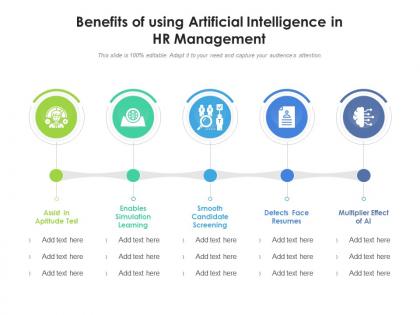
Benefits of using artificial intelligence in hr management




Try Before you Buy Download Free Sample Product
 Impress Your
 Audience
 100%
100% Editable
 Save Hours
 of Time


Our Benefits Of Using Artificial Intelligence In HR Management are topically designed to provide an attractive backdrop to any subject. Use them to look like a presentation pro.
People who downloaded this PowerPoint presentation also viewed the following :
Benefits of using artificial intelligence in hr management with all 2 slides:
Use our Benefits Of Using Artificial Intelligence In HR Management to effectively help you save your valuable time. They are readymade to fit into any presentation structure.
FAQs for Benefits of using artificial intelligence
Key benefits of integrating AI into HR management include automated recruitment screening, predictive analytics for employee retention, personalized learning recommendations, streamlined performance evaluations, and enhanced workforce planning capabilities. These technologies enable HR teams to reduce administrative workload, identify top talent more efficiently, and deliver data-driven insights for strategic decision-making, ultimately improving employee experiences while optimizing organizational productivity.
AI enhances recruitment by automating resume screening, analyzing candidate fit through predictive analytics, conducting initial video interviews, and identifying top talent patterns from successful hires. Through machine learning algorithms, HR teams streamline hiring timelines, reduce unconscious bias, and improve candidate matching accuracy, with many organizations finding significantly faster placements and enhanced hiring quality.
Machine learning enhances employee performance evaluations by analyzing comprehensive data patterns, identifying skill gaps, reducing bias through objective metrics, and providing predictive insights about future performance trends. These technologies enable HR teams to deliver more accurate assessments, personalized development recommendations, and strategic workforce planning, with many organizations finding significantly improved employee engagement and retention rates.
HR departments should consider data privacy protection, algorithmic bias prevention, transparency in decision-making processes, employee consent protocols, and fairness in recruitment and performance evaluations. These considerations help organizations maintain trust while leveraging AI, with many companies finding that establishing clear ethical guidelines and regular bias audits ultimately delivers better employee experiences and stronger legal compliance.
AI assists in reducing hiring bias by standardizing candidate evaluations, removing identifying information during initial screenings, and analyzing job descriptions for biased language. Through machine learning algorithms, organizations can evaluate candidates based purely on skills and qualifications rather than demographic factors, while AI-powered assessment tools ensure consistent evaluation criteria across all applicants, ultimately delivering more equitable hiring processes and diverse talent acquisition.
AI enhances employee engagement and retention through predictive analytics, personalized career development recommendations, sentiment analysis of feedback, and automated recognition systems. These technologies enable HR teams to identify at-risk employees, customize growth opportunities, and deliver targeted interventions, with many organizations finding that AI-driven insights significantly improve retention rates and employee satisfaction.
AI-driven analytics inform workforce planning by analyzing performance data, predicting skill gaps, identifying high-potential employees, and forecasting turnover risks across departments. Through machine learning algorithms, organizations streamline recruitment processes, enhance employee development programs, and optimize resource allocation, with many companies finding that predictive insights ultimately deliver improved retention rates and strategic talent alignment.
HR teams face challenges including data privacy concerns, employee resistance to automated processes, integration complexities with existing systems, potential algorithmic bias, and skills gaps in AI management. While these hurdles require careful planning, many organizations find that strategic implementation with proper training, transparent communication, and phased rollouts ultimately delivers enhanced efficiency and better decision-making capabilities.
Chatbots streamline HR operations by automating routine inquiries, providing 24/7 support, reducing response times, and freeing HR teams for strategic tasks. These AI-powered systems handle benefits questions, policy clarifications, and leave requests instantly, with many organizations finding that employees receive faster, consistent answers while HR professionals focus on talent development and employee engagement initiatives.
Common AI tools in HR management include applicant tracking systems with resume screening, chatbots for employee inquiries, predictive analytics for workforce planning, performance management platforms, and automated scheduling software. These technologies streamline recruitment processes, enhance employee experiences, and optimize resource allocation, with many organizations finding that strategic AI integration delivers faster hiring, reduced administrative costs, and improved talent retention across diverse industries.
AI facilitates personalized employee development plans by analyzing individual performance data, learning preferences, skill gaps, and career aspirations to create customized learning pathways. Through machine learning algorithms, organizations can automatically recommend relevant training modules, mentorship opportunities, and skill-building exercises, while tracking progress in real-time, ultimately enhancing employee engagement and retention.
AI significantly enhances diversity and inclusion initiatives by removing unconscious bias from recruitment processes, analyzing compensation equity across demographics, and identifying patterns in promotion decisions that may disadvantage certain groups. Through machine learning algorithms, organizations streamline fair hiring practices, ensure equitable performance evaluations, and create data-driven strategies that promote workplace inclusivity, ultimately delivering measurable diversity outcomes and stronger organizational culture.
Predictive analytics in AI helps HR anticipate turnover rates by analyzing employee data patterns, performance metrics, engagement scores, and behavioral indicators to identify at-risk personnel. Through machine learning algorithms, organizations can proactively address retention issues, implement targeted interventions, and optimize workforce planning strategies, ultimately reducing recruitment costs and maintaining operational continuity.
HR staff require training in AI fundamentals, data interpretation, ethics and bias recognition, system integration, and change management principles. Through comprehensive programs covering algorithmic decision-making, privacy compliance, and human-AI collaboration, organizations enable their teams to leverage recruitment automation, performance analytics, and employee engagement tools effectively, ultimately delivering enhanced talent management while maintaining strategic human oversight.
Future trends in AI and HR management include predictive workforce analytics, personalized employee development pathways, automated compliance monitoring, AI-powered performance evaluations, and intelligent talent acquisition systems. These advancements streamline recruitment processes, enhance employee engagement, and minimize administrative overhead, with many organizations finding that strategic AI integration ultimately delivers competitive advantage through data-driven decision making and optimized resource allocation.
-
Great designs, really helpful.
-
Use of icon with content is very relateable, informative and appealing.
-
Much better than the original! Thanks for the quick turnaround.