


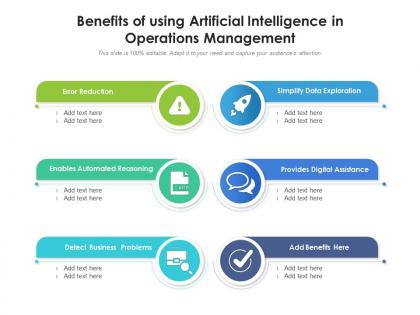
Benefits of using artificial intelligence in operations management




Try Before you Buy Download Free Sample Product
 Impress Your
 Audience
 100%
100% Editable
 Save Hours
 of Time


Our Benefits Of Using Artificial Intelligence In Operations Management are topically designed to provide an attractive backdrop to any subject. Use them to look like a presentation pro.
People who downloaded this PowerPoint presentation also viewed the following :
Benefits of using artificial intelligence in operations management with all 2 slides:
Use our Benefits Of Using Artificial Intelligence In Operations Management to effectively help you save your valuable time. They are readymade to fit into any presentation structure.
FAQs for Benefits of using artificial intelligence
Integrating artificial intelligence into operations management delivers predictive maintenance capabilities, automated quality control, optimized inventory management, enhanced demand forecasting, and streamlined resource allocation. These AI-powered systems enable manufacturers and logistics companies to reduce operational costs by up to 20%, minimize downtime, and accelerate decision-making processes, ultimately delivering significant competitive advantages in increasingly complex supply chain environments.
AI enhances supply chain visibility through real-time tracking, predictive analytics, demand forecasting, automated risk detection, and integrated data platforms. These technologies streamline operations by identifying potential disruptions before they occur, optimizing inventory levels, and enabling faster response times, with many manufacturing and retail organizations finding significantly improved resilience and competitive advantage.
Machine learning enhances demand forecasting by analyzing historical sales data, seasonal patterns, market trends, customer behavior, and external factors like weather or economic indicators. Through advanced algorithms, retailers predict inventory needs, manufacturers optimize production schedules, and logistics companies streamline supply chains, ultimately delivering improved accuracy and reduced operational costs while minimizing stockouts and excess inventory.
AI-driven predictive analytics enhances inventory management by analyzing historical data, demand patterns, seasonal trends, and market conditions to forecast optimal stock levels. Through machine learning algorithms, retailers and manufacturers can reduce carrying costs, minimize stockouts, and automate reordering processes, with many organizations finding that predictive models ultimately deliver 20-30% improvements in inventory efficiency.
AI-powered automation streamlines manufacturing processes by optimizing production scheduling, predicting equipment maintenance needs, enhancing quality control through real-time monitoring, and reducing waste through intelligent resource allocation. These technologies enable manufacturers to minimize downtime, accelerate production cycles, and improve product consistency, with automotive and electronics companies finding that automated systems deliver significantly lower operational costs and faster time-to-market.
Organizations face challenges including data quality and integration issues, employee resistance to change, high implementation costs, skill gaps in AI expertise, and regulatory compliance concerns. While these obstacles can seem daunting, many companies find that strategic planning, comprehensive training programs, and phased implementation approaches enable them to overcome these hurdles, ultimately delivering streamlined operations and competitive advantage.
AI technologies support logistics and transportation decision-making through predictive analytics, route optimization algorithms, demand forecasting models, and real-time tracking systems. These solutions enhance operational efficiency by reducing fuel costs, minimizing delivery times, and improving fleet utilization, with many transportation companies finding that AI-driven insights ultimately deliver competitive advantage and enhanced customer satisfaction.
AI revolutionizes quality control by enabling real-time defect detection, predictive maintenance, automated inspection processes, and pattern recognition across production lines. Through computer vision and machine learning algorithms, manufacturers in automotive, electronics, and pharmaceuticals achieve faster defect identification, reduced waste, and enhanced product consistency, ultimately delivering significant cost savings and improved customer satisfaction.
Companies measure AI ROI in operations management by tracking cost reductions, efficiency gains, throughput improvements, error rate decreases, and labor optimization metrics. Through comprehensive analytics dashboards, organizations monitor inventory costs, production cycles, and quality improvements, with many manufacturing and logistics companies finding that AI delivers 15-30% operational cost savings while enhancing competitive advantage.
Deploying AI in business operations presents both opportunities and responsibilities, including data privacy protection, algorithmic bias prevention, employee displacement concerns, and transparency in decision-making processes. While financial services and healthcare organizations increasingly leverage AI for efficiency, they must balance automation benefits with ethical governance, ultimately ensuring fair outcomes, maintaining human oversight, and building stakeholder trust.
AI facilitates real-time data analysis by processing vast datasets instantly, identifying patterns and anomalies automatically, and generating actionable insights through machine learning algorithms and predictive analytics. These systems enable operations teams in manufacturing, logistics, and retail to monitor performance continuously, respond to disruptions immediately, and optimize workflows dynamically, ultimately delivering faster decision-making and enhanced operational efficiency.
Operations managers need skills in data analysis, AI tool selection, change management, cross-functional collaboration, and strategic thinking to effectively leverage artificial intelligence. These competencies enable managers to interpret AI insights, implement automation solutions, and guide teams through digital transformation, with many manufacturing and logistics organizations finding that combining technical understanding with leadership capabilities delivers enhanced operational efficiency and competitive advantage.
AI contributes to sustainability initiatives by optimizing resource consumption, reducing waste through predictive analytics, and enhancing energy efficiency across operational processes. These technologies enable manufacturers to minimize material waste, logistics companies to optimize delivery routes for reduced emissions, and facilities to automate energy management systems, ultimately delivering significant cost savings while meeting environmental goals.
AI enhances workforce planning through predictive analytics, demand forecasting, skills gap analysis, automated scheduling, and real-time resource optimization. These technologies streamline operations by accurately predicting staffing needs, matching employee capabilities to tasks, and dynamically adjusting allocations based on demand patterns, with many organizations finding that AI-driven workforce management reduces costs while improving productivity and employee satisfaction.
Manufacturing, logistics, healthcare, financial services, and retail are leading AI adoption in operations management. These industries leverage AI for predictive maintenance, supply chain optimization, resource allocation, and quality control, with manufacturing companies finding that AI-driven operations reduce downtime by 30% while enhancing efficiency and competitive advantage.
-
Great designs, really helpful.
-
Editable templates with innovative design and color combination.