


Diapositives de présentation Powerpoint Blockchain





Try Before you Buy Download Free Sample Product
 Impress Your
 Audience
 100%
100% Editable
 Save Hours
 of Time


Utilisez des diapositives de présentation PowerPoint Blockchain faisant l'objet de nombreuses recherches pour éduquer votre public sur les transactions de paiement en ligne sécurisées et les techniques cryptographiques. Afficher les méthodes de cryptage et le concept de réseau décentralisé qui permet le transfert facile de valeurs numériques telles que la monnaie et les données. Les développeurs Bitcoin peuvent incorporer ces modèles de présentation PowerPoint blockchain prêts pour le contenu conçus par des professionnels pour leur travail. Ce jeu couvre des sujets tels que le grand livre distribué, le fonctionnement d'un grand livre distribué, les cas d'utilisation, les avantages de la blockchain industrielle, les limitations de la blockchain, etc. Illustrez l'idée de transférer des fonds directement entre deux parties sans aucune banque ni société de carte de crédit à l'aide de modèles de présentation blockchain PPT. Démontrez le fonctionnement des crypto-monnaies, présentez le processus et ses avantages à l'aide de diapositives PPT de crypto-monnaie. Ces modèles sont entièrement personnalisables. Vous pouvez modifier les diapositives selon votre convenance. Modifiez la couleur, le texte, l'icône et la taille de la police selon vos besoins. Télécharger maintenant. Engagez-vous avec les incrédules à travers nos diapositives de présentation Blockchain Powerpoint. Expliquez les raisons de vos convictions.
People who downloaded this PowerPoint presentation also viewed the following :
Contenu de cette présentation Powerpoint
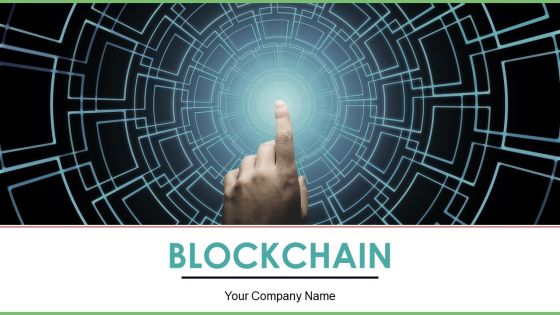
Diapositive 1 : Cette diapositive présente BLOCKCHAIN avec des images pertinentes. Indiquez le nom de votre entreprise et commencez.
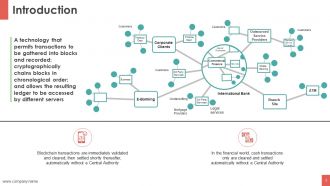
Diapositive 2 : Cette diapositive présente une introduction avec les points suivants : entreprise, clients, succursale, site, guichet automatique, services tiers, service de trésorerie, banque mobile, service des finances, souscription, hypothèque, fournisseurs, services juridiques, clients, banque internationale, Employés internes, Commercial, Finance, Services, E-Banking, Entreprises clientes, Prestataire de services de paiement, Sous-traitance, Prestataires de services.
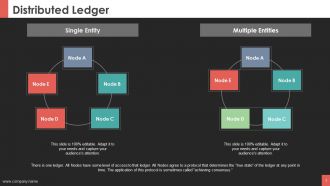
Diapositive 3 : Cette diapositive présente l'entité unique et les entités multiples du grand livre distribué avec des nœuds.
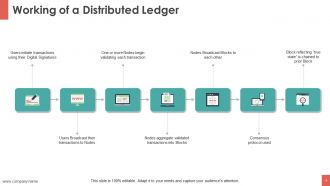
Diapositive 4 : Cette diapositive présente le fonctionnement d'un affichage de grand livre distribué - Les utilisateurs initient des transactions à l'aide de leurs signatures numériques, les utilisateurs diffusent leurs transactions aux nœuds, un ou plusieurs nœuds commencent à valider chaque transaction, les nœuds regroupent les transactions validées en blocs, les nœuds diffusent des blocs les uns aux autres , Protocole de consensus utilisé, Le bloc reflétant « l'état réel » est chaîné au bloc précédent.
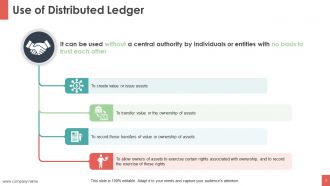
Diapositive 5 : Cette diapositive montre l'utilisation du grand livre distribué avec les points suivants : il peut être utilisé sans autorité centrale par des individus ou des entités sans aucune base pour se faire confiance, pour créer de la valeur ou émettre des actifs, pour transférer de la valeur ou la propriété des actifs , Pour enregistrer ces transferts de valeur ou de propriété d'actifs, Pour permettre aux propriétaires d'actifs d'exercer certains droits associés à la propriété, et pour enregistrer l'exercice de ces droits.
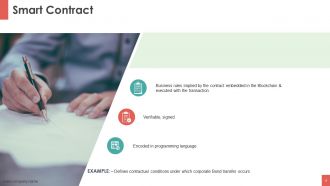
Diapositive 6 : Cette diapositive affiche le contrat intelligent.
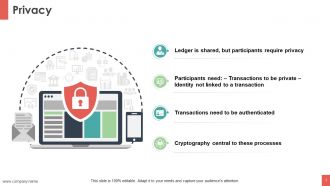
Diapositive 7 : Cette diapositive montre la confidentialité avec les points suivants : le grand livre est partagé, mais les participants ont besoin de confidentialité, les participants doivent : les transactions doivent être privées ;
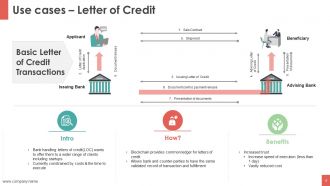
Diapositive 8 : Cette diapositive montre les cas d'utilisation - Lettre de crédit montrant- Confiance accrue, Augmentation de la vitesse d'exécution (moins d'un jour), Coût considérablement réduit, Avantages, Intro, Demandeur, Bénéficiaire, Banque émettrice, Banque conseillère, Contrat de vente, Expédition , Demande de lettre de crédit, Libération de documents, Lettre de crédit d'émission, Lettre de crédit de conseil, Présentation de documents, Présentation de documents, BANQUE, Contrôle des documents, libération de paiement, Transactions de lettres de crédit de base.
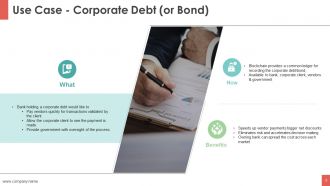
Diapositive 9 : Cette diapositive montre le cas d'utilisation - Dette d'entreprise (ou obligation).
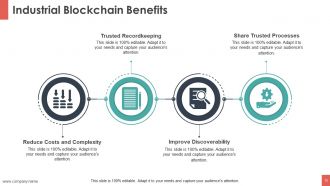
Diapositive 10 : Cette diapositive montre les avantages de la blockchain industrielle tels que : réduire les coûts et la complexité, améliorer la découvrabilité, la tenue de dossiers de confiance, partager des processus de confiance.
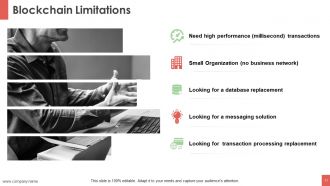
Diapositive 11 : Cette diapositive présente les limitations de la chaîne de blocs telles que : besoin de transactions hautes performances (millisecondes), petite organisation (pas de réseau d'entreprise), recherche d'un remplacement de base de données, recherche d'une solution de messagerie, recherche d'un remplacement pour le traitement des transactions.
Diapositive 12 : Ceci est intitulé Diapositives supplémentaires avec des images pour avancer. Modifier/modifier l'image selon les besoins.
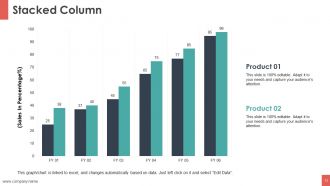
Diapositive 13 : Cette diapositive montre un graphique à colonnes empilées pour une comparaison de deux produits/entités, des informations, des spécifications, etc.
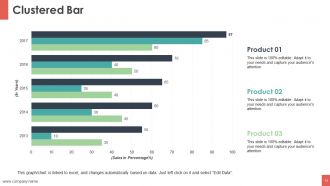
Diapositive 14 : Cette diapositive montre un graphique à barres groupé pour une comparaison de deux produits/entités, des informations, des spécifications, etc.
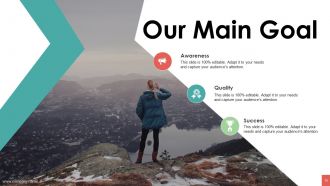
Diapositive 15 : Il s'agit d'une diapositive sur nos principaux objectifs. Énoncez vos objectifs ici.
Diapositive 16 : Il s'agit d'une diapositive d'image du diagramme de Venn pour afficher des informations, des spécifications, etc.
Diapositive 17 : Il s'agit d'une diapositive d'image de carte mentale pour afficher des informations, des spécifications, etc.
Diapositive 18 : Ceci est la diapositive Générer une idée. Indiquez ici les informations, les spécifications, les aspects innovants, etc.
Diapositive 19 : Ceci est une diapositive de remerciement avec le numéro de rue de l'adresse, la ville, l'état, les numéros de contact, l'adresse e-mail.
Diapositives de présentation Powerpoint Blockchain avec les 19 diapositives :
Évoquez la compassion avec nos diapositives de présentation Powerpoint Blockchain. Développez leurs sentiments pour leurs semblables.

FAQs for Blockchain
So blockchain is this digital record book that gets copied across tons of computers. New info gets "chained" to old blocks using some crypto math stuff - makes it super hard to mess with old records. Here's the thing though - you'd have to hack most of the computers at once to change anything, which is basically impossible. Everyone can see the same transactions happening live, so there's your transparency. Honestly, most projects don't actually need this level of trust verification. Only go blockchain if you really need that decentralized security aspect, otherwise you're just overcomplicating things.
So blockchain is basically like having a permanent receipt for everything in your supply chain. Raw materials, manufacturing, shipping - it all gets logged and can't be changed later. Honestly, it's pretty wild how fast you can trace stuff back now, like minutes instead of weeks. Super helpful for recalls obviously. The cool part is nobody can mess with the records without everyone else knowing, so you actually know who screwed up where (sorry, but it's true lol). I'd probably start by figuring out which suppliers would even be down to try this tech first.
So basically blockchain just cuts out all those middleman banks that usually make international transfers take forever and cost a fortune. Your money can move peer-to-peer in minutes instead of bouncing around between 3-4 banks for days. Ripple's doing this with some major banks already, though adoption is still kinda all over the place honestly. The cool part is you can actually track your payment in real-time - no more wondering where your cash went for three business days. My cousin uses it for his overseas freelance work and loves it. If you're doing regular international payments, definitely check out blockchain options.
So basically, public blockchains like Bitcoin are open to anyone - total transparency but they're slow and expensive as hell. Private ones? Only certain people get access. Banks love these because they can control everything and transactions are way faster. If you're building something where trust matters and you want everyone to see what's happening, go public. But honestly, most businesses just use private ones for internal stuff since they don't want competitors peeking at their data. Really depends on whether you prioritize openness or speed.
Okay so smart contracts are basically programs that run themselves on blockchain. When certain conditions get met, they automatically execute - no need for a middleman or anything. It's like setting up "if this happens, then do that" rules that nobody can mess with once they're live. Pretty neat concept honestly. You get transparency since anyone can check the code, plus way lower costs without all those intermediaries taking their cut. They work great for insurance payouts, tracking supply chains, payment automation - that kind of stuff. If you're curious about trying it out, I'd start simple. Maybe set up an automated recurring payment or something basic just to see how it actually works.
So crypto is basically what makes blockchain networks actually work - it's like paying miners to validate transactions and keep everything secure. No government controls it, which is pretty cool honestly. You can send it anywhere instantly without dealing with banks or those annoying exchange rates. The thing is, most people think it's just digital money, but it's more like the economic backbone that holds these networks together. Without crypto incentives, the whole decentralized thing would fall apart. That's why every blockchain project needs some kind of token - it's not just hype, it actually serves a purpose.
So basically, blockchain keeps a permanent record of every single change made to patient files - like who touched what and when. Once something's logged, you can't go back and mess with it without everyone knowing. Pretty clever honestly. Healthcare providers get verified through cryptography before they can access anything, so there's always a clear trail of who did what. Makes it way harder for people to pull shady stuff since everything's out in the open. I'd say start small though - maybe test it out with prescription records first since that's where you see the most fraud anyway.
Yeah so blockchain's biggest headache is speed - Bitcoin only does like 7 transactions per second, Ethereum's around 15. Meanwhile Visa's crushing thousands. It's genuinely annoying waiting ages for stuff to process. Most projects are using layer-2 solutions now though. Lightning Network for Bitcoin, Polygon for Ethereum - they handle transactions off the main chain which is way faster. There's also sharding where you basically split everything into smaller chunks, plus newer consensus methods that don't suck like proof-of-work does. Honestly if you're building anything, just go straight to those layer-2 options. Way less headache.
Dude, so blockchain basically flips the script on digital identity. Instead of Facebook or Google hoarding your info, you control it yourself. Say you need to prove you're 21 - you can do that without giving up your birthday or home address. No single company owns your data anymore, which honestly feels long overdue. Microsoft and some governments are testing these "self-sovereign identity" things already. It's pretty wild - you pick what to share and when. If you're building something that needs identity verification, check out Hyperledger Indy or uPort. They'll show you how it actually works in practice.
Yeah so blockchain's environmental impact is pretty rough - Bitcoin burns through electricity like crazy, we're talking Argentina-level consumption. It's all because of this "proof of work" thing where computers basically race to solve puzzles that eat tons of energy. But here's the thing - Ethereum just switched to "proof of stake" and cut their energy use by like 99%, which is wild. I mean, if you're thinking about blockchain stuff for work or whatever, just check what consensus mechanism they're using first. Makes a massive difference.
Blockchain basically lets customers own their loyalty points for real - they can transfer them between programs or trade with other people. Way more flexible than regular airline miles. Smart contracts handle the automation part, so bonus points hit accounts instantly when someone reaches spending goals. The transparency is huge too since customers see exactly how everything works, which honestly builds way more trust than traditional programs. Cross-brand partnerships become possible where your points work at totally different businesses. I'd check out existing blockchain loyalty platforms first though - no point reinventing the wheel when there's already decent options out there to build on.
Honestly, it's a total shitshow right now - no country can agree on how to handle crypto regulation. The US calls everything securities, China just banned it all (typical), while Europe's actually putting together decent frameworks like MiCA. Singapore and Switzerland are basically rolling out red carpets for crypto companies though. What kills me is how something totally legal in one place can land you in jail somewhere else. Cross-border compliance is genuinely nightmare fuel. My buddy's startup spent like 6 months just figuring out licensing requirements. Don't even think about expanding without getting lawyers in each country first.
So blockchain's actually changing how real estate works - crazy stuff. Property ownership history gets recorded permanently, which means way less fraud and title drama. Smart contracts handle escrow automatically too, cutting out tons of paperwork (thank god). Some counties are already putting property records on blockchain systems. Title searches that used to take forever now happen super fast. You'll see shorter closing times and lower costs, which is huge. Oh, and if you're house hunting soon, definitely ask your agent about blockchain platforms - not all of them use it yet but it's worth checking.
Honestly, blockchain voting could be pretty game-changing. Your vote gets locked in with crypto security, and anyone can verify the results are legit - no more worrying about stuffed ballot boxes or those sketchy voting machines breaking down. Nobody controls the whole system since it's decentralized, which builds way more trust. Remote voting actually becomes possible without sacrificing security. Though obviously you'd still need to figure out the whole digital divide thing and keep votes private while staying transparent. Estonia's been testing this stuff out, plus some cities here in the US if you want to see how it's going.
Look, forget the overpriced monkey pics for a sec. NFTs are actually pretty cool because they let you prove you own digital stuff without some company controlling it. Concert tickets that can't be faked, diplomas you can verify instantly, game items that work across different games - that kind of thing. Real estate shares too, which is wild to think about. The royalty part is genius though - artists get paid every time their work gets resold. My advice? Skip the hype projects and look for ones solving actual problems. That's where the real money will be.
-
This Template So Bueatiful
-
Great Work! I have been looking for a recommended blockchain certification training course
and managed to find this link. -
this template so bueatiful
-
Innovative and attractive designs.