


 0 Comment
 Customer Reviews

PDCA (Plan-Do-Check-Act) is an invaluable asset to organizations striving for continuous improvement and systematic problem-solving. Imagine an organization in which every process, decision, and strategy was driven by a structured approach with continuous feedback loops. That's exactly what PDCA provides organizations in manufacturing, healthcare, and service industries alike. It provides an invaluable framework for optimizing operations and solving issues more effectively.
However, despite its evident advantages, many organizations struggle to implement PDCA successfully. Why? Due to the complexity of continuous improvement cycles, it is hard to implement effectively: mapping problems out, testing solutions, measuring outcomes, and making long-term changes. Thus, there can be a gap between understanding its importance and knowing how best to apply it in daily business operations.
A key challenge organizations face is developing tailored PDCA models that stay relevant and adaptable to changing needs—without consuming excessive time and effort.
Explore our blog on Top 10 Plan Do Act Templates to provide a simple and effective approach to solving problems and managing changes.
To overcome this hurdle, SlideTeam has created the Top 10 PDCA Model Templates. From Deming Cycle to Shewhart Cycle, Iterative Improvement Models, and Strategic Improvement Models, these comprehensive yet editable templates have everything covered. They can be easily downloaded in PNG or JPG formats so teams can immediately implement them without relying on modeling from scratch.
So, explore our blog to learn more about these templates and how they can assist your business with overcoming challenges, optimizing processes, and realizing sustainable growth.
Refer to our blog on Top 10 Continuous Improvement Process Templates to prepare your team on the how, why, and when of implementing a CIP for better results.
Template 1: PDCA Model of Digital Supply Chain Successful Strategies
This PPT Slide demonstrates how organizations can connect planning, execution, and evaluation digitally to achieve a 360-degree view across their organization. This model facilitates rapid adaptation of the curriculum to market demands with advanced technologies like AI, AR, and blockchain integration. It helps to know how digital tools provide real-time visibility and seamless coordination.

Template 2: PDCA Model for Performance Improvement Process
This presentation slide provides a PDCA framework for systematically improving employee performance. It elaborates on the plan phase, allowing the exact source of performance problems to be found. The do phase is when teams build and deploy their targeted solutions. Lastly, the act phase is a way of documenting results for future use. This is best to maximize productivity and improve. Get it now to create a data—and results-based performance culture.

Template 3: PDCA Model of ISO 9001 Quality Management System
This PowerPoint Slide shows how organizations can synchronize with ISO standards by following a quality improvement cycle. The first is to plan to establish goals and determine risks. The second ensures that processes are executed. The check phase is when organizations observe how they perform. Lastly, the act phase involves making changes to get better results. This framework promotes quality at all levels, whether initiating processes or enhancing existing ones.

Template 4: PDCA Model for Preventive Maintenance Frequencies
This PowerPoint Template covers the PDCA loop and outlines how organizations can monitor failures and optimize maintenance schedules. The planning phase is about identifying maintenance requirements. The do phase is where teams execute plans to mitigate issues. The check phase reviews to see if trends can be tracked. Also, the act phase helps with data-driven modifications. It is best to transition from reactively addressing issues to a more proactive approach

Template 5: PDCA Model as Business Process Improvement Methodology
This presentation theme covers process improvement cycles to help organizations identify inefficiencies and implement long-term changes. It also allows them to test hypotheses on a small scale. The check phase involves reviewing and analyzing results and effectiveness. The last phase of the process is the Act phase, which is to make adjustments to improve the process. It lays plantable type to accelerate execution based on data and process.

Template 6: Kaizen PDCA Model for Process Improvement
The following slide outlines the Kaizen PDCA Model for continuous improvement. It covers four stages of planning to spot the areas you need to work on: the Do phase, where solutions are implemented at a small scale. The Check step measures results to see if the solution performed as expected. Also, the act stage helps consolidate successful changes. It guides the teams to make essential changes.

Template 7: PDCA Change Management Model for Continuous Improvement
This presentation theme describes four cycles of the systematic improvement model. In the Plan phase, key problems or areas that need changing are identified. The do phase involves what needs to be done to solve those problems. The check phase is all about inspecting the results. The act phase builds on the improvements that have been made. It is best for training teams and building awareness around structured change management.

Template 8: IT Service Integration After Merger, Ensuring Continuous Process PDCA Model
This PPT Slide displays the PDCA methodology that supports IT service integration following a merger and can maintain continual process improvement in your organization while you transition. These core four phases—Plan, Do, Check, and Act—underlie a well-designed framework for integration. A clear depiction of post-merger complexities for leaders and IT teams aiming to run post-merger companies for optimal synergies.

Template 9: PDCA Model for Effective Change Management Implementing ADKAR
This PowerPoint template offers the corrective action process for PDCA. The plan phase lays down the groundwork to determine what needs to be changed. The Do step is where teams test and implement change initiatives. The Check phase refers to the review of results. Lastly, the Act phase is where areas of improvement are identified. It helps to make change happen with clarity and confidence.
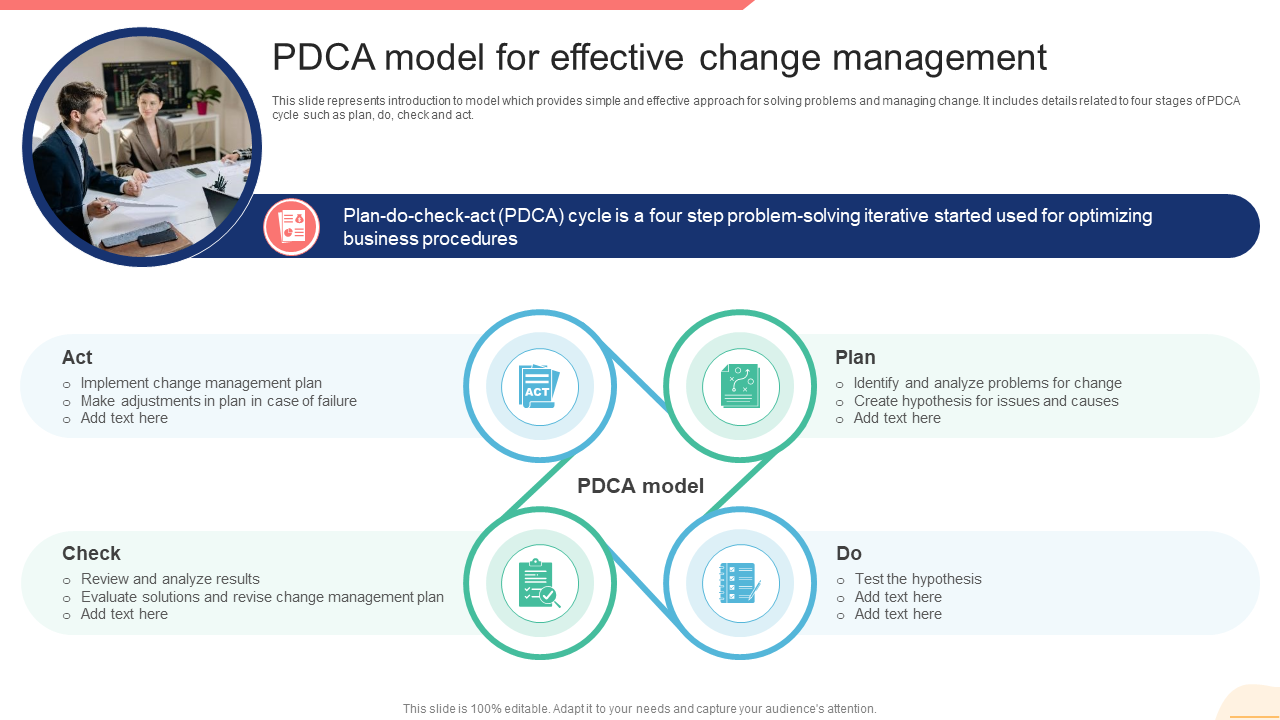
Template 10: PDCA Model for Preventive Maintenance Plan
This presentation slide ensures the proper execution of a preventive Maintenance Plan. It outlines four critical steps: Plan, Do, Check, and Act. This amazing step assists the maintenance teams with proactive strategy development. This slide is applicable to mitigate unexpected downtime, prolong the life cycle of assets, and improve up-time efficiency. Get it now for a sustainable and scalable PDCA driving process.

Plan Smart. Do Better. Grow Continuously!
With the new era of competition and quality, the PDCA (Plan-Do-Check-Act) model is not just an approach — it is a mentality. PDCA is crucial for performance enhancement loop, overcoming bottlenecks in operations, and fostering a culture of continual growth across sectors from healthcare and manufacturing to education, IT, and business consulting.
PDCA cycle empowers you to eliminate guesswork and develop a measurable, data-driven, and results-oriented quality management cycle. Where professionals face a roadblock is precisely the model you convey to your team or incoming stakeholders — this is its true power.
Our templates are designed to make your action-reflection cycle easier to follow, more engaging, and better at accelerating decision-making.
Whatever your scenario, these slides will ensure you show your PDCA strategies with maximum clarity and confidence—be it presentations in a boardroom or training a team. Don’t wait! Download them for better planning and smarter execution.
PS: Get an insight on our blog on Top 10 Program Improvement Plan Templates to make valuable assessments concerning their programs and recognize where they actually stand.
PDCA Model FAQs
1. What are the 5 stages of the PDCA process?
The PDCA process consists of four key stages that are the following:
Plan - Develop a strategy or an improvement plan based on the identified issue
Do - Execute the step on a scale
Check - Observing and evaluating the results.
Act - If the solution is standardized and successful, Continue, but if not, adjust the plan and repeat
This variation helps teams organize better-focused continuous improvement activities with more clarity at the beginning.
2. What is 5S in PDCA?
5S is a workplace organization method that complements the PDCA cycle by creating a clean and efficient environment that is easily organized, making it easier to execute processes and improve upon them later. The S5 stands for:
Sort (remove unnecessary items)
Set in order (organize what remains)
Shine (clean and inspect)
Standardize (Recognize standards for cleanliness and order)
Sustain (Maintain and revise standards)
3. What are the tools used in the PDCA cycle?
There are several tools to aid a team in executing each phase of the PDCA cycle. Some of them include:
During the planning phase, the tools Root Cause Analysis and Fishbone Diagrams may be used.
Flowcharts aid in the mapping processes in planning and doing phases.
Check Sheets, Control Charts, and Pareto Charts may be used to check performance.
During the Acting phase, the changed procedures that proved successful are formalized with guiding tools called Standard Operating Procedures (SOPs).
Throughout the entire PDCA cycle, these tools are utilized to organize thoughts, monitor changes, and enable educated choices based on the data available.