


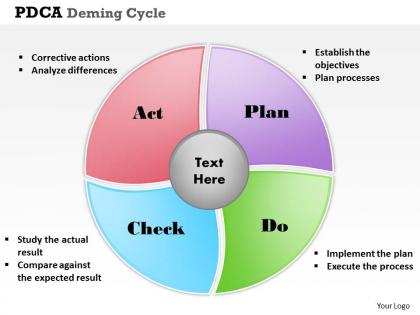
Pdca deming cycle powerpoint template slide




Try Before you Buy Download Free Sample Product
 Impress Your
 Audience
 100%
100% Editable
 Save Hours
 of Time


Our PDCA Deming Cycle PowerPoint Template Slide get you blistering along. Your ideas will go at full gallop.
People who downloaded this PowerPoint presentation also viewed the following :
Pdca deming cycle powerpoint template slide with all 6 slides:
Depend on our PDCA Deming Cycle PowerPoint Template Slide to make the cut. They will help you plan your play.
FAQs for Pdca deming cycle
So PDCA is pretty straightforward once you get it. You **Plan** by figuring out what's broken and how to fix it. Then **Do** - try your solution but keep it small scale first (learned this the hard way lol). **Check** means looking at what actually happened vs what you expected. Finally **Act** - if it worked, make it official. If not, back to the drawing board. It's basically the scientific method for business stuff. Each step connects to the next one, so you're always improving something. Honestly just pick something simple to start with - makes it way less overwhelming.
First thing - map out what you're actually doing now. Can't fix something you don't get, right? Then set real metrics, not fuzzy stuff like "improve quality." Test changes small before going company-wide (learned this the hard way). Actually check your results against data, not just how it feels. Whatever works gets standardized, whatever doesn't goes back to planning. Honestly, most places bomb because they totally skip the checking part. You need regular review meetings and someone who actually owns this process. PDCA only works if it becomes routine, not some one-off thing you try once.
Honestly, the worst part is getting everyone on the same page about what you're actually fixing. People get excited and want to skip straight to doing stuff without planning properly - been there, done that mistake myself. Then nobody wants to admit during the "Check" phase when things go sideways. Communication falls apart constantly because everyone interprets the plan differently. Oh, and good luck getting people to actually follow through on the "Do" part consistently. Set up clear owners for each step and do regular check-ins, otherwise people will just say "yeah it's going great" when it's not.
PDCA is basically the foundation for both lean and Six Sigma - that's how you actually put their ideas to work. Lean uses it to cut waste and improve flow. Six Sigma? They built their whole DMAIC thing around it (Define-Measure-Analyze-Improve-Control is just Plan-Do-Check-Act with fancier names). Both approaches need data and constant tweaking, which PDCA handles perfectly. I mean, once you see the connection, it's pretty obvious. Next time you're doing kaizen or any process improvement - oh wait, you mentioned you're working on that supply chain thing, right? - just start with PDCA and you'll naturally pull from both methodologies.
Honestly, digital tools make PDCA way less painful. Start with planning - Asana or Trello work great for mapping out goals and tracking progress. The "Do" phase gets easier with data collection apps and IoT sensors that automatically grab performance metrics (beats manually updating spreadsheets forever). Tableau or Power BI are solid for the "Check" phase - their dashboards actually make trends visible instead of buried in rows of numbers. For "Act," workflow automation helps you roll out what worked across your whole team. Oh, and don't feel pressured to buy fancy new software right away - just use whatever you've already got access to first.
So basically treat each sprint like its own little PDCA loop. Start by setting your hypothesis and metrics during planning (Plan). Track everything while you execute (Do). Here's where most teams mess up - actually spend time reviewing what worked instead of just rushing to the next thing (Check). Then tweak your approach based on what you learned (Act). I swear, half the teams I know skip that review step and then act shocked when they keep running into the same issues. Once you get into this rhythm, it becomes second nature. Way better than only doing it when everything's on fire.
Data analysis in the Check phase is basically how you know if your plan actually worked or if you're just kidding yourself. Compare your results to what you aimed for in the planning stage. Look for gaps, trends, weird stuff that happened. Those metrics you set up earlier? This is when they actually matter. The whole point is understanding not just whether you hit targets, but why things played out the way they did. Honestly, without decent data review here, you're flying blind when you get to the Act phase. Just make sure you're measuring the right things and being real about what the numbers say.
Honestly, skip the boring theory presentations. Get them into hands-on workshops where they're actually working through real scenarios from your workplace. Have them role-play each PDCA phase - most people bomb the "Check" part because they don't know what to track (I've watched so many teams just... forget that step exists). Pair newbies with someone who's done this before for their first few rounds. Your managers need to actually use PDCA too, not just talk about it. Oh, and start with small stuff that won't break anything if it goes sideways. They'll need several practice cycles before it feels natural.
Toyota's the classic example - they used PDCA to totally transform manufacturing and cut waste. Hospitals do it for patient safety stuff, reducing infections and whatnot. Software teams basically built agile around these same principles for product updates. Hotels even use it to make customers happier. Honestly though, most teams mess up the "Check" part - they skip actually analyzing what happened. That's where everything falls apart. My advice? Pick one small process first and really get the hang of the cycle. Don't try to revolutionize everything at once or you'll just create chaos.
Just shrink those cycles way down - daily or weekly instead of months. Sprint planning = your "Plan" phase. Development work = "Do." Daily standups and reviews = "Check." Retrospectives = "Act." Honestly, startups are already pivoting constantly anyway, so this fits perfectly. Pick one tiny experiment you can test in 48 hours - seriously, that short. Don't make it complicated. I'd start with something super focused, like testing one small feature or hypothesis. Run through all four steps fast and dirty. You'll learn more from three quick cycles than one long drawn-out one.
So for Plan phase, grab your baseline numbers first - defect rates, cycle times, whatever you're fixing. Set clear targets too. When you hit Do, watch implementation stuff like training completion and whether people actually follow the new process (spoiler: they often don't at first). Check is pretty straightforward - just compare your results to those original targets. Act phase tracks adoption rates and if changes actually stick around. Honestly, don't go crazy with metrics though. Pick maybe 2-3 per phase or you'll get buried in spreadsheets. Keep it simple initially.
Dude, leadership totally makes or breaks this stuff. If your bosses are just going through the motions, everyone else will too - it becomes this dead checklist thing. But when leaders actually run their own PDCA cycles and share what they're learning? That changes everything. They need to ask good questions during reviews and not freak out when experiments don't work. I've seen it go both ways honestly. The magic happens when they model the behavior instead of just demanding it from everyone else. Ask your leadership team what they're currently experimenting with - you'll learn a lot from their answer.
PDCA's way more flexible - just four simple steps you can cycle through super quickly. DMAIC is Six Sigma's thing, five phases with tons of statistical analysis and data requirements. Honestly, DMAIC can be total overkill if you're just trying to fix something small. PDCA works for pretty much any improvement situation and you can iterate fast. DMAIC's more structured, project-based with specific gates you have to hit. Both have their place though. Got a complex process with serious defect issues? DMAIC's probably worth the extra work. Just want to improve something and test it out quickly? PDCA all the way.
Honestly, you're supposed to keep cycling through PDCA - that's the whole point. Don't wait months between rounds like some teams do, it kills the momentum. How often depends on what you're working on though. Fast projects? Maybe weekly or even daily cycles. Bigger stuff can go monthly or quarterly. I'd say just pick whatever doesn't stress your team out and adjust from there. The cool thing about PDCA is you can totally change the timing based on what you discover each round. Oh, and don't overthink it - better to start somewhere than get stuck planning the perfect schedule.
Honestly, feedback loops are game-changers for PDCA cycles. You get real-time info instead of waiting till the bitter end to see if anything actually worked. It's like having GPS that reroutes you - except for your process, obviously. Catch problems early during planning, tweak things while you're doing them, and get way better data when checking results. The coolest part? What you learn from one cycle automatically makes your next planning phase smarter. I'd start simple - just figure out what feedback matters most and find easy ways to grab it as you go.
-
Great designs, Easily Editable.
-
Awesome presentation, really professional and easy to edit.