


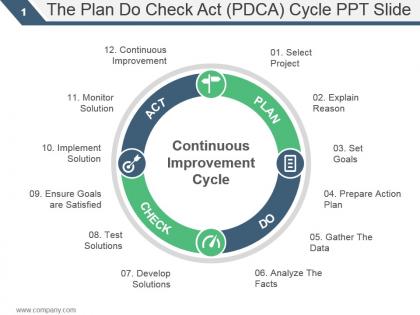
The plan do check act pdca cycle ppt slide




Try Before you Buy Download Free Sample Product
 Impress Your
 Audience
 100%
100% Editable
 Save Hours
 of Time


Gourmets delight in gastronomic ability. Entrepreneurs delight in the excellence of our The Plan Do Check Act Pdca Cycle Ppt Slide.
People who downloaded this PowerPoint presentation also viewed the following :
The plan do check act pdca cycle ppt slide with all 5 slides:
Always head forward with our The Plan Do Check Act Pdca Cycle Ppt Slide. Keep your eyes focused in front.

FAQs for The plan do check act pdca
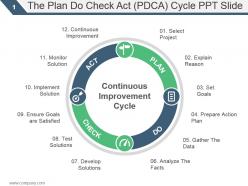
So PDCA is basically four steps that loop together: Plan (figure out the problem and how you'll fix it), Do (try your solution but start small), Check (see if it actually worked), and Act (make it official if it worked, or tweak it if it didn't). Honestly, I always think of it like trying a new recipe before cooking for guests - you don't want to mess up the whole dinner, right? Keep that Do phase small so you can learn what works without creating a disaster. Once you finish Act, it just cycles back to Plan again. Pretty straightforward once you get the hang of it.
Make your Plan phase super specific first - vague goals are honestly the death of these things. Keep the Do part small so you can actually track what's happening. Most people (including me tbh) get lazy during Check, but you really need that data to see if anything worked. Then Act is either making it standard or changing course based on what you learned. I'd say treat each cycle like an experiment, not something you're married to. Also keep cycles short - maybe 2-4 weeks tops. Any longer and you'll lose steam or get distracted by other stuff.
Each PDCA phase needs its own metrics since they're doing completely different things. Plan phase? Track how clear your goals are and if timelines make sense. During Do, focus on whether you're actually following the process and catch defects early. Check is honestly where most teams get stuck overthinking everything - just do variance analysis and track milestone completion. Don't overcomplicate it. For Act, measure if you actually implemented changes and documented what you learned. Pick maybe 2-3 metrics per phase max. Otherwise you'll drown in data and never make decisions.
PDCA works great in manufacturing, healthcare, and software dev. Manufacturing can test tiny production tweaks before going big. Healthcare improves patient safety without messing up actual care. Software teams are totally obsessed with it - and honestly, they should be since it matches how they already build things. Here's the thing: these industries all have stuff you can actually measure, processes that happen over and over, and they're cool with making lots of small changes. If your field has those three things, you'd be crazy not to try PDCA cycles.
PDCA works great for innovation because you can test stuff without betting the farm. Plan something small, try it out, then actually look at what happened - not what you wanted to happen. Most people skip that checking part, which is honestly where all the good insights are. It's just organized experimenting, but that's how real breakthroughs happen anyway. Try running one tiny PDCA loop on whatever assumption you're most worried about. Way better than spending months planning something that might totally flop.
Oh man, the biggest mistake I see? Teams skip right past actually understanding the problem and jump into solutions. Classic move. Then they treat the Check phase like some box to tick instead of really digging into what went wrong. But honestly, the worst thing is when companies do one cycle and call it done - like PDCA is some project with an end date. It's supposed to keep going! The Act phase should loop right back into planning the next round. Document what you learned too, otherwise you're just spinning your wheels.
Honestly, tech makes PDCA cycles so much easier. Dashboards let you watch your KPIs during the "Check" phase without constantly pulling reports. Project management tools are clutch for tracking action items in "Do" and "Act" - no more wondering who's supposed to do what. AI platforms catch patterns you'd never spot manually, which is huge for figuring out what actually moves the needle versus what just looks good on paper. Oh, and cloud tools keep everyone on the same page throughout all four phases. My advice? Pick one tool that fixes your biggest pain point first. Whether that's messy data collection or team coordination issues, start there and build from it.
Honestly, if your leadership isn't bought in, PDCA becomes this pointless exercise that everyone rolls their eyes at. Leaders have to actually put money and people behind it - and yeah, they need to walk the walk too. But here's the thing that trips up most teams: people won't be honest in the "Check" phase if they're scared of getting in trouble. I've seen so many teams where everyone just tells management what they want to hear instead of the real data. My advice? Get your bosses on board first, then work on making your team feel safe enough to actually tell the truth. Without both, you're just wasting time.
Yeah, PDCA fits agile perfectly! The mapping is super clean - sprint planning covers your Plan phase, Do is just the sprint work itself, then Check happens in retros and reviews. After that, Act means actually fixing stuff for next time. Honestly, agile already does this cycle naturally every 1-2 weeks instead of dragging it out over months. I'd suggest picking one improvement and following it through a complete PDCA loop in your upcoming sprint. You'll probably be surprised how well it clicks together.
PDCA is basically just plan-do-check-act on repeat, but it actually works pretty well for getting teams comfortable with trying stuff. Your people stop freaking out about mistakes because they know there's always another cycle coming. Each round is small, so nobody's risking everything on one big bet. Plus it gets everyone used to measuring results instead of just crossing their fingers. I'd pick one tiny process - maybe how you handle customer emails or something - and just run it through a couple cycles. You'll be surprised how fast people start thinking differently about problems. Way less drama, more "okay let's fix this."
PDCA is super straightforward - just Plan, Do, Check, Act on repeat. Anyone can jump in without training. Six Sigma though? That's a whole different beast with certifications, statistical charts, and formal phases. Think of it like using a hammer vs. bringing out power tools. I've honestly seen teams waste months getting caught up in Six Sigma paperwork when they could've fixed things faster with basic PDCA. Start simple with PDCA for quick fixes. Save Six Sigma for when you're tackling massive process problems that actually need all that heavy data analysis.
PDCA is honestly a game-changer for small businesses - you can test stuff without risking everything. Pick something that's driving you crazy, like how you onboard customers or track inventory. Plan a small test, run it for a few weeks with whatever resources you've got, then check if it actually moved the needle. If it worked, scale it up. If not, try something else. Way better than those all-or-nothing decisions that can wreck a small business (learned that one the hard way). The whole cycle keeps you improving without breaking the bank. Try it for a month and you'll be surprised what you discover.
Dude, Toyota's the obvious one everyone talks about - they basically invented lean manufacturing with PDCA. Motorola crushed it too with Six Sigma stuff, cutting defects like crazy. But honestly? Healthcare examples hit different. Virginia Mason Medical Center slashed patient wait times in half and made everything way safer. Even little places work - Zingerman's Deli (random, I know) uses it for food quality and customer service. My advice? Just grab one tiny process you deal with and test it out. You don't need some massive corporation budget to see results.
Look, PDCA training totally changes how your people tackle problems. No more band-aid solutions - they actually plan stuff out, test it, then check if it worked. Pretty neat watching it click for everyone. You'll notice way fewer problems coming back to bite you since folks verify their fixes before calling it done. Creates this common problem-solving language too, which honestly makes cross-department stuff way smoother. Just run a workshop with real examples from your workplace - skip the textbook scenarios or you'll lose half the room in five minutes.
You should totally try drawing out the PDCA cycle in your next meeting - it's a game changer. People get it instantly when they can see the wheel with your actual project examples in each section. No more confusion about whether you're planning or doing. Plus it stops those annoying meetings where everyone jumps around between different phases (you know the ones). I've seen teams have literal "aha" moments when they realize where they actually are in the process. Just sketch a simple circle with four parts and map your current stuff onto it. Trust me on this one.
-
Best Representation of topics, really appreciable.
-
Great quality slides in rapid time.