

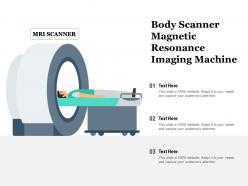
Body scanner magnetic resonance imaging machine





Try Before you Buy Download Free Sample Product
 Impress Your
Audience
 100%
Editable
 Save Hours
of Time


Our Body Scanner Magnetic Resonance Imaging Machine are topically designed to provide an attractive backdrop to any subject. Use them to look like a presentation pro.
People who downloaded this PowerPoint presentation also viewed the following :
Body scanner magnetic resonance imaging machine with all 2 slides:
Use our Body Scanner Magnetic Resonance Imaging Machine to effectively help you save your valuable time. They are readymade to fit into any presentation structure.

FAQs for Body scanner magnetic
Body scanner MRI differs from CT scans and X-rays through superior soft tissue contrast, no ionizing radiation exposure, multiplanar imaging capabilities, and advanced functional assessment options. While CT scans excel in bone imaging and X-rays offer rapid screening, MRI delivers detailed organ visualization and tissue characterization, with healthcare facilities finding enhanced diagnostic accuracy for neurological, musculoskeletal, and cardiac conditions.
MRI machines use powerful magnetic fields to align hydrogen atoms in the body, then apply radiofrequency pulses to disturb this alignment. When the pulses stop, atoms return to their original position, releasing energy signals that vary by tissue type. These signals are processed by sophisticated computers to generate detailed cross-sectional images, enabling medical professionals to diagnose conditions with exceptional precision and clarity.
Body scanner MRI technology excels at diagnosing soft tissue disorders, neurological conditions, musculoskeletal injuries, cardiovascular diseases, and oncological concerns. This comprehensive imaging approach enables healthcare providers to detect brain tumors, spinal cord injuries, joint damage, and cardiac abnormalities with exceptional detail, while minimizing patient discomfort and delivering faster, more accurate diagnoses than traditional methods.
Body scanner MRI safety for patients with implanted devices depends on device type, MRI strength, and specific protocols, with many modern pacemakers, joint replacements, and cochlear implants now MRI-conditional under controlled circumstances. Healthcare facilities increasingly use specialized screening procedures and device-specific imaging protocols, enabling safer diagnostic access while minimizing risks, ultimately expanding treatment options for patients with implants.
Recent advancements include artificial intelligence integration, faster imaging sequences, higher magnetic field strengths, improved software algorithms, and enhanced patient comfort features. These technologies streamline diagnostic processes by reducing scan times, increasing image resolution, and minimizing patient anxiety, with many hospitals finding that AI-assisted analysis delivers faster diagnoses and improved treatment outcomes.
Contrast enhancement in MRI improves tissue visualization by introducing gadolinium-based agents that alter magnetic properties, creating stronger signal differences between normal and abnormal tissues, blood vessels, and organ structures. These contrast agents enhance detection of tumors, inflammation, and vascular abnormalities by highlighting areas with increased blood flow or compromised barriers, ultimately enabling radiologists to deliver more accurate diagnoses and treatment planning across oncology, cardiology, and neurological applications.
Steps to minimize patient discomfort during body scanner MRI procedures include positioning aids, noise reduction headphones, communication systems, climate control, and sedation options when necessary. These comfort measures enhance patient cooperation by reducing claustrophobia, managing acoustic concerns, and ensuring proper positioning, with many healthcare facilities finding that comprehensive comfort protocols significantly improve scan quality while reducing procedure anxiety and repeat imaging needs.
The coil choice significantly impacts MRI image quality through signal-to-noise ratio optimization, spatial resolution enhancement, and contrast improvement tailored to specific anatomical regions. Specialized coils, such as cardiac coils for heart imaging or breast coils for cancer detection, deliver superior diagnostic accuracy by maximizing signal reception from target tissues, ultimately enabling radiologists to detect smaller abnormalities and provide more precise diagnoses.
Body scanner MRI risks include claustrophobia, allergic reactions to contrast agents, potential heating of metallic implants, kidney complications from gadolinium, and rare nephrogenic systemic fibrosis. While these limitations present challenges, most healthcare facilities minimize risks through careful patient screening, advanced safety protocols, and alternative imaging options, with many hospitals finding that proper preparation and patient education significantly reduce adverse outcomes and enhance diagnostic accuracy.
Body scanner MRI delivers superior diagnostic accuracy for soft tissue conditions, neurological disorders, and musculoskeletal injuries compared to CT scans, X-rays, and ultrasounds. Through advanced magnetic resonance technology, healthcare institutions achieve enhanced tissue contrast, detailed organ visualization, and precise disease detection, while eliminating radiation exposure, ultimately enabling faster diagnoses and improved patient outcomes across medical specialties.
Body scanner MRI plays a crucial role in preoperative planning by providing detailed anatomical imaging, identifying tissue characteristics, mapping blood vessels, assessing tumor boundaries, and evaluating organ function before surgical procedures. This comprehensive imaging enables surgeons to develop precise surgical strategies, minimize complications, and optimize patient outcomes, while postoperatively tracking healing progress, detecting complications, and ensuring successful recovery across specialties.
**INPUT**: What factors can influence the duration of a body scanner MRI session? **OUTPUT**: Body scanner MRI session duration depends on scan complexity, body area examined, patient cooperation, contrast requirements, and machine specifications. These factors combine to create sessions ranging from 15 minutes for simple scans to over an hour for comprehensive examinations, with hospitals and imaging centers finding that proper patient preparation and advanced equipment significantly streamline the process while maintaining diagnostic accuracy. [Word count: 60 words]
Artificial intelligence and machine learning enhance MRI interpretation by automating image analysis, detecting anomalies with greater precision, and reducing diagnostic time from hours to minutes. These technologies streamline radiologist workflows by prioritizing urgent cases, minimizing human error, and enabling faster patient treatment decisions, with many hospitals finding that AI-assisted interpretation delivers significantly improved diagnostic accuracy and operational efficiency.
Ethical considerations include informed consent complexities, potential overdiagnosis leading to unnecessary interventions, healthcare resource allocation fairness, psychological impact of incidental findings, and privacy concerns regarding sensitive imaging data. These challenges present opportunities for healthcare institutions to develop comprehensive protocols that balance early detection benefits with patient autonomy, ultimately delivering more transparent screening programs while minimizing anxiety and ensuring equitable access across diverse populations.
Patient data privacy in MRI facilities is managed through encrypted data transmission, HIPAA-compliant storage systems, access controls with user authentication, regular security audits, and anonymization protocols for research purposes. These comprehensive measures work together to protect sensitive medical information while enabling healthcare providers to deliver precise diagnostic services, with many hospitals and imaging centers finding that robust privacy frameworks ultimately enhance patient trust and regulatory compliance.
No Reviews