


Bucket theory of marketing sample of ppt




Try Before you Buy Download Free Sample Product
 Impress Your
 Audience
 100%
100% Editable
 Save Hours
 of Time


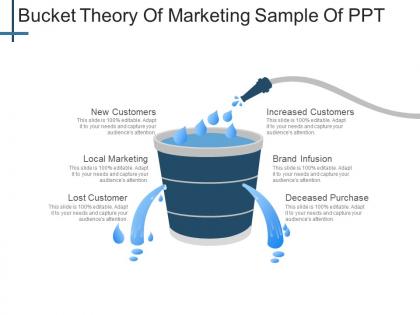
The leaky bucket is a widely known algorithm which has been very neatly described through a diagram in this bucket theory of marketing sample of PPT. Business analysts make use of the leaky bucket theory PPT model to talk about the leak & loss in the system. We have provided you with a basic visual but you can adjust it to suit your organizational needs. Simply take the assistance of our leaking bucket marketing PowerPoint template and provide productive information to your audience. Once you download this professionally crafted PowerPoint presentation graphic, you can use it to talk about numerous business illustrations related to sales, human resource, and more. Irrespective of the kind of industry you work in, you can easily make use of and discuss the bucket theory of marketing PPT presentation visual to decipher a complex piece of information in an easy to comprehend manner. And, if you belong specifically to sales or marketing, then this is a very essential piece of slide design for you. Use it to express with ease the concepts like sales funnel and customer acquisition. And since you will be using these visually impactful illustrations, instead of heavy texts, your audience is definitely going to applaud your presentation. Ideas germinate from our Bucket Theory Of Marketing Sample Of Ppt. They are correctly cultivated.
People who downloaded this PowerPoint presentation also viewed the following :
Content of this Powerpoint Presentation
Description:
The image illustrates a PowerPoint slide titled "Bucket Theory Of Marketing Sample Of PPT," which uses the metaphor of a bucket to represent a company's customer base and the dynamics affecting its size and quality. The bucket symbolizes the current customer pool, with various elements contributing to or depleting it:
1. New Customers:
Represented by water droplets falling into the bucket, indicating the influx of new clientele.
Local Marketing: Suggesting that targeted local marketing efforts can help to fill the bucket with new customers.
2. Lost Customer:
Illustrated by water dripping out of a hole in the bucket, signifying the loss of customers.
3. Increased Customers:
Additional droplets flowing into the bucket from a faucet, representing growth in the customer base through various strategies.
4. Brand Infusion:
Implies strengthening the brand, potentially leading to an increase in customers.
5. Deceased Purchase:
Likely a typo that should read "Decreased Purchase," shown by water leaking from the bucket, denoting a decline in sales or customer purchasing activity.
Use Cases:
This conceptual marketing model is applicable across a range of industries:
1. Retail:
Use: Analyzing customer acquisition and retention.
Presenter: Marketing Manager
Audience: Sales teams, store managers
2. E-commerce:
Use: Optimizing online marketing campaigns.
Presenter: Digital Marketing Specialist
Audience: Marketing department, web analysts
3. Healthcare:
Use: Managing patient relationships and outreach.
Presenter: Practice Manager
Audience: Healthcare providers, administrative staff
4. Real Estate:
Use: Attracting new clients and retaining existing ones.
Presenter: Real Estate Broker
Audience: Sales agents, real estate marketers
5. Financial Services:
Use: Increasing client base for financial products.
Presenter: Financial Advisor
Audience: Sales force, customer service reps
6. Hospitality:
Use: Maximizing guest acquisition and minimizing turnover.
Presenter: Hotel Manager
Audience: Hotel staff, marketing team
7. Education:
Use: Student enrollment strategies and minimizing dropouts.
Presenter: Admissions Director
Audience: School counselors, education marketers
Bucket theory of marketing sample of ppt with all 5 slides:
Hasten institutional development with our Bucket Theory Of Marketing Sample Of Ppt. Bring about improvements in critical areas.





FAQs for Bucket theory of marketing
So the bucket theory is pretty straightforward - think of your marketing like water going into a bucket full of holes. Most companies just keep dumping money into ads without fixing why customers leave in the first place. You've got to plug those leaks before adding more water, you know? Track where people are dropping off and fix your retention issues first. Otherwise you're just burning cash acquiring customers who'll bounce anyway. I see this mistake everywhere - businesses obsessing over getting new people while completely ignoring churn rates. Honestly, audit your existing funnel before throwing more money at it.
So imagine your customers are like water in a leaky bucket. New ones come in through the top, but you're constantly losing existing customers through holes in the bottom. Most companies obsess over getting new customers (pouring more water in) but totally ignore the fact that they're hemorrhaging existing ones. That's honestly backwards if you ask me. If your retention sucks, you're basically filling a sieve - I learned this the hard way at my last job. You'll burn through cash trying to replace everyone who leaves. Start by figuring out your churn rate first, then work on plugging those holes while still bringing new people in.
Honestly, just track where people are dropping off in your funnel - that's where your leaks are. Check conversion rates between each stage (awareness to consideration to purchase). Big drop-offs? That's your problem right there. Surveys are clutch though - ask people why they didn't buy or what confused them. Your site analytics will show cart abandonment and bounce points too. Oh, and make sure your messaging isn't all over the place across different channels. That creates confusion fast. Social listening catches complaints you might've missed otherwise. Start with your biggest drop-off point first.
So the bucket thing totally changes how you look at CLV. You're managing customer value flow over time, right? Acquisition fills your bucket, but if retention sucks, you've got massive holes everywhere. Even amazing new customers won't save your CLV then. Honestly, I've seen companies throw money at acquisition while bleeding customers - it's painful to watch. Plugging those retention holes usually beats dumping more cash into getting new people. Track both sides though: how much value flows in (new customers) and what you're losing (churn, downgrades). That's your real lifetime value.
First thing - stop the bleeding before you dump more money into ads. Figure out why customers are bailing and fix that mess first. Most people totally skip this part, then wonder why nothing works. Content that actually helps people beats promotional garbage every time. Get your referral game tight too since friends telling friends is basically marketing gold. Oh and quit sending the same boring emails to everyone - segment that list! I'd honestly start by tracking where you're losing people. That's usually where the quick wins are hiding. Way better than just throwing more prospects at a broken system.
Honestly, data analytics is what makes the bucket thing actually useful instead of just another marketing theory. You can finally see which touchpoints are doing the heavy lifting between awareness, consideration, and conversion. The surprising stuff is where it gets interesting - like discovering your emails convert way better than they acquire new people. Also shows you exactly where people are bailing out of each bucket and how long they're camping out in consideration (some folks take forever to decide). First thing I'd do is set up tracking between each stage. That way you see what's really happening in your customer journey, not whatever fantasy version you had in your head.
Dude, loyal customers are like gold - they actually stick around instead of bouncing after one purchase. You're not constantly bleeding money trying to replace people who disappear. They buy more stuff, come back regularly, and honestly? They'll even recommend you to their friends without you asking. It's wild how much easier business gets when you're not always scrambling for new customers. Focus on keeping the ones you have happy first. Retention programs work, but really it just comes down to not sucking at what you do. Way less stressful than constantly hunting for fresh blood, trust me.
Think of each marketing channel as a leaky bucket - your email list, social media, website traffic, all of them. People constantly drop off through unsubscribes and natural churn. Most marketers just keep pouring new people in without fixing the holes, which is honestly backwards. Find your biggest leaks first. Maybe your email open rates are terrible? Fix that before adding more subscribers. Then yeah, keep filling while you're plugging holes. I'd start by checking retention rates across everything - probably this week if you can swing it. The filling part's easier than people think.
Honestly, the biggest myth is thinking you can't grow until you've fixed every single leak - that's just backwards. Some churn happens no matter what you do, it's not always a sign your marketing sucks. Also that whole "retention is cheaper than acquisition" thing? Depends on your business model, doesn't always hold up. Don't stress about tiny leaks when you've got major holes bleeding customers. My take: grow while you fix the big problems, but don't wait for perfect retention before scaling. You'll be waiting forever.
Yeah, the bucket thing works everywhere - you just gotta figure out what your "leaks" actually are. SaaS companies lose people during crappy onboarding or confusing pricing. Retail? Usually checkout friction or shipping costs that kill conversions. E-commerce is honestly the worst because customers can bail at like 20 different points. But here's the thing - you're always doing the same dance between getting new customers and keeping the ones you have. I'd start by mapping where people drop off in your funnel. That's probably where your biggest problems are hiding.
Start with conversion rates between each stage - that's your bread and butter for seeing how people actually move through. Customer lifetime value matters a ton, plus retention rates to know if your best customers stick around. Time spent and pages visited show you how deep people are getting into your stuff (honestly those engagement metrics are underrated). Churn by segment is clutch too since it shows exactly where you're losing people. I'd focus on conversions first though, then add the other stuff once you've got that dialed in.
Okay so bucket theory works amazing with content marketing - here's why. You're basically filling different "buckets" depending on where people are. New folks get awareness stuff to draw them in. People already checking you out? Give them educational content that builds trust. Existing customers need the deeper resources. What I love about this approach is you're not constantly shoving sales pitches down everyone's throat (which is super annoying tbh). Instead you're actually helping solve their problems while naturally guiding them through your funnel. Just map your content to each bucket stage and you'll be golden.
Dude, ignoring your marketing bucket is like throwing money in the trash. You'll watch your customer costs go through the roof because people keep slipping away - bad onboarding, crappy service, zero follow-up, you name it. Honestly reminds me of that time I tried fixing our leaky faucet instead of just calling a plumber. You get stuck in this brutal cycle where you're constantly hunting for new customers just to replace the ones walking out the door. Find your biggest leak first - that's gonna give you the quickest wins.
Look at your actual customer data first - who's buying from you right now, not who you *think* should be buying. Find the demographics with the best lifetime value and conversion rates. Those are your winners. Honestly, most companies screw this up by chasing imaginary customers instead of doubling down on what works. Pick maybe 2-3 solid demographic buckets based on market size and how well you actually solve their problems. Don't go crazy trying to target everyone - you'll just burn through cash. Focus your marketing budget on those key groups until you've got real momentum, then think about expanding.
Customer feedback shows you exactly where things are breaking down. Survey the people who bounced and ask what made them leave - usually it's trust issues or pricing that scares them off. Exit interviews with customers who churned are honestly the best intel you'll get. Focus on patching the biggest leaks first instead of just dumping more leads in at the top (waste of time and money). Pick one problem area, fix it, then measure what changed. Way more effective than trying to fix everything at once.
-
Much better than the original! Thanks for the quick turnaround.
-
Very unique, user-friendly presentation interface.