


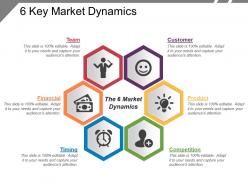
6 key market dynamics






Try Before you Buy Download Free Sample Product
 Impress Your
 Audience
 100%
100% Editable
 Save Hours
 of Time


Introducing 6 Key Market Dynamics PowerPoint layout to illustrate the importance and factors affecting the marketing dynamics. This PPT slide displays the crucial role of marketing dynamics in the business plan of any company. The ready to use PPT template highlights the key elements like customer needs, product features, market competitors, timing criteria, financial profile and team fitness. Included with various high-grade icons, this PowerPoint presentation can explain the constituents to the company’s basic approach. This PPT template is ready to use to create a strategic marketing plan to ace your business. By the assistance of this PowerPoint theme, the employees get a clear view of the factors which directly affect their business plan. The PPT slide gives the ability to highlight the areas which require more research and resource deployment. The PPT visuals make the presentation informative and engaging. Thus download this PowerPoint presentation and make your marketing analysis on point.
People who downloaded this PowerPoint presentation also viewed the following :
6 key market dynamics with all 5 slides:
Our 6 key market dynamics call a halt to doubts. Do not allow anxieties to enter.

FAQs for 6
So basically, demand shifts when people's income changes, their tastes evolve, population grows/shrinks, or substitute products get cheaper/pricier. Supply moves around because of production costs, new tech, how many competitors enter the market, regulations - oh and weather totally screws with agriculture markets. I learned that the hard way tracking corn futures once. These forces bounce off each other constantly though. Don't try tracking every single factor or you'll go nuts. Just focus on the 2-3 biggest movers in whatever industry you're looking at and you'll be fine.
When money gets tight, people flip into survival mode pretty fast. They ditch the fancy stuff and go straight for generics, discount stores, whatever lasts longer or does multiple things. Price becomes everything. Then when times are good again? Boom - everyone's back to buying premium everything and splurging on experiences. Here's the tricky part though - these shifts always happen a few months after the actual economic change. So you've gotta watch employment numbers and consumer confidence surveys instead of waiting for your sales to tank. Trust me, by then you're already behind.
Honestly, competition is what makes markets actually work. Companies have to fight for customers, so prices drop closer to what things actually cost to make. Plus they're constantly trying to one-up each other with better products or they'll lose business. Without competition though? Total nightmare for consumers. Prices go up, quality goes to shit, and innovation basically stops. I've seen this happen in industries where one company dominates - they get lazy real quick. How competitive your industry is determines everything about your pricing strategy and how fast you need to pivot when things change.
Basically, tech comes in and makes old stuff irrelevant - or completely changes what customers expect. Netflix vs Blockbuster is the classic example. Who wants to drive to rent movies when you can stream at home? Usually disruption starts tiny, going after customers nobody else cares about, then boom - it scales everywhere. The tricky part is it rarely comes from your obvious competitors. Some random company in a totally different space suddenly eats your lunch. I'd honestly spend more time watching adjacent industries than direct rivals. Stay paranoid about emerging tech, even if it seems unrelated to your business right now.
Regulations are like the rulebook for markets - they decide who gets to play and how. Banking after 2008 is a perfect example of this. New rules totally flipped how banks operate. Sometimes regs kill competition with licensing hoops, other times they break up monopolies to create more. Price controls mess with what companies can charge too. Here's what's annoying though - compliance costs eat into profits big time. They also shift what people buy when certain products get banned or new standards pop up. Pro tip: watch for regulatory announcements since they usually telegraph market changes way before anything actually happens.
Honestly, global stuff hits local markets way faster than most people realize. Your customers start acting differently the second they see scary news - either hoarding toilet paper or suddenly refusing to spend money on anything. Currency gets weird when there's international drama, which screws with import prices. Then boom, everything costs more at your local level. I learned this the hard way during the whole supply chain mess a few years back. Even random events in other countries can make people super price-conscious overnight. Just stay plugged into world news and ask yourself "how's this gonna mess with my customers?" Works better than you'd think.
Most traders rely on technical stuff like chart patterns and moving averages, plus fundamental analysis - earnings reports, economic data, that kind of thing. Elliott Wave theory is popular but honestly it's a pain to learn. Regression analysis helps spot cycles, and sentiment indicators are great for reading market mood. Oh, and quantitative models work across different timeframes. My buddy swears by RSI indicators too. Start simple though - get comfortable reading charts and key economic data first. You can always add fancier tools later once you're not drowning in information.
Honestly, social media changed everything about marketing. You're not just shouting ads at people anymore - you can actually talk to them. Instagram, TikTok, Twitter - they all let you respond to comments and share what your customers post. It's way more interactive than old-school advertising ever was. Plus you can see what's working instantly and change course if something's not hitting right. My cousin runs a small business and she swears by this approach. The trick is actually being real with people instead of just promoting stuff constantly. Way better than those cheesy TV commercials from back in the day.
Honestly, pricing is like your product's first impression - mess it up and you're done. Go too low and customers assume you suck. Too high? They'll think you're just being greedy (trust me on this one). You want that sweet spot where your price matches what people actually get. Premium works if you're actually premium. Budget's fine too, just own it instead of pretending otherwise. Try testing different prices and watch how people react - the psychology stuff gets pretty obvious once you see it happening.
Honestly, you've gotta stay flexible and watch market signals like a hawk. Have backup plans ready before shit hits the fan - learned that lesson during COVID and it sucked. Keep cash flow loose, nurture those supplier relationships (they'll save your ass). Don't hesitate to pivot fast when the data's screaming at you. Your team needs decision-making power without jumping through approval hoops all day. Build early warning systems now. Track competitors daily, customer feedback, industry buzz - all of it. Being reactive instead of proactive is expensive.
Okay so market segmentation is basically how you avoid blowing your budget on people who'll never buy from you. Break your audience into groups - age, behavior, what they actually need. Then talk to each group differently. Like, you wouldn't pitch a 22-year-old student the same way you'd talk to some 45-year-old VP, right? That'd be weird. The whole point is making your messaging feel personal instead of generic spam. Honestly, most companies try to segment too many groups at once. Start with your top 2-3 customer types and test what works with each.
Here's the thing - your customers aren't making logical decisions like econ textbooks pretend they do. They see the first price and get stuck on it. Losing $20 feels way worse than gaining $20 feels good (weird, right?). Most people procrastinate big purchases and copy what others are doing - that's why everyone obsesses over reviews now. Your customers don't think "is this worth $50?" They think "is this better than that other thing?" How you present choices matters more than the actual options. Work with these quirks instead of fighting them.
Honestly, you'll know when growth rates start tanking and everyone's slashing prices like crazy. Profit margins get squeezed hard. Customer acquisition becomes stupidly expensive since you're all fighting over the same people - I've seen companies burn through cash so fast it's insane. Don't get sucked into price wars though. Find your niche or focus on keeping current customers happy longer. Maybe look at adjacent markets? The companies that survive usually stick to what makes them different instead of trying to be the cheapest option out there.
Look, your supply chain is basically what makes or breaks how fast you can react when the market goes crazy. Good supply chains let you ramp up production or switch to new products without missing a beat. I've watched so many companies with messy supplier relationships just completely whiff on huge opportunities while smarter competitors clean up. You need flexibility built into everything - your suppliers, your logistics, all of it. Oh, and get real-time data flowing so you're not flying blind. That way you'll spot what's coming and actually move on it instead of scrambling later.
Look, profit matters but don't be a total asshole about it. Be upfront with your pricing and don't jack up prices just because people are desperate - that stuff comes back to haunt you. Your employees and customers will remember how you treated them. Honestly, I've seen too many companies think they're being clever with shady tactics like price-fixing or creating fake shortages. Here's my test: would you be cool with your strategy being splashed across social media tomorrow? If not, maybe rethink it.
-
Topic best represented with attractive design.
-
Easily Editable.