


Building Management System For Facility Management Facility Management And Maintenance




Try Before you Buy Download Free Sample Product
 Impress Your
 Audience
 100%
100% Editable
 Save Hours
 of Time


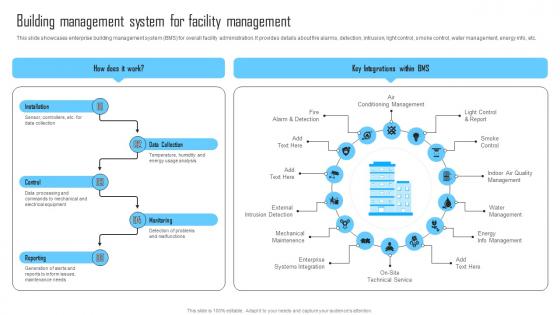
This slide showcases enterprise building management system BMS for overall facility administration. It provides details about fire alarms, detection, intrusion, light control, smoke control, water management, energy info, etc.
People who downloaded this PowerPoint presentation also viewed the following :
Building Management System For Facility Management Facility Management And Maintenance with all 6 slides:
Use our Building Management System For Facility Management Facility Management And Maintenance to effectively help you save your valuable time. They are readymade to fit into any presentation structure.





FAQs for Building Management System For Facility Management Facility
You'll need sensors for temp, humidity, occupancy - the basics. Controllers process that data and make the actual decisions. Actuators handle your HVAC, lighting, security stuff. Honestly, the network infrastructure is huge - I've seen too many setups fail because nothing can talk to each other properly. Your facility team needs a user interface they won't hate using, which is harder to find than you'd think. Integration is key though. Don't get stuck with a bunch of isolated systems that basically ignore each other - total nightmare to manage.
So basically a BMS handles all your HVAC, lighting, and equipment automatically based on who's actually in the building. Pretty smart stuff - it learns your patterns over time. No more wasting cash heating empty offices or leaving lights blazing all night (seriously, drives me crazy when I see that). The energy reports are super detailed too, so you can spot exactly where money's going down the drain. Plus it dims lights when there's enough natural sunlight and can even catch maintenance problems early. I'd start by checking where you're bleeding energy right now - that's gonna give you the biggest bang for your buck.
So IoT basically connects all your building systems - HVAC, lights, security, air quality sensors, the whole deal. They all feed data to your building management system in real-time, which honestly gives you way more insight than you'd expect. You can actually predict equipment failures before they happen and adjust energy use based on when people are actually in the building, not just schedules. Everything becomes automated instead of you constantly putting out fires. My advice? Start with just a couple sensor types first. Prove it works and saves money before going crazy with sensors everywhere.
So basically a BMS handles all the annoying stuff automatically - temp, humidity, air quality, lighting. It monitors everything and adjusts before people start complaining about being too hot or the air feeling gross. The system actually learns your building's patterns too, which is pretty cool - it'll start warming up conference rooms before meetings. Honestly, when people aren't distracted by being uncomfortable, they just perform better. You set your ranges once and forget about it. Way better than dealing with constant "it's freezing in here" emails from Karen in accounting.
Dude, integration is gonna be your biggest pain. Getting all your HVAC, lighting, and security stuff to actually work together through the BMS? Total nightmare, especially with old equipment. Network issues are brutal too - running cables in older buildings makes you want to quit. Oh, and your staff will hate the change, so training takes forever. Honestly, commissioning drags on way longer than anyone expects. Budget like double the integration time you think you need. Get facilities on board early though - that actually saves you headaches later.
So data analytics basically flips your BMS from just reacting to problems into actually predicting them. Pretty cool stuff - you'll catch equipment failures before they happen and spot energy usage patterns you never noticed. Like, your building starts learning quirky things about itself over time. Maybe the west side always overheats by 3pm or your boilers work way harder on Mondays for some reason. You can ditch the guesswork on schedules and use real occupancy data instead. I'd honestly just pick one system to start with - HVAC's usually the easiest win. Then you can prove the ROI and expand from there.
Start with network segmentation - get that BMS off your corporate network and away from the internet with proper firewalls and VLANs. Default passwords are a nightmare, change those ASAP. Strong authentication for remote access is non-negotiable. I know updating legacy BMS stuff is annoying but you've gotta stay current on security patches. Set up monitoring so you'll catch weird activity fast. Encrypt device communications if you can. Honestly, people still think of BMS as "just building controls" but it's really another attack surface now. Treat it like any critical IT system because that's what it is.
So basically, BMS systems now talk to smart devices through IoT sensors, cloud APIs, and wireless stuff like WiFi and Zigbee. Pretty wild how smooth it all works now. Your BMS becomes like command central - it pulls data from smart thermostats, lighting, occupancy sensors, air quality monitors, you name it. Then AI kicks in to automatically optimize everything. Just make sure your network can actually handle all that data flowing around (learned that one the hard way). I'd start with whatever systems will save you the most energy first, then build out from there.
Yeah, cloud BMS is definitely the way to go. You can check your building data from literally anywhere - super convenient. The upfront costs are way lower since you're not buying a bunch of hardware. Scaling is easy too when you need more capacity. Auto updates happen in the background, which is nice because honestly who has time for that stuff? The analytics help catch energy waste early, which saves money down the line. Security's actually better than most on-premise setups. I'd probably test it on one building first though, just to see how it works for your specific situation before going all-in.
So basically, a BMS handles all your environmental compliance stuff automatically. It monitors energy use, emissions, water, air quality - the whole deal. When you're getting close to regulatory limits, boom, you get alerts. No more scrambling at the last minute. The reporting side is huge too - generates those compliance reports that used to be such a pain. Auditors eat up the data logging since it's rock solid. But honestly? The best part is optimizing your systems to stay comfortably within limits instead of constantly firefighting. Just set up monthly dashboards and you'll never get blindsided during inspections.
BMS costs usually hit $2-8 per square foot, so yeah, bigger buildings can get pricey fast - we're talking six figures sometimes. Most places save 15-30% on energy bills in year one though, plus maintenance gets way cheaper with predictive scheduling. ROI typically lands around 3-5 years, which isn't terrible. Definitely get three quotes and make sure training's included - I've seen too many facilities drop $200K then have nobody who knows how to actually use the damn thing. Oh, and factor in your building's complexity when budgeting.
So basically, your BMS watches all your HVAC and electrical stuff 24/7, catching weird patterns before things actually die on you. Temperature going nuts? Energy usage spiking randomly? It'll flag that stuff. You can set alerts when equipment starts acting sketchy - way better than dealing with 3am emergency calls, trust me. The trick is setting up monitoring on your most important systems first, then expanding from there. Don't try to monitor everything at once or you'll drown in alerts. Focus on what would actually screw you over if it failed.
AI and IoT stuff is everywhere now - buildings basically predict their own problems and cut energy costs without anyone touching them. Cloud systems are taking over since you can manage everything from your phone. Sustainability requirements are no joke anymore with all the ESG pressure. Also, cybersecurity's become a real headache because everything's online now. You should probably start looking into cloud migration for your setup. I mean, that's where it's all going anyway, and the analytics you'll get are actually pretty solid once you're there.
Dude, your employees are living with this BMS every single day - they're the ones who actually know what's broken. Conference rooms that are freezing? Lighting controls that make no sense? They'll tell you all of it. So many facilities teams just wing it with comfort settings instead of asking. Set up surveys or feedback sessions, especially after updates. Their input shows you where to put sensors and what automation actually works. Oh, and don't ignore complaints about mobile apps - those things can be terrible. Regular check-ins keep everything running better.
So basically, centralized BMS has one main controller running your whole building - HVAC, lights, everything. Decentralized spreads that control across multiple smaller units in different zones. Centralized's way easier to manage, but if that main controller craps out, you're screwed. With decentralized, you get backup systems and quicker local responses. Downside? Coordinating all those separate controllers gets messy fast. Honestly, I'd go decentralized if you need rock-solid reliability or you're dealing with weird zoning stuff. The extra complexity is worth it when things inevitably break.
-
Great quality product.
-
The PPTs are extremely simple to modify. Thank you for providing the slides that are ready to be used. They assist me in saving a lot of time.