

SWOT Analysis Of Facility Management Services Market Facilities Management And Maintenance Company




Try Before you Buy Download Free Sample Product
 Impress Your
 Audience
 100%
100% Editable
 Save Hours
 of Time


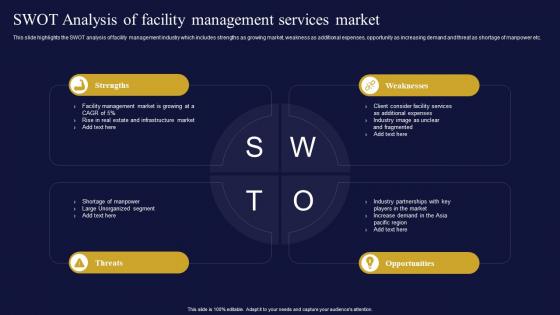
This slide highlights the SWOT analysis of facility management industry which includes strengths as growing market, weakness as additional expenses, opportunity as increasing demand and threat as shortage of manpower etc.
People who downloaded this PowerPoint presentation also viewed the following :
SWOT Analysis Of Facility Management Services Market Facilities Management And Maintenance Company with all 6 slides:
Use our SWOT Analysis Of Facility Management Services Market Facilities Management And Maintenance Company to effectively help you save your valuable time. They are readymade to fit into any presentation structure.





FAQs for SWOT Analysis Of Facility Management Services Market Facilities Management
Honestly, the biggest thing is getting those annoying day-to-day facility headaches off your team's plate. You know how maintenance scheduling and vendor stuff just eats up everyone's time? These services handle all that with way better systems than most companies have in-house. They've already got the relationships with contractors and suppliers figured out - which, let me tell you, saves a ton of hassle. Your costs become way more predictable too since they're actually monitoring things before stuff breaks. I'd look at what's currently sucking up the most time for your people and start there.
Dude, start with IoT sensors - they'll give you real-time data on HVAC, space usage, all that stuff. Predictive analytics are clutch because you catch problems before they get expensive. Mobile apps honestly changed everything for us. Your team responds way faster and clients love getting instant updates. Oh, and cloud platforms are perfect for centralizing data and automating the boring stuff like scheduling. My advice? Don't try to do everything at once though. Pick maintenance tracking first, get really good at it, then add more features. Trust me on this one.
Oh man, FM workforce issues are brutal right now. High turnover is killing everyone because people see facilities work as invisible and underpaid. Training costs are insane too - like, you finally get someone trained on HVAC systems and boom, they leave for better money elsewhere. Most companies are cheap about upskilling which honestly just makes the problem worse. Cross-training helps a ton though, makes people feel less stuck. Career paths are huge - nobody wants to feel like they're gonna be changing lightbulbs forever, you know?
Honestly, going green can totally make or break your rep in facility management now. Clients expect the whole package - energy-efficient systems, waste reduction, eco-friendly cleaning stuff. It's basically expected at this point, which is kinda crazy how fast that shifted. Fall behind and they'll just pick your competitors instead. Plus your own employees actually care about this stuff too, so it helps with retention. Oh, and the reputation boost is real - people see you as responsible and forward-thinking. I'd start with a quick audit of what you're already doing, then grab some easy wins you can roll out fast.
Dude, smart buildings are where the money is right now. IoT sensors, automated HVAC, predictive maintenance - that stuff can cut operating costs by 20-30% for clients. Most old-school FM companies are still figuring out basic automation, so you'd have a real edge. Data analytics is the goldmine though - clients are drowning in sensor data but don't know what to do with it. You could help them optimize energy usage, space planning, all that. Get certified on the major platforms first. Oh, and pitch complete solutions instead of just maintenance contracts. Trust me, that's what separates you from everyone else still doing things the old way.
Honestly, you've gotta ditch the whole "everyone gets their own permanent desk" thing - that's so 2019. Make everything modular so spaces can flip between solo work and team collaboration super fast. Your tech needs to work just as well for people at home as it does in the office. Booking systems for desks and meeting rooms are a lifesaver when you never know who's showing up. Oh, and build in flexibility for whatever crazy health protocols might pop up next - we all learned that lesson the hard way. Just bake adaptability into every contract and design choice you make.
Customer feedback is like having a crystal ball for facility management. It shows you what's actually broken versus what you think might be broken. Look for patterns in complaints - that's where the gold is. People complaining about the same elevator every week? There's your answer. Positive feedback matters too since it tells you what not to mess with. Set up surveys, suggestion boxes, maybe even grab people for quick chats. The trick is actually doing something with what you hear though. I'd review everything monthly and turn the biggest issues into real action items. Without feedback you're basically flying blind.
Ugh, new regs are such a headache but you gotta roll with them. Your whole FM strategy needs tweaking when compliance costs jump around. Budget planning gets messy, staff needs retraining, and service delivery changes overnight. Here's the thing though - sometimes stricter rules actually help. Like environmental regs pushing you toward green practices that clients love anyway. My advice? Build monitoring into your planning so you're not freaking out last minute. Set up industry alerts and always keep extra cash for compliance stuff. Trust me on this one.
Budget cuts will hit you first - facilities always get axed as "unnecessary costs." Tech startups are undercutting everyone with automated stuff, and clients keep pulling services in-house. The labor shortage isn't helping either, makes it tough to keep quality consistent. Honestly, competition's brutal right now. Everyone's pitching the same "integrated solutions" buzzword nonsense - I swear half these companies copied each other's presentations. Your move? Don't compete on price alone. Build relationships they can't replace and show real results beyond just saving money. Be the vendor they actually need, not just want.
Dude, you gotta be ruthless about priorities right now. Put your money where it actually matters - HVAC, security, safety stuff that keeps the place running. Everything else? Time to get scrappy. Your vendor relationships are gonna make or break you here, honestly. Push for better contracts, bundle services together, maybe even handle some stuff in-house if the math works out. Oh and definitely loop in your stakeholders about what corners you're cutting - nobody likes surprises when quality drops because budgets are tight. Short sentences help sometimes. But really, this whole situation separates the pros from everyone else.
So most FM companies are going hard on IoT sensors these days - catches problems before they blow up your budget. AI tools help figure out how people actually use office space (and trust me, it's never what you'd expect). Everyone's doing mobile apps for service requests now, that's just table stakes. Digital twins are the newer thing - basically virtual building models. Oh and energy management is huge right now with all the sustainability push. When you're talking to providers, definitely grill them about their tech setup. That's honestly what separates the good ones from the meh ones these days.
Honestly, good facility management is all about staying ahead of problems. They do daily safety checks, keep HVAC running properly for clean air, and make sure emergency exits aren't blocked with random stuff. Regular maintenance schedules prevent bigger disasters later. What I really look for is how fast they respond to incidents - you want 24/7 coverage, not someone who disappears at 5pm. They handle all the boring regulatory compliance too, which saves you major headaches. If you're checking out a new provider, ask to see their daily checklists and response times. Those metrics don't lie.
Yeah, remote work totally changed facility management but didn't kill it. Traditional stuff like daily cleaning took a hit, obviously. But now there's demand for flexible space solutions and hybrid setups. Companies still need someone handling their smaller offices - I mean, buildings don't manage themselves, right? The smart FM companies are switching to remote monitoring and on-demand services instead. Oh, and space optimization consulting is huge now. You should focus on flexibility and tech integration. That's honestly where the money is these days.
Honestly, partnering with other service providers is where the real money is. Find security companies, landscapers, cleaning crews - whoever fills your service gaps. You become like the conductor coordinating everything while they handle their specialty. Your clients get better results, you don't need huge upfront costs, and you can negotiate volume discounts. Plus you look like the strategic guy who has all the connections, not just another contractor. I'd start mapping out what services you're missing, then hunt down solid partners who actually know their stuff. Way smarter than trying to do everything yourself.
Track your response times for maintenance requests first - that's always a dead giveaway of how things are really running. First-time fix rates matter too. Energy costs per square foot will save you money if you actually pay attention to it. Space utilization is where most companies totally blow it though, so definitely measure that. Oh, and don't skip employee satisfaction surveys about the workspace - people will tell you exactly what's broken. Safety incidents obviously. I'd start with maybe 3-4 metrics that actually matter to your situation, then add more once you've got those dialed in.
-
Great product with effective design. Helped a lot in our corporate presentations. Easy to edit and stunning visuals.
-
Slideteam offers pocket-friendly products. As a college student this is a really necessary thing to look at while paying for something.