


Swot Analysis Of Facility Management Services Market Integrated Facility Management Services And Solutions




Try Before you Buy Download Free Sample Product
 Impress Your
 Audience
 100%
100% Editable
 Save Hours
 of Time


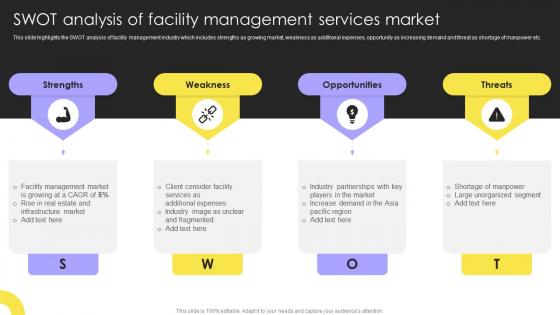
This slide highlights the SWOT analysis of facility management industry which includes strengths as growing market, weakness as additional expenses, opportunity as increasing demand and threat as shortage of manpower etc.
People who downloaded this PowerPoint presentation also viewed the following :
Swot Analysis Of Facility Management Services Market Integrated Facility Management Services And Solutions with all 6 slides:
Use our Swot Analysis Of Facility Management Services Market Integrated Facility Management Services And Solutions to effectively help you save your valuable time. They are readymade to fit into any presentation structure.





FAQs for Swot Analysis Of Facility Management Services Market Integrated Facility Management
SWOT analysis comprises four critical components: Strengths, Weaknesses, Opportunities, and Threats, which systematically evaluate internal capabilities and external market conditions. These components enhance strategic planning by enabling organizations to leverage competitive advantages, address operational gaps, and capitalize on market opportunities, with many companies finding that this structured approach streamlines resource allocation and accelerates decision-making processes.
Businesses can effectively identify strengths by conducting comprehensive internal audits, gathering customer feedback, analyzing competitive advantages, reviewing financial performance metrics, and assessing unique resources or capabilities. Through systematic evaluation of core competencies, operational efficiencies, and market positioning, organizations uncover valuable assets like superior technology, skilled workforce, or brand recognition, ultimately enabling strategic leverage for competitive advantage.
Organizations can leverage weaknesses by transforming them into development opportunities through targeted training programs, strategic partnerships, technology investments, and process improvements. Many companies find that addressing skill gaps through upskilling initiatives, outsourcing non-core functions, or collaborating with stronger partners ultimately delivers enhanced capabilities, operational efficiency, and competitive positioning in their markets.
External opportunities can be systematically identified through market research, competitor analysis, industry trend monitoring, regulatory change tracking, and customer feedback evaluation. These methods enable organizations to uncover emerging markets, technological advances, and shifting consumer preferences across sectors like retail, healthcare, and financial services, ultimately delivering competitive advantage and strategic positioning in an increasingly dynamic business environment.
Market research provides the essential data foundation for identifying external threats by analyzing competitor activities, industry trends, regulatory changes, economic shifts, and consumer behavior patterns. Through comprehensive market analysis, organizations can accurately assess potential threats like emerging competitors, market saturation, or technological disruptions, ultimately enabling proactive strategic planning and competitive advantage in an increasingly dynamic business environment.
Teams minimize bias in SWOT analysis through diverse perspectives, structured frameworks, external facilitators, data-driven validation, and rotating devil's advocate roles. These approaches streamline objective assessment by challenging assumptions, incorporating multiple viewpoints, and grounding insights in quantifiable metrics, with many organizations finding that cross-functional teams deliver more balanced strategic evaluations and competitive advantage.
Common SWOT pitfalls include being overly optimistic about strengths, ignoring competitive threats, focusing on internal perspectives only, creating vague generalities, and failing to prioritize findings strategically. These missteps undermine decision-making by delivering incomplete assessments, with many organizations finding that structured frameworks, external validation, and specific measurable criteria ultimately enhance accuracy and strategic value.
SWOT analysis integrates effectively with strategic planning tools like Porter's Five Forces, balanced scorecards, scenario planning, and competitive analysis matrices to create comprehensive strategic frameworks. This strategic combination enables organizations to cross-validate insights, identify overlooked opportunities, and develop more robust strategies, with many companies finding that integrated approaches deliver deeper market understanding and stronger competitive positioning.
SWOT analysis becomes less effective in rapidly changing markets where traditional planning timeframes are compressed, highly complex situations requiring specialized analytical frameworks, or when organizations lack reliable data for accurate assessment. While useful for strategic planning, many companies find that dynamic environments like emerging tech sectors, crisis management scenarios, or highly regulated industries with frequent policy changes require more agile, real-time analytical approaches.
Small businesses benefit from SWOT analysis through greater agility in addressing weaknesses, faster implementation of strategic changes, and more direct connection between insights and action. Unlike larger corporations with complex hierarchies, small businesses can pivot quickly based on SWOT findings, enabling rapid market adaptation, resource reallocation, and competitive positioning in niche markets.
SWOT analysis proves particularly valuable for healthcare organizations, financial institutions, retail chains, manufacturing companies, and technology startups navigating competitive landscapes. These sectors leverage SWOT frameworks to assess market positioning, identify growth opportunities, and mitigate operational risks, with many finding that systematic strength-weakness evaluations ultimately enhance strategic decision-making and competitive advantage.
Businesses should revisit their SWOT analysis quarterly or bi-annually, with additional reviews triggered by major market shifts, strategic pivots, or competitive changes. Companies in rapidly evolving sectors like technology and retail often conduct monthly assessments, while manufacturing and healthcare organizations typically find semi-annual reviews sufficient, ultimately ensuring strategic decisions remain aligned with current market realities.
Creative SWOT presentation methods include interactive dashboards, visual storytelling with infographics, scenario-based case studies, competitive positioning maps, and strategic roadmap timelines. These approaches enhance audience engagement by transforming traditional quadrant formats into dynamic narratives, with many organizations finding that visual storytelling and interactive elements significantly improve stakeholder understanding and strategic decision-making outcomes.
Stakeholder feedback enhances SWOT analysis by providing diverse perspectives, uncovering blind spots, and validating assumptions through real-world insights from customers, employees, and partners. This collaborative approach delivers more comprehensive assessments, with organizations across retail, healthcare, and manufacturing finding that multi-stakeholder input reveals critical market dynamics and operational realities, ultimately strengthening strategic decision-making accuracy.
Visual aids enhance SWOT analysis presentations by transforming complex data into digestible formats, improving stakeholder comprehension, and enabling faster decision-making through clear visual hierarchy. Charts and graphs allow organizations to showcase competitive positioning, trend analysis, and strategic priorities more effectively, with many executive teams finding that visual presentations increase engagement and facilitate more productive strategic discussions.
-
I am extremely pleased with these PPT slides that we used for our event. They were easy to modify and came out great in all aspects!
-
Wow! The design and quality of templates on SlideTeam are simply the best.