


Facility Management Framework And Process Model Global Facility Management Services




Try Before you Buy Download Free Sample Product
 Impress Your
 Audience
 100%
100% Editable
 Save Hours
 of Time


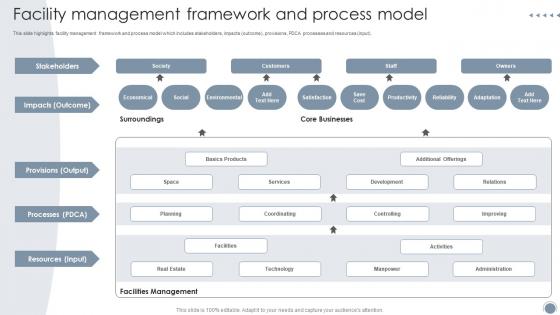
This slide highlights facility management framework and process model which includes stakeholders, impacts outcome, provisions, PDCA processes and resources input.
People who downloaded this PowerPoint presentation also viewed the following :
Facility Management Framework And Process Model Global Facility Management Services with all 6 slides:
Use our Facility Management Framework And Process Model Global Facility Management Services to effectively help you save your valuable time. They are readymade to fit into any presentation structure.





FAQs for Facility Management Framework And Process Model Global
Core components of an effective facility management framework include strategic planning, space management, maintenance operations, technology integration, and performance metrics. These components work together by streamlining operational efficiency, enhancing asset utilization, and minimizing costs, with many organizations finding that this integrated approach ultimately delivers improved workplace experiences and competitive advantage.
Technology integration in facility management frameworks occurs through IoT sensors for real-time monitoring, automated HVAC and lighting systems, predictive maintenance software, mobile workforce management apps, and integrated building management platforms. These technologies streamline operations by reducing energy costs, preventing equipment failures, and enabling faster response times, with many organizations finding that strategic automation ultimately delivers significant operational savings and improved tenant experiences.
Sustainability practices serve as core pillars in modern facility management frameworks, encompassing energy optimization, waste reduction, water conservation, green building certifications, and carbon footprint monitoring. These initiatives streamline operational costs while enhancing corporate responsibility, with many organizations finding that sustainable facilities deliver significant cost savings, improved employee wellness, and stronger competitive positioning in increasingly environmentally-conscious markets.
A facility management framework helps in risk management and safety compliance by establishing systematic protocols for hazard identification, regulatory monitoring, and incident response procedures. Through standardized safety audits, compliance tracking systems, and predictive maintenance schedules, organizations like hospitals and manufacturing plants can minimize operational risks, ensure regulatory adherence, and ultimately deliver safer work environments while reducing liability costs.
Key performance indicators for facility management frameworks include space utilization rates, energy consumption metrics, maintenance response times, cost per square foot, and tenant satisfaction scores. These KPIs enable organizations to streamline operational efficiency, reduce overhead costs, and enhance workplace experiences, with many companies finding that tracking these metrics delivers measurable improvements in resource allocation and competitive advantage.
A facility management framework supports space utilization by providing systematic data collection, analytics-driven insights, and standardized planning processes that optimize real estate footprints. Through integrated space management systems, organizations streamline occupancy tracking, enhance resource allocation, and deliver significant cost reductions, with many companies finding that strategic space planning ultimately improves operational efficiency while reducing overhead expenses.
Organizations can develop comprehensive facility management frameworks by establishing clear governance structures, implementing standardized processes, integrating technology systems, conducting regular performance assessments, and maintaining stakeholder communication protocols. These practices enable facilities teams to streamline operations, reduce costs, and enhance workplace experiences, with many organizations finding that strategic frameworks deliver improved resource allocation and operational efficiency across multiple locations.
Stakeholder engagement can be incorporated through regular feedback sessions, cross-functional committees, digital communication platforms, satisfaction surveys, and collaborative decision-making processes. These approaches enable facility managers to align services with user needs, anticipate operational challenges, and enhance workspace experiences, with many organizations finding that structured stakeholder involvement ultimately delivers improved service quality and stronger organizational support.
**INPUT**: What are the challenges of implementing a facility management framework in a large organization? **OUTPUT**: Implementation challenges include coordinating across multiple locations, integrating legacy systems, standardizing diverse processes, managing stakeholder resistance, and ensuring consistent data quality. While these complexities can overwhelm organizations initially, strategic phased rollouts enable companies to streamline operations systematically, with many large enterprises finding that proper change management ultimately delivers significant cost reductions and operational efficiency. [Word count: 58 words]
A facility management framework adapts to changing regulations through regular compliance audits, flexible policy structures, automated monitoring systems, and continuous staff training programs. By implementing scalable technology solutions and maintaining updated documentation processes, organizations can quickly respond to new safety, environmental, and operational standards, ultimately ensuring regulatory compliance while minimizing disruption and costs.
A facility management framework improves employee satisfaction and productivity by optimizing workspace environments, streamlining maintenance processes, and enhancing resource allocation across organizational facilities. Through strategic space planning and proactive maintenance protocols, organizations deliver comfortable work environments, faster service responses, and seamless operational experiences, with many companies finding that well-managed facilities ultimately reduce workplace stress while boosting overall performance.
The facility management framework addresses maintenance through predictive scheduling, preventive protocols, and asset tracking systems that monitor equipment performance, optimize replacement timing, and minimize operational disruptions. By integrating lifecycle management across facilities, organizations streamline maintenance costs, extend asset longevity, and enhance operational efficiency, with many finding that strategic maintenance planning delivers significant cost savings.
Establishing a robust facility management framework involves initial technology investments, staff training costs, and system integration expenses, but delivers significant long-term savings through operational efficiency and predictive maintenance. Organizations across healthcare, manufacturing, and corporate sectors typically see 15-25% reductions in facility costs, enhanced asset lifecycles, and improved regulatory compliance, ultimately providing substantial ROI and competitive advantage.
Data analytics enhances facility management decision-making by providing real-time insights into space utilization, energy consumption patterns, and maintenance needs through predictive modeling and performance tracking. With comprehensive data visualization, facility managers can optimize resource allocation, reduce operational costs, and improve tenant satisfaction, while many organizations finding that analytics-driven strategies deliver significant efficiency gains and competitive advantage.
Continuous improvement strategies include regular performance audits, predictive maintenance programs, stakeholder feedback systems, technology integration assessments, and benchmarking against industry standards. These approaches streamline operations by identifying inefficiencies, optimizing resource allocation, and enhancing service delivery, with many organizations finding that systematic review cycles ultimately deliver reduced costs and improved tenant satisfaction.
-
Graphics are very appealing to eyes.
-
“Superb. What a great finding. Thankful for SlideTeam. We were paying people to make slides which went all in vain. We are so happy to have found you.”