


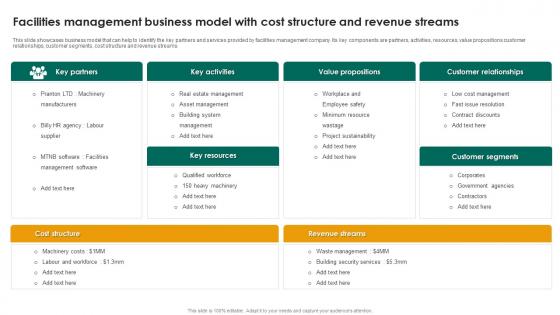
Facilities Management Business Model With Cost Structure And Revenue Streams




Try Before you Buy Download Free Sample Product
 Impress Your
 Audience
 100%
100% Editable
 Save Hours
 of Time


This slide showcases business model that can help to identify the key partners and services provided by facilities management company. Its key components are partners, activities, resources, value propositions customer relationships, customer segments, cost structure and revenue streams.
People who downloaded this PowerPoint presentation also viewed the following :
Facilities Management Business Model With Cost Structure And Revenue Streams with all 6 slides:
Use our Facilities Management Business Model With Cost Structure And Revenue Streams to effectively help you save your valuable time. They are readymade to fit into any presentation structure.





FAQs for Facilities Management Business Model With Cost Structure
Key components include service portfolio diversification, technology integration, strategic vendor partnerships, performance measurement systems, and scalable operational frameworks. These elements work together by streamlining facility operations, enhancing cost efficiency, and delivering predictable outcomes, with many organizations finding that comprehensive facilities management ultimately reduces overhead costs while improving workplace productivity and tenant satisfaction.
Technology enhances facilities management efficiency through IoT sensors, automated maintenance scheduling, energy management systems, mobile workforce apps, and predictive analytics platforms. These solutions streamline operations by reducing manual inspections, minimizing equipment downtime, and optimizing resource allocation, with many organizations finding that integrated technology delivers significantly lower operational costs and improved tenant experiences.
Sustainability serves as a cornerstone of modern facilities management, encompassing energy efficiency initiatives, waste reduction programs, water conservation systems, green building certifications, and sustainable procurement practices. These strategies enable organizations across healthcare, corporate, and educational sectors to significantly reduce operational costs, enhance occupant wellbeing, and achieve competitive advantage while meeting increasingly stringent environmental regulations.
Service-level agreements significantly enhance customer satisfaction in facilities management by establishing clear performance expectations, response times, and quality standards that ensure consistent service delivery. These structured agreements enable facilities managers to provide measurable outcomes like faster maintenance responses and improved building operations, while giving clients transparency and accountability, ultimately delivering stronger partnerships and competitive advantage in an increasingly service-focused market.
Facilities management companies face occupancy unpredictability, technology integration complexities, cost optimization pressures, health protocol management, and space utilization inefficiencies in hybrid environments. These challenges present opportunities for strategic service diversification, with many companies finding that flexible scheduling systems, IoT monitoring solutions, and data-driven space optimization ultimately deliver enhanced operational efficiency and competitive advantage.
Data analytics optimizes facilities management performance by predicting equipment failures, analyzing space utilization patterns, and monitoring energy consumption trends in real-time. Through IoT sensors and predictive algorithms, organizations streamline maintenance schedules, reduce operational costs, and enhance tenant experiences, with many commercial properties finding that data-driven insights deliver significant efficiency gains and competitive advantages.
Key trends shaping facilities management include smart building technologies, sustainability initiatives, integrated workplace management systems, data-driven predictive maintenance, and flexible space solutions. These innovations streamline operations by reducing energy costs, enhancing occupant experiences, and optimizing resource allocation, with many organizations finding that strategic technology adoption delivers significant competitive advantages in an increasingly efficiency-focused market.
Effective communication influences facilities management success by ensuring seamless coordination between stakeholders, minimizing service disruptions, and accelerating issue resolution across multiple departments and vendors. Through integrated communication platforms, facilities managers streamline maintenance requests, enhance tenant satisfaction, and optimize resource allocation, with many organizations finding that transparent communication protocols ultimately reduce operational costs and improve workplace productivity.
Best practices for integrating health and safety measures in facilities management include regular risk assessments, comprehensive staff training programs, emergency response protocols, preventive maintenance schedules, and continuous monitoring systems. These approaches streamline compliance by reducing workplace incidents, enhancing operational efficiency, and ensuring regulatory adherence, with many organizations finding that proactive safety integration ultimately delivers lower insurance costs and improved employee productivity.
Facilities management businesses ensure compliance by conducting regular regulatory audits, implementing standardized operating procedures, maintaining detailed documentation systems, and establishing ongoing staff training programs. Through automated compliance tracking software and partnerships with legal experts, organizations streamline adherence to safety, environmental, and building codes, ultimately reducing liability risks while enhancing operational efficiency and client trust.
Outsourcing facilities management typically reduces capital expenditures, eliminates staffing costs, and provides predictable monthly expenses, while in-house management offers greater control but requires significant investment in personnel, equipment, and training. Many organizations find that outsourcing delivers 15-30% cost savings through economies of scale and specialized expertise, ultimately enabling better resource allocation toward core business activities.
Customer expectations reshape facilities management by demanding personalized experiences, real-time responsiveness, and technology-driven solutions like mobile apps and IoT monitoring systems. These evolving demands push providers to integrate sustainability practices, flexible workspace designs, and data analytics capabilities, with many organizations finding that proactive, tech-enabled service delivery ultimately enhances tenant satisfaction and competitive positioning.
Facilities management professionals should evaluate performance using occupancy rates, energy consumption per square foot, maintenance response times, tenant satisfaction scores, and cost per workstation metrics. These measurements enable organizations to optimize space utilization, reduce operational expenses, and enhance workplace experiences, with many companies finding that comprehensive tracking ultimately delivers significant cost savings and improved employee productivity.
Facilities management companies can adopt proactive maintenance by implementing predictive analytics, IoT sensors, scheduled inspections, preventive service protocols, and data-driven maintenance schedules. These technologies streamline operations by identifying potential issues before failures occur, reducing emergency repairs, and extending equipment lifespan, ultimately delivering cost savings and improved tenant satisfaction.
Employee training enhances facilities management by developing technical competencies, improving safety protocols, and ensuring efficient resource utilization across organizational operations. Through comprehensive training programs, facilities teams deliver faster maintenance responses, reduce operational costs, and maintain higher service standards, with many organizations finding that well-trained staff significantly streamline workflows and enhance overall workplace experiences.
-
You can rely on SlideTeam whenever you run out of designs for your presentation. Thank you so much SlideTeam!
-
No second thoughts when I’m looking for excellent templates. SlideTeam is definitely my go-to website for well-designed slides.