


Global Facility Management Services SWOT Analysis Of Facility Management Services Market




Try Before you Buy Download Free Sample Product
 Impress Your
 Audience
 100%
100% Editable
 Save Hours
 of Time


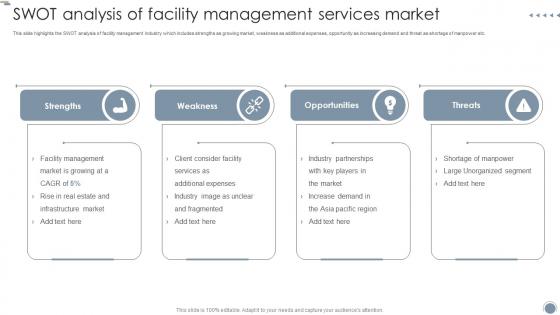
This slide highlights the SWOT analysis of facility management industry which includes strengths as growing market, weakness as additional expenses, opportunity as increasing demand and threat as shortage of manpower etc.
People who downloaded this PowerPoint presentation also viewed the following :
Global Facility Management Services SWOT Analysis Of Facility Management Services Market with all 6 slides:
Use our Global Facility Management Services SWOT Analysis Of Facility Management Services Market to effectively help you save your valuable time. They are readymade to fit into any presentation structure.





FAQs for Global Facility Management Services SWOT Analysis Of Facility
You basically need four main things: preventive maintenance, space management, vendor coordination, and staying compliant with regulations. Get ahead of problems with regular HVAC checks and cleaning schedules - way cheaper than emergency fixes. Space planning helps you figure out better layouts and occupancy stuff. Vendor management is honestly such a pain, but good contracts with clear metrics save your sanity later. Oh, and don't ignore safety/environmental compliance or you're asking for trouble. I'd start by looking at what you've already got going, then tackle whatever gaps could mess with your operations first.
So basically, facility management handles all the safety stuff you probably don't want to deal with yourself. They do routine inspections, keep fire systems working, monitor air quality - that whole mess. Honestly, OSHA regulations are a nightmare to navigate alone. These folks stay current on compliance changes while catching problems before they blow up into expensive disasters or someone gets hurt. I'd start by looking at what safety gaps you currently have. That way you'll know exactly where FM support would help most. Trust me, it's worth having pros handle the technical stuff.
Dude, you really can't run a big facility these days without tech - it's like trying to drive blindfolded. IoT sensors track your HVAC, predictive maintenance software literally tells you "hey, this thing's gonna break next Tuesday," and mobile apps handle all your work orders. Data analytics is where it gets really cool though - real-time energy tracking, space usage, maintenance costs, the whole deal. I know a guy who still tries to do everything on spreadsheets and honestly it's painful to watch. Start with basic facility management software if you haven't already. Game changer.
Dude, your facility management team can seriously cut your energy costs. Start with an energy assessment - that's your best bet for finding the big savings. HVAC maintenance alone saves like 20-30% if it's been ignored (which honestly, it usually has). They'll set up smart building systems, fix your lighting schedules, and catch weird usage spikes before they kill your budget. Plus they handle the boring stuff - insulation checks, sealing windows, even grabbing utility rebates you probably didn't know existed. The monitoring systems are pretty cool too, they spot problems you'd never notice.
Track your occupancy data like crazy - sensors or badge swipes work best. Don't guess what people need, see what they actually use. We did hot-desking for our hybrid team and honestly cut real estate costs by 30% last year. Dead conference rooms are such a waste. Create flexible zones that can flip between collaborative and focus work. Oh, and those "dead zones" you think nobody uses? Check the data first - sometimes you're wrong. Start with two weeks of measuring current usage, then adjust layouts based on real patterns. Regular audits help too.
Honestly, think of vendors more like business partners than just people you pay. Get everything in writing upfront - contracts, service levels, all that boring stuff. Weekly check-ins are clutch for anything mission-critical. Being upfront about what matters most to your facility usually gets you better treatment too. Yeah, track their performance with numbers, but don't forget to actually tell them when they're crushing it, not just when stuff goes sideways. Quick fixes prevent bigger headaches later. Oh, and maybe start by listing out who you're currently working with and how each relationship actually feels right now.
Honestly, start with the basics - cost per square foot and tenant satisfaction scores. Track energy consumption too since that adds up fast. Response times for maintenance requests are huge, and definitely monitor space utilization rates. I can't tell you how many companies waste money on empty conference rooms! Also keep an eye on preventive maintenance completion rates and vendor performance. Safety incident frequency matters too. But here's the thing - don't go crazy trying to measure everything at once. Pick like 5-7 metrics that actually matter to your company, get those dialed in first, then add more operational stuff later.
Dude, your office space totally affects whether people actually want to show up. Clean bathrooms, decent AC, working printers - sounds boring but it matters way more than you'd think. I've seen companies lose great employees over stupid stuff like broken heating or flickering lights. People get grumpy fast when they're uncomfortable all day. Start with the obvious stuff first: keep it clean, make sure temps aren't awful, and don't let equipment fall apart. Honestly, a little attention to these basics can save you from constantly hiring replacements. It's like... why make work harder than it needs to be?
Dude, the coordination part is brutal - you're basically herding cats across different cities. Budget management gets insane when you're dealing with that scale. Communication breaks down constantly between teams and vendors, which is probably the most frustrating part honestly. Everything that's simple with one location becomes this massive headache when multiplied. You end up drowning in maintenance schedules and compliance stuff while trying to make processes work everywhere. Oh, and don't get me started on integrating new tech with ancient legacy systems. Get a decent CMMS system ASAP and nail down your communication protocols early. Trust me on this one.
Dude, sustainability isn't optional in facility management anymore - it's literally driving everything. Energy-efficient HVAC systems are huge. Same with waste reduction and switching to eco-friendly cleaning stuff. The initial costs? Yeah, they'll hurt your budget at first, but you actually save money long-term. Preventive maintenance becomes your best friend since you're trying to squeeze every year out of equipment. Oh, and you'll be obsessing over energy data and carbon numbers like never before. Seriously though, start with an energy audit - shows you the biggest problem areas right away.
Honestly, preventive maintenance is like car oil changes - boring but totally worth it. You'll catch small problems before they turn into expensive disasters. Trust me, dealing with broken AC in July when tenants are furious? Not fun. Regular checks on your HVAC, elevators, plumbing keep everything running and actually make equipment last way longer. Safety inspectors love it too. Just start with a basic calendar - even monthly walkthroughs of critical stuff can save you serious money later. It's one of those things that seems like extra work until it saves your butt.
Honestly, the whole "one desk per person" thing is pretty much toast at this point. You're gonna want to set up hoteling systems so people can book desks when they need them. Focus your energy on common areas and meeting rooms - that's what actually gets people to show up. Cleaning protocols need to be way more intense for shared spaces, and your tech better handle hybrid meetings or you're screwed. Track who's actually coming in so you can adjust HVAC and maintenance accordingly. Makes no sense paying to heat an empty building, right? The trick is matching your services to real usage instead of pretending everyone's there full-time.
IoT sensors are absolutely changing the game right now - you can actually predict HVAC failures before they happen, which is wild. Smart building tech is everywhere, and tenants are really caring about sustainability metrics these days. Space optimization software has gotten insanely good too. Honestly, it'll show you how people actually use your buildings (spoiler: nothing like what you'd expect). Your team can monitor multiple facilities remotely instead of running around constantly. I'd start small though - just pilot some sensors on your most critical systems. The ROI data you'll get makes budget conversations way easier later.
Dude, communication literally saves your ass in facility management. You know those "nobody told me the elevator would be down all week" disasters? Yeah, that's what happens when info doesn't flow. Daily huddles with your team are a game-changer - just 10 minutes to sync on maintenance, vendor stuff, whatever's happening. Weekly updates to stakeholders too, even if it feels like overkill sometimes. Trust me, catching problems early beats dealing with pissed-off tenants later. Your vendors will actually respect you more when expectations are crystal clear upfront. It's honestly the difference between smooth sailing and constant firefighting.
Honestly, data analytics is like having a crystal ball for facility management. You can track energy usage, space utilization, maintenance schedules - all that stuff you're probably already collecting anyway. The cool part? Predicting when equipment's about to crap out before it actually does. Plus you can optimize cleaning based on real foot traffic instead of just guessing. I'd start by seeing what data you already have - most places are sitting on way more info than they realize. It's wild how much money you can save just by being smarter about scheduling and space allocation.
-
“Thank you to the SlideTeam. Your presentations look really skillful and have made my life so much easier.”
-
SlideTeam just saved my project! Thank you so much. The variety of templates helped me showcase multiple perspectives easily.