


Facility Management Company Profile SWOT Analysis Of Facility Management Services Market





Try Before you Buy Download Free Sample Product
 Impress Your
 Audience
 100%
100% Editable
 Save Hours
 of Time


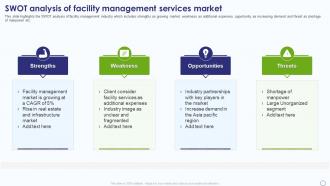
This slide highlights the SWOT analysis of facility management industry which includes strengths as growing market, weakness as additional expenses, opportunity as increasing demand and threat as shortage of manpower etc.
People who downloaded this PowerPoint presentation also viewed the following :
Facility Management Company Profile SWOT Analysis Of Facility Management Services Market with all 6 slides:
Use our Facility Management Company Profile SWOT Analysis Of Facility Management Services Market to effectively help you save your valuable time. They are readymade to fit into any presentation structure.





FAQs for Facility Management Company Profile SWOT Analysis Of Facility
Honestly, your best bet is that bird's eye view - you can catch inefficiencies that site managers totally miss when they're stuck in the weeds. Centralized oversight is clutch for standardizing processes too. The data side is where you really shine though - tracking energy usage, space utilization, maintenance costs, all that measurable stuff that actually matters. Preventive maintenance programs are absolute money savers, way better than waiting for things to break. I'd start by picking your top 3 biggest headaches and figure out how to attack them systematically. Trust me, that approach works.
Honestly, tech can help with pretty much everything if you do it right. Start with something simple like maintenance tracking - don't try to overhaul your entire system at once or you'll lose your mind. IoT sensors are great for catching problems before they blow up, and mobile apps make work orders way less painful. The upfront costs kinda suck, but the ROI is decent once everything's running. Cloud platforms mean your team can access stuff from anywhere, which is clutch. AI predictive maintenance is pretty cool too - it'll flag equipment that's about to fail. Data analytics will show you energy usage patterns and how people actually use your spaces. Baby steps though.
Honestly? Most places I've seen struggle with ancient software that barely talks to itself, let alone other systems. Budget constraints don't help either - you're constantly patching instead of fixing properly. Communication between departments is usually a mess too. The skilled tech shortage is brutal right now, especially people who can handle both legacy stuff and newer systems. Way too many companies just wait for things to break instead of staying ahead of it. Without decent data on how your equipment's actually performing, you're just guessing. I'd start by figuring out what tech you're working with and where departments aren't talking to each other.
So many ways to make your facility more sustainable! LED lights and smart HVAC are obvious starting points - they'll actually save you money pretty quickly. Low-flow fixtures help with water costs too. Don't overlook waste programs and switching to green cleaning supplies. The procurement side matters more than people think - choosing sustainable vendors makes a real difference. ROI is honestly better than most expect on these things. I'd do an energy audit first though, just to see where you're bleeding the most money. Then hit the easy wins before tackling bigger projects.
Dude, communication is everything in facility management. You're juggling teams, vendors, maintenance requests - it gets messy fast without solid communication. I've literally watched places turn into chaos because nobody talked to each other properly. Set up clear ways for people to report problems, maybe daily check-ins with your crew. Oh, and get some kind of system going - could be software or just regular meetings, whatever works. The key is making sure info flows both ways. Can't just be top-down orders, you know? Your team needs to feel heard too.
Honestly, you've got some big headaches coming your way. Budget cuts during recessions are brutal - they'll slash your resources first. Cyber attacks are targeting building systems more now, which is scary stuff. Weather's getting crazy too, and that drives up insurance costs fast. New regulations around sustainability keep changing the game. The talent shortage is real since all the experienced guys are retiring. Oh, and these tech startups are trying to make us all obsolete with their fancy solutions. Supply chain issues for equipment? Still a mess. You should probably check these threats quarterly and have backup plans ready.
Honestly, you gotta start checking your critical stuff regularly before it breaks down on you. Document everything - age, when it was last serviced, what the manufacturer says, weird issues you've seen. Trust your gut too - if something feels wonky during a walkthrough, dig deeper. I learned that the hard way once. Make a simple risk chart showing what's likely to fail vs. what would totally screw you over cost-wise. Focus your maintenance budget on the scary stuff first. It's way better than constantly putting out fires.
Dude, you've got SO much power to change workplace culture! Think about it - you're creating spaces where people actually want to hang out, fixing stuff when it inevitably breaks (and trust me, something's always broken), plus organizing events that don't suck. Your wellness programs? They actually matter for morale. Same with sustainability stuff - people get genuinely excited about that. Here's the thing though: don't just wait for complaints to roll in. Survey people regularly. Ask what would make their workday better. Being proactive instead of constantly putting out fires makes all the difference. You're basically showing everyone the company gives a damn.
Honestly, you can't run facilities properly without data anymore. Track your energy patterns, equipment performance, space usage - all that stuff. Makes a huge difference when you're trying to get budget approved too. Even just throwing numbers into Excel beats guessing what's going wrong. Equipment failures become predictable, which is kind of wild when you think about it. Your boss will actually listen when you can show real ROI instead of just saying "trust me, this'll work." Start simple with whatever metrics matter most to your building. Way better than flying blind like we used to.
Honestly, start with solid contracts that spell out exactly what you expect - response times, quality standards, all that stuff. Regular check-ins are huge too. I learned this the hard way, but always have backup vendors ready because your main guy will definitely flake when you need them most. Those quarterly meetings where you actually review performance data? Total game changer. Don't skip the boring stuff either - proper onboarding, insurance checks, safety training. Oh, and create scorecards tracking quality and timing. Sounds nerdy but it'll save your sanity when things go sideways.
Honestly, facility management is huge for keeping people happy at work. Good lighting and temperature control matter way more than you'd think - nobody's productive when they're freezing or squinting. Set up different zones: quiet spots for deep work, open areas for collaboration. Ergonomic chairs are worth the investment (trust me on this one). Clean bathrooms and reliable wifi are non-negotiables. Plants actually do help with air quality and mood. Oh, and survey your team first! They'll tell you exactly what's driving them crazy. Fix those things and you'll see the biggest impact on productivity.
Regulatory changes will totally flip your facility management on its head. New fire codes? Boom, you're redoing evacuation plans. Updated accessibility rules mean retrofitting everything - and honestly, it's never cheap. Your budget gets wrecked because compliance isn't negotiable. I always tell people to monitor what's coming down the pipeline in your industry. Set up alerts from regulatory bodies so you're not scrambling last minute. Oh, and budget an extra 10-15% each year for this stuff. Trust me on that one. Building some flexibility into your planning saves you major headaches later.
Dude, you absolutely need emergency planning built into your facility management - I can't stress this enough. Think fires, natural disasters, power outages, security issues. Most places I've worked at just wing it when disasters hit, which is honestly terrifying to watch. For your SWOT analysis, weak emergency prep should definitely go under threats/weaknesses. Strong disaster planning? That's a major strength. Start by looking at what emergency stuff you already have in place, figure out what's missing, then map out realistic response plans for the scenarios most likely to actually happen to you.
Honestly, you've gotta loop people in from day one - waiting till things go sideways is brutal. Monthly coffee chats with department heads work wonders for figuring out what they actually want (versus what you assume). Email chains are the worst, so try Slack or Teams for quick updates instead. Share dashboards showing maintenance schedules and space usage so everyone's on the same page. I swear, half the battle is just getting out of that FM bubble we all fall into sometimes. When people give feedback, actually do something about it and let them know. Seriously though, start with those coffee meetings this week - they're game changers.
Dude, IoT sensors are literally everywhere now - they're tracking everything. AI's doing predictive maintenance so your stuff breaks less. Cloud platforms are connecting HVAC, security, all of it in one place. Space analytics are massive too since everyone's doing hybrid work differently. Buildings are basically becoming data centers with people walking around lol. The tech moves insanely fast though. Don't get sucked into every new gadget - just focus on what'll actually fix your real problems. Otherwise you'll go crazy trying to keep up.
-
Graphics are very appealing to eyes.
-
Great templates that you can use in your next keynote or conference. They are perfect for quick and visually-engaging delivery.