

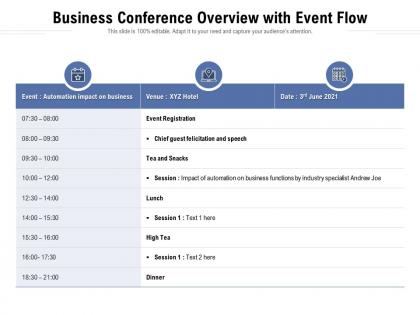
Business conference overview with event flow




Try Before you Buy Download Free Sample Product
 Impress Your
 Audience
 100%
100% Editable
 Save Hours
 of Time


Our Business Conference Overview With Event Flow are topically designed to provide an attractive backdrop to any subject. Use them to look like a presentation pro.
People who downloaded this PowerPoint presentation also viewed the following :
Business conference overview with event flow with all 2 slides:
Use our Business Conference Overview With Event Flow to effectively help you save your valuable time. They are readymade to fit into any presentation structure.

FAQs for Business conference overview
Successful event planning includes clear objective definition, comprehensive budget management, strategic venue selection, effective timeline development, and robust vendor coordination. These components work together by ensuring seamless logistics, minimizing unexpected costs, and delivering memorable attendee experiences, with many organizations finding that systematic planning ultimately enhances brand reputation and achieves measurable event ROI.
Setting a realistic event budget requires defining clear objectives, researching venue costs, catering expenses, technology needs, marketing requirements, and staffing allocations while including a 10-15% contingency buffer. Many organizations find that prioritizing must-have elements over nice-to-have features, negotiating package deals with vendors, and tracking expenses through detailed spreadsheets ultimately delivers cost-effective events without compromising attendee experience.
Technology revolutionizes modern event management by streamlining registration processes, enhancing attendee engagement, automating logistics coordination, and enabling real-time analytics tracking. Through mobile apps, virtual platforms, and data management systems, event organizers deliver personalized experiences, reduce operational costs, and maximize attendance rates, while gaining valuable insights that ultimately enhance future event success and competitive positioning.
Event managers can effectively measure attendee engagement through real-time polling, session attendance tracking, networking activity monitoring, social media interactions, and post-event feedback surveys. These measurement strategies enable organizations to assess content relevance, optimize future programming, and demonstrate ROI, with many conferences and corporate events finding that comprehensive engagement analytics ultimately deliver improved attendee experiences and stronger business outcomes.
Event risk management strategies include comprehensive insurance coverage, detailed contingency planning, venue safety assessments, vendor contract protections, and real-time monitoring systems. These approaches work together by identifying potential disruptions early, establishing clear response protocols, and maintaining backup solutions, with many event organizers finding that proactive risk planning significantly reduces costs while ensuring seamless attendee experiences.
Selecting the right venue involves evaluating capacity requirements, location accessibility, technical infrastructure, budget constraints, and alignment with event objectives. Different events demand specific considerations, with corporate conferences requiring advanced AV capabilities and breakout spaces, while weddings prioritize ambiance and catering facilities, ultimately ensuring attendee satisfaction and event success.
Best practices for promoting events online include leveraging social media platforms, creating engaging video content, implementing email marketing campaigns, partnering with influencers, and utilizing event listing websites. These strategies enhance visibility by building anticipation through targeted content, expanding reach through strategic partnerships, and driving registrations through personalized messaging, with many event organizers finding that multi-channel approaches deliver significantly higher attendance rates.
Sustainability can be incorporated into event planning through digital ticketing and registration, locally-sourced catering, waste reduction strategies, energy-efficient venues, and carbon offset programs. These eco-friendly approaches streamline operations while reducing environmental impact, with many event organizers finding that sustainable practices also lower costs, enhance brand reputation, and attract environmentally-conscious attendees, ultimately delivering competitive advantage.
**INPUT**: What are the most important factors to consider when creating an event timeline? **OUTPUT**: Key factors include venue logistics, vendor coordination schedules, attendee flow patterns, technical setup requirements, and buffer time allocation for unforeseen circumstances. These elements work together by streamlining operational efficiency, minimizing last-minute disruptions, and enhancing attendee experiences, with many event organizers finding that strategic timeline planning ultimately delivers smoother execution and competitive advantage. [Word count: 54 words]
Handling last-minute changes requires contingency planning, real-time communication systems, and flexible resource allocation to address unexpected situations quickly. Event managers utilize backup vendor networks, cross-trained staff, and mobile coordination tools to pivot seamlessly, with many finding that proactive risk assessment and clear escalation protocols ultimately minimize disruption while maintaining attendee satisfaction and event objectives.
Event management software delivers streamlined planning, automated registration, real-time attendee tracking, integrated marketing tools, and comprehensive analytics capabilities. These platforms enhance operational efficiency by reducing manual tasks, minimizing coordination errors, and centralizing communication, with many organizations finding that automated workflows and data insights ultimately enable more engaging events while significantly reducing planning time and costs.
Personalizing large event experiences involves leveraging attendee data, creating customized agendas, offering targeted networking opportunities, providing personalized content recommendations, and implementing interactive technologies like mobile apps with AI-driven suggestions. Through registration analytics and behavioral tracking, event organizers can deliver tailored experiences, curated sessions, and relevant vendor connections, ultimately enhancing engagement and satisfaction while building stronger attendee loyalty.
**INPUT**: What trends are shaping the future of event management? **OUTPUT**: Future event management trends include hybrid event formats, AI-powered personalization, sustainable practices, immersive technologies, and data-driven analytics platforms. These innovations streamline planning processes, enhance attendee engagement, and reduce operational costs, with many organizations finding that strategic technology integration delivers measurable ROI while creating more memorable, scalable experiences. [Word count: 52 words]
Post-event feedback gathering involves distributing digital surveys, conducting stakeholder interviews, analyzing attendance metrics, reviewing social media sentiment, and collecting vendor assessments. Event organizers streamline this process through automated survey platforms and analytics tools, enabling them to identify improvement opportunities, enhance attendee satisfaction, and deliver more impactful future events while maintaining competitive advantage.
Essential skills for successful event management include project coordination, budget management, vendor negotiation, timeline planning, and crisis resolution capabilities. These competencies enable professionals to streamline complex logistics, enhance client experiences, and deliver memorable events across corporate, hospitality, and entertainment sectors, with many organizations finding that skilled event managers ultimately reduce costs while significantly improving attendee satisfaction and brand reputation.
-
Great product with highly impressive and engaging designs.
-
Very unique, user-friendly presentation interface.
-
Excellent work done on template design and graphics.
-
Visually stunning presentation, love the content.
-
Easily Understandable slides.
-
Unique design & color.
-
Great experience, I would definitely use your services further.
-
Great product with effective design. Helped a lot in our corporate presentations. Easy to edit and stunning visuals.