


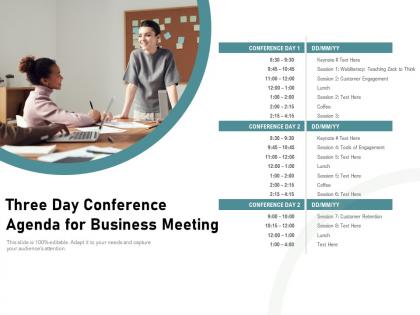
Three day conference agenda for business meeting




Try Before you Buy Download Free Sample Product
 Impress Your
 Audience
 100%
100% Editable
 Save Hours
 of Time


Our Three Day Conference Agenda For Business Meeting are explicit and effective. They combine clarity and concise expression.
People who downloaded this PowerPoint presentation also viewed the following :
Three day conference agenda for business meeting with all 2 slides:
Give your audience a fulfilling experience. They will find our Three Day Conference Agenda For Business Meeting elevating.
FAQs for Three day conference agenda
Obviously you need the basics - session titles, times, locations, speakers. But here's what people actually care about: brief descriptions so they can pick what to attend, plus buffer time between sessions (trust me, everyone runs long). Throw in break times and networking stuff too. QR codes are clutch for digital versions with maps and updates. Build in wiggle room because something always goes sideways. Keep it scannable - nobody reads giant text blocks. Oh and don't forget organizer contact info somewhere obvious.
Honestly, a good agenda is like creating a story with ups and downs. Map out your content first, then mix up the formats - don't do three presentations in a row or people will mentally check out. I learned this the hard way at a conference last year! Short interactive sessions work great between longer talks. Build in buffer time too because nobody wants to sprint between rooms. The whole point is keeping energy high by varying the pace. When people can see what's coming next and it flows logically, they stay way more engaged throughout the day.
Give speakers 15-20 minutes max and build in buffer time - they ALWAYS run long, I swear. Panel discussions need 30-45 minutes with Q&A. Put your meatier content in the morning when everyone's actually awake, then do interactive stuff after lunch (when people are basically zombies anyway). You'll want 10-15 minute breaks between big sessions for networking. Oh, and actually enforce your time limits! Tell speakers upfront what they get. Having someone play timekeeper helps tons - they can do the awkward "wrap it up" signals so you don't have to be the bad guy.
Mix things up with different session types - workshops for hands-on people, panels for those who learn by listening, visual stuff with charts and demos. Interactive breakouts are gold, honestly everyone gets into those. Set up quiet corners for introverts to recharge and high-energy group work for the extroverts. Oh and definitely record sessions since some folks need to go back and rewatch things later (I'm totally one of those people). Just don't do lecture after lecture or you'll watch people zone out real quick.
Oh man, you definitely need to stay flexible with your agenda! Speakers always run over time, tech breaks down, or someone starts a heated debate that's actually worth having. I learned this the hard way at my first event - ended up scrambling when our keynote bailed. Build buffer time between sessions and have backup content ready to go. Get someone on your team to be the "agenda quarterback" who can make quick calls. Also make sure you can communicate changes fast through your app or whatever. Your agenda isn't set in stone, trust me.
Honestly, pre-event surveys are a game changer - way better than just winging it and hoping people show up engaged. Ask attendees about their biggest challenges and what topics they actually want to hear about. You'll get real data on experience levels too, so your content won't be too dumbed down or completely over their heads. The responses help you prioritize which sessions matter most and spot knowledge gaps you didn't even know existed. Sometimes you'll even find potential speakers in your audience, which is pretty cool. Just make sure you send it out like 6-8 weeks early so you've got time to pivot if needed.
Okay so first thing - figure out what you actually want from this conference, then use that to screen speakers. I always check their recent talks and see if they truly get the topic, not just name-drop buzzwords. Big mistake I've seen? Booking celebrity speakers who sound impressive but totally whiff on the content. Have real conversations with them upfront about your goals. Ask how they'd customize their talk - honestly, most good speakers will offer to tweak things anyway. Get an outline beforehand if you can. Oh, and definitely do a quick call before the event to make sure you're on the same page. Trust me, it'll save you from those cringey moments where the keynote doesn't match the vibe at all.
Skip the awkward forced networking - nobody likes that stuff. Instead, just build in longer coffee breaks and cocktail hours between speakers when people actually want to chat. Those speed networking things are honestly the worst, but small group discussions work great because people solve real problems together. Oh, and try themed hangout spots during breaks like "startup founders corner." The trick is giving people something concrete to talk about, not just swapping business cards. Schedule these right after good sessions when everyone's pumped up and has fresh ideas bouncing around.
Dude, breakout sessions are seriously where it's at. Way better than just having everyone sit through generic keynotes all day. People actually get to participate and ask real questions in smaller groups - makes such a difference. You can cover way more ground too since multiple topics run at once. Oh, and don't go crazy with options though. Like 2-3 tracks max or people get overwhelmed trying to pick. It's kinda like choosing between a boring lecture and an actual hands-on workshop. Much more worth it.
Set up different tracks so people can pick their vibe - deep technical stuff vs broader overviews. I go for like 60-70% technical since that's what most people show up for, but honestly? The general sessions always get the best reviews. Weird, right? Mix in some keynotes and panels between your hardcore presentations. Oh, and definitely label sessions by difficulty level - saves everyone the awkwardness of being in the wrong room. Pro tip: put your most accessible content right after lunch when everyone's half asleep. Have a few potential attendees peek at your draft agenda first to see if the balance feels right.
Oh dude, packed agendas are the worst! People's brains just shut down after a few hours - I've totally been there. Everyone ends up rushing around like crazy with zero time to actually think about what they just heard. And don't even get me started on trying to find a bathroom break when every minute's scheduled. The best conversations happen randomly in hallways anyway, but tight schedules kill those moments completely. Honestly? Less is more. Give people breathing room and focus on having real discussions instead of shoving everything possible into one day.
Honestly, visual templates are a game changer for agendas. People's brains just shut off when they see those endless bullet point lists - I've watched it happen in real time. Color coding different sessions helps so much, and little icons for breaks or whatever make everything scannable. Your attendees can actually figure out their day without getting a headache. White space is huge too. Don't cram everything together like you're rationing paper or something. Simple fonts, clear time blocks, maybe some visual hierarchy. It'll look way more professional than those dense Word docs everyone defaults to.
QR codes are everywhere now - just slap them on badges and people can pull up the agenda instantly. Mobile apps are solid too since you can send updates if something changes last minute. Those touchscreen displays in lobbies look pretty slick, honestly. NFC badges are cool but kinda expensive unless you've got budget to burn. Oh, and there's always the simple route - just make a mobile-friendly webpage that works on everyone's phone. That's probably where I'd start. Super easy to update if a speaker bails or times shift around.
Honestly, dive into that feedback from your last event - it's like having a cheat sheet for next time. Check what people actually said about sessions, not just the star ratings. Interactive stuff usually kills it while long lectures put everyone to sleep (shocking, I know). Pay attention to timing complaints too since people get cranky about weird lunch schedules. Short sessions work better than marathon ones. Don't just skim the comments either - actually read them, even the snarky ones. They'll tell you exactly what to tweak for your next agenda.
Yeah, audience size totally changes everything about your agenda. Small groups? Go for workshops and interactive stuff. Big crowds need more traditional presentations and maybe breakout sessions. But honestly, demographics matter way more than size. C-suite folks want big picture strategy while managers need actual tactics they can use Monday morning. You've got to think about their experience level too - are they newbies or veterans? Industry background makes a huge difference. I always send out a quick survey beforehand because guessing wrong is painful. Trust me on that one.
No Reviews