


Business Engagement And Communication Plan Flowchart




Try Before you Buy Download Free Sample Product
 Impress Your
 Audience
 100%
100% Editable
 Save Hours
 of Time


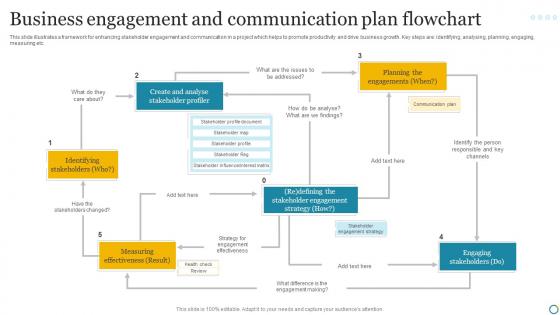
This slide illustrates a framework for enhancing stakeholder engagement and communication in a project which helps to promote productivity and drive business growth. Key steps are identifying, analysing, planning, engaging, measuring etc.
People who downloaded this PowerPoint presentation also viewed the following :
Business Engagement And Communication Plan Flowchart with all 6 slides:
Use our Business Engagement And Communication Plan Flowchart to effectively help you save your valuable time. They are readymade to fit into any presentation structure.






FAQs for Business Engagement And
Honestly, it comes down to three things: be clear, keep it short, and know who you're talking to. Pick the right way to reach them too - like, don't send a novel over Slack when a quick call would work better. Your emails should have one main point, and if you need something from them, just say it directly. I'm terrible at this sometimes, but rambling messages never get good responses. Also listen when they actually respond back! Quick test - look at your last few messages. Did you get straight to what you needed? That'll tell you everything.
Dude, visual aids are total game-changers for presentations. Instead of drowning people in numbers, charts actually show them patterns they can understand instantly. Diagrams work great for breaking down complicated stuff too. Honestly? People's attention spans are terrible these days, so anything visual keeps them from zoning out. Just don't go overboard - you want them supporting your points, not distracting from them. Oh, and make sure everything's readable from the cheap seats! There's this 6x6 rule I learned somewhere - max 6 bullet points, 6 words each per slide. Works pretty well.
Honestly, feedback is what keeps teams from completely falling apart communication-wise. Most breakdowns happen because everyone thinks they're on the same page but they're totally not. When you give and receive feedback regularly, you actually learn how each person communicates best - their style, what works, what doesn't. It's like having this ongoing tune-up for how you all talk to each other. The trick is making it feel normal, not like some scary performance review thing. Maybe just try asking "how'd that meeting feel to you?" after your next team call and see what happens.
Oh man, this stuff trips people up all the time! Like, you think you're being super clear but then it totally backfires. Some cultures are really direct - they'll just tell you what's up. Others dance around things more politely. And don't even get me started on time expectations... some people care way more about relationships than hitting deadlines. Body language is weird too - eye contact that feels normal to you might be uncomfortable for someone else. My advice? Just ask people upfront how they prefer to communicate. Saves so much awkwardness later.
Honestly, the best trick is just putting your main point right at the top - don't make people hunt for it. Short sentences work way better than long rambling ones. And please, skip the corporate speak... "synergistic solutions" just means "working together" so why not say that? I always read my stuff out loud before hitting send because if I trip over the words, whoever's reading it will too. Oh, and bullet points are your friend when you're listing things. Basically write like you're telling a smart friend who doesn't know your industry jargon.
Oh man, body language is everything at work. Like, way more than you'd think. There's this stat that 55% of communication is non-verbal while actual words are only 7% - kinda blows your mind. So if you're hunched over in meetings or can't make eye contact, you're basically shooting yourself in the foot without knowing it. Good posture makes such a difference. Same with matching your tone to what you're saying. I swear, once you start noticing how you carry yourself, you'll see it immediately. Your coworkers will too.
Start with your best point and build from there. Figure out exactly what you want them to do afterward - that's huge. People retain stuff better in threes, so group your main points that way. Practice those slide transitions because nothing's worse than awkward dead air (learned this the hard way). Stories beat data dumps every time. Your slides should back you up, not do all the talking - keep text light and actually look at people. Oh, and end with a real call-to-action. "Any questions?" is such a weak finish.
Honestly, the right tech makes remote work so much smoother. Video calls for big discussions, Slack for quick questions - you just gotta match the tool to what you need. Screen sharing is a lifesaver when you're trying to explain something complicated (way better than those confusing email threads that go on forever). Platforms like Teams or Slack keep everyone updated in real-time. Oh, and definitely set some ground rules with your team about which platform to use when. Otherwise you'll have people messaging you everywhere and it gets chaotic fast.
Dude, storytelling is like magic for presentations. People zone out with boring bullet points, but throw in a good story? Suddenly they're paying attention. Our brains are just wired that way - we remember narratives way better than random facts. Stories hit you emotionally too. Give your audience real characters and problems they can connect with. I always tell people to start with a customer story or some challenge scenario. Makes everything way more relatable than just diving into data. Trust me, you'll notice the difference right away. Way better than another snooze-fest slide deck.
Track engagement rates, meeting attendance, response times - the usual stuff. But honestly? Numbers don't tell you everything. You gotta actually ask people how they're feeling about your messages through surveys or just casual check-ins. Are they confused or overwhelmed? Getting what they need? I'd set up feedback loops every quarter or so - like mini communication audits. That way you can fix small issues before they blow up into bigger headaches. It's way easier to course-correct early than deal with major problems later.
Oh man, language barriers are brutal - people literally can't understand each other sometimes. Then you've got the whole hierarchy thing where employees are too intimidated to actually talk to their managers. Cultural stuff trips everyone up too because what sounds normal to you might come off super rude to someone else. Don't even get me started on information overload - everyone's buried under emails and Slack messages. Remote teams make it worse with time zones all over the place. Honestly? Half the time people just hate whatever platform IT picked for communication. You need multiple ways for people to connect and make sure they feel safe speaking up without getting their heads bitten off.
Your workplace culture basically dictates how everyone talks to each other. Hierarchical places? Expect formal emails and people tiptoeing around their boss. Flatter companies usually go for casual Slack convos instead of stuffy memos - honestly way better imo. The vibe also decides if people actually speak up or stay quiet when things go wrong. Transparent cultures get you real feedback and open debates. Risk-averse ones make everyone super careful about what they say. Just watch how your leadership communicates though - that style always filters down to everyone else eventually.
Start with psychological safety - everything falls apart without it. Ask open questions in meetings and don't panic-fill the awkward silence (I used to be terrible at this). Share your own screw-ups too. Respond to feedback with genuine curiosity instead of getting defensive. Set up regular one-on-ones that aren't just boring status checks. Here's the thing though - consistency matters more than perfection. Your team has to see that speaking up actually changes things, not just empty "my door's always open" BS.
Honestly, templates are lifesavers. You're not reinventing the wheel every single time you need to make a presentation. The structure's already there, so you can just focus on what you're actually trying to say instead of agonizing over design choices for hours. Your team will thank you too - no more presentations that look like they came from five different companies. I'd grab 3-4 solid templates for different situations and just swap out colors and content when you need them. Way easier than starting with a blank slide (which is basically my personal hell).
Honestly, just don't be shady. Tell the truth about what you can actually deliver and when - nobody likes getting burned by fake promises. Keep confidential stuff confidential, obviously. Oh and watch your language choices because inclusive communication actually matters way more than some people realize (learned that one the hard way). Don't play games or hide info that'll bite someone later. I always think about how I'd want someone to talk to me in the same situation. If you're torn between being too open or too secretive, go with more transparency. It's saved me so many headaches.
-
Use of icon with content is very relateable, informative and appealing.
-
The templates are easy to get, and the chat customer support is excellent.