

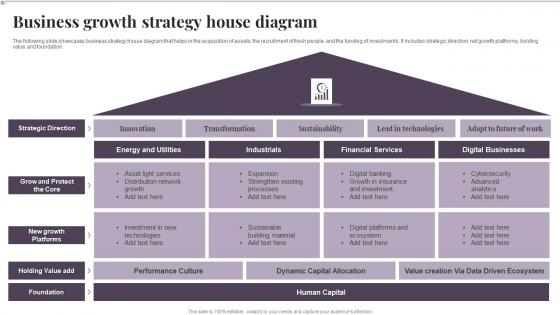
Business Growth Strategy House Diagram




Try Before you Buy Download Free Sample Product
 Impress Your
 Audience
 100%
100% Editable
 Save Hours
 of Time


The following slide showcases business strategy house diagram that helps in the acquisition of assets, the recruitment of fresh people, and the funding of investments. It includes strategic direction, net growth platforms, holding value and foundation.
People who downloaded this PowerPoint presentation also viewed the following :
Business Growth Strategy House Diagram with all 6 slides:
Use our Business Growth Strategy House Diagram to effectively help you save your valuable time. They are readymade to fit into any presentation structure.





FAQs for Business Growth
Honestly, it comes down to three big things. First, write down your processes - I can't stress this enough because when I didn't do this early on, everything was chaos whenever I stepped away. Second thing is stop trying to please every customer and just focus hard on the ones who actually make you money. Way more effective than spreading yourself thin everywhere. Then hire people who can actually grow, not just warm bodies to fill spots right now. Oh and here's what I'd do - pick whatever's driving you most crazy right now and fix that one thing first. Don't try to do everything at once.
Honestly, market research is like having a cheat sheet before a big test. It shows you what customers actually want (not what you think they want), who you're really up against, and where there's space to grow. I've watched so many companies just wing it and crash hard - such a waste of money and time. Research tells you if people will buy your stuff, what they'll pay, and how to stand out. Oh, and it stops you from doing everything at once, which never works anyway. Just do one good study before making any major moves. You'll thank yourself later.
Look, customer feedback is literally your cheat sheet for what's actually working vs. what's just bleeding cash. It shows you real market opportunities and which features people genuinely care about - not the stuff you *think* they want. You'll catch problems early before they explode into expensive disasters. Plus honestly, your customers know your weak spots better than you do sometimes. Use it to figure out where to spend your money next and avoid those "why did we build this" moments. Even basic surveys can uncover some pretty surprising insights, so definitely start collecting it if you haven't already.
Honestly, just go where your customers are already hanging out online. Google ads work great for catching people who are actually searching for your stuff. Social media targeting is solid too. Email marketing? Super unsexy but the ROI is insane if you're not terrible at it. Focus on helping people solve real problems instead of being salesy all the time - nobody wants that spam energy. Track everything religiously because the numbers don't lie about what's actually making you money. Oh, and don't try to be everywhere at once. Pick two channels max, get good at those first, then branch out.
Honestly, I'd focus on the money stuff first - revenue growth, customer acquisition cost, and lifetime value. Those three will tell you if you're actually building something sustainable or just bleeding cash. Churn rate's huge too, especially if you've got recurring revenue. And don't sleep on gross margins - I've seen too many companies grow their way into bankruptcy because they ignored unit economics. The operational side matters just as much though. Employee productivity and customer satisfaction can totally implode when you're scaling fast. Pick maybe 5-7 key metrics and check them weekly. More than that and you'll just confuse yourself with data overload.
Look, partnerships are basically a shortcut to getting stuff you'd otherwise spend years building yourself. You share costs and get access to their customer base while they get whatever you're good at. Say you're amazing at making products but suck at getting them to people - find someone who's got distribution figured out. Risk gets split too, which honestly just feels better than betting everything on yourself. The trick is finding people who want similar things but bring different skills. I'd start by writing down what you need vs what you've got to offer. Then hit up your network or check industry groups - you'd be surprised who's looking for exactly what you do.
Your value prop is honestly everything when it comes to growth - it's why people pick you instead of the other guy. I learned this the hard way after burning through way too much ad spend with zero direction. Everything flows from there: your messaging, who you go after, even what features you build next. Short sentences work. Longer ones need to actually flow and sound natural. If some new marketing idea doesn't fit with your core value prop, skip it. First figure out what makes you actually different, then double down on getting that message out there. Otherwise you're just shouting into the wind and hoping someone hears you.
Honestly, just get super close to your customers and actually listen to what's bugging them. That's where the gold is hiding. I'm always checking social media to see what people are bitching about or what they wish existed. Sometimes the biggest opportunities are problems people don't even realize they have yet. Watch your competitors too - see where they're dropping the ball. Once you spot something good, move fast. Don't overthink it. Just run small tests or pilot stuff to see if there's real demand. I learned the hard way that speed wins over trying to make everything perfect first.
Honestly, most people try to scale way too fast before they're ready. Cash flow becomes a nightmare. Don't spread yourself across like 5 different growth channels at once - pick maybe two and actually test them right. Also, I see this all the time - people get obsessed with follower counts or whatever instead of focusing on what's actually making money. Operations matter too btw, make sure you can handle more customers before you go after them. Oh and seriously, don't forget about your current customers while chasing shiny new ones. That's such a rookie mistake but everyone does it.
Start with automating the stuff that's eating your time - CRM, email sequences, inventory tracking. Honestly, I can't believe how many people are still drowning in spreadsheets when decent tools cost like $20/month. Your team can actually focus on strategy instead of data entry. Analytics platforms are game-changers too. They'll show you which customers are worth chasing and where you're wasting effort. Pick one pain point first, maybe whatever takes your team 2 hours every day. Measure how much time you save, then keep expanding from there.
Yeah so diversifying is huge because you're not stuck if one thing fails completely. Different products mean different customer groups, which usually keeps money coming in more steadily. I learned this the hard way honestly - had one main service and when that market got weird, things got stressful fast. You'll discover what people actually want too, sometimes in ways you didn't expect. New opportunities just pop up. But don't go nuts right away - try one new thing first and see how it goes before expanding like crazy.
Honestly, don't just pump out more stuff - you've gotta build systems that can actually handle the volume. Start with automated testing and solid documentation, then gradually add people (hiring sprees are usually a disaster). Train your current team on harder projects while slowly bringing in fresh blood. The real trick? Figure out what quality means for your business in concrete terms first. I learned this the hard way - you can't scale what you can't measure. Focus on growing your ability to keep standards high, not just getting bigger for the sake of it.
Honestly, the biggest mistake I see is companies getting so hyped about new customers that they totally forget about their existing ones. Sure, automate some stuff - email sequences are fine. But your top clients? They need actual humans talking to them, not just robots. Build out your customer success team before you think you need it. Create segments so you're not treating your biggest accounts like random leads. Loyalty programs work if they're not garbage. Oh, and set up some kind of monthly dashboard to track who's actually sticking around - you'd be surprised how many red flags you miss otherwise.
Honestly, culture and org changes can be game-changers because they change how people actually work day-to-day. You shift to being more innovative? People start making bolder decisions that add up over time. Restructure teams or flatten things out, and suddenly you've got speed and collaboration you didn't even realize was possible. I've watched companies that were stuck for years just take off after fixing how their departments talked to each other. The trick is figuring out what behaviors you want first - then design everything around making those happen naturally. Sounds simple but it's surprisingly powerful.
Look, you gotta know where your money's going before you can grow anything. I learned this the messy way - can't just wing it and pray things work out. Map out your next 12-18 months of revenue and expenses first. That's your starting point. Once you've got that down, you'll actually see which growth moves make sense and which ones are just shiny distractions. It helps you time everything better too - like when to hire people or buy equipment without screwing yourself over. Honestly, most cash flow disasters are totally avoidable if you just plan ahead a bit.
-
They had the topic I was looking for in a readymade presentation…helped me meet my deadline.
-
No second thoughts when I’m looking for excellent templates. SlideTeam is definitely my go-to website for well-designed slides.