

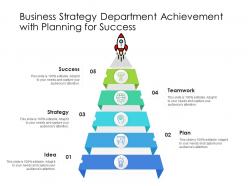
Business strategy department achievement with planning for success





Try Before you Buy Download Free Sample Product
 Impress Your
Audience
 100%
Editable
 Save Hours
of Time


Our Business Strategy Department Achievement With Planning For Success are topically designed to provide an attractive backdrop to any subject. Use them to look like a presentation pro.
People who downloaded this PowerPoint presentation also viewed the following :
Business strategy department achievement with planning for success with all 2 slides:
Use our Business Strategy Department Achievement With Planning For Success to effectively help you save your valuable time. They are readymade to fit into any presentation structure.

FAQs for Business strategy department achievement with
Key components include clear vision and mission statements, comprehensive market analysis, competitive positioning, strategic objectives with measurable goals, and robust implementation frameworks. These elements work together by aligning organizational resources, guiding decision-making processes, and establishing accountability measures, with many companies finding that integrated strategic planning ultimately delivers sustained competitive advantage and measurable growth outcomes.
Businesses align strategies with evolving market conditions through continuous market research, agile planning frameworks, customer feedback integration, and competitive intelligence systems. By implementing flexible operational models and data-driven decision making, organizations can pivot quickly when market shifts occur, ultimately maintaining competitive advantage and sustainable growth in dynamic environments.
Data analytics plays a pivotal role in shaping business strategies by providing actionable insights, identifying market trends, optimizing resource allocation, and predicting customer behaviors. Through advanced analytics tools, organizations across sectors like retail, healthcare, and financial services can enhance decision-making processes, minimize risks, and ultimately deliver competitive advantages while maximizing operational efficiency.
Organizations measure business strategy success through key performance indicators (KPIs), financial metrics like revenue growth and profit margins, customer satisfaction scores, market share analysis, and operational efficiency benchmarks. These measurement frameworks enable companies to track progress systematically, identify areas needing adjustment, and demonstrate tangible outcomes, with many finding that regular assessment cycles ultimately deliver competitive advantage and strategic clarity.
Company culture significantly influences strategic decision-making by shaping risk tolerance, communication patterns, leadership approaches, and employee engagement levels throughout the organization. Strong cultures enable faster consensus-building and implementation, while misaligned cultures can create resistance and delays, with many successful organizations finding that culture-strategy alignment ultimately delivers better execution, higher employee buy-in, and sustained competitive advantage.
Businesses leverage competitive analysis by monitoring competitor pricing, product features, market positioning, customer feedback, and strategic partnerships to identify gaps and opportunities. Through systematic competitor research, companies can refine their value propositions, adjust pricing strategies, and discover underserved market segments, ultimately delivering enhanced competitive advantage and more targeted customer experiences.
Common business strategy pitfalls include inadequate market research, unrealistic goal setting, poor resource allocation, insufficient competitor analysis, and lack of stakeholder alignment. These challenges often derail strategic initiatives by creating misaligned expectations, operational inefficiencies, and missed market opportunities, with many organizations finding that thorough planning and continuous evaluation ultimately deliver sustainable competitive advantage.
Customer feedback influences business strategy formulation by revealing market demands, identifying service gaps, and highlighting competitive opportunities that drive strategic pivots. Through systematic feedback analysis, organizations refine product offerings, enhance customer experiences, and optimize resource allocation, with many companies finding that customer-driven strategies deliver stronger market positioning and sustainable competitive advantages.
Best practices for communicating business strategy across teams include clear messaging frameworks, regular cascading sessions, visual documentation, interactive workshops, and consistent feedback loops. These approaches enhance alignment by translating high-level objectives into departmental goals, enabling cross-functional collaboration, and ensuring strategic clarity, with many organizations finding that structured communication ultimately delivers improved execution and measurable business outcomes.
Small businesses can develop competitive strategies in saturated markets by focusing on niche specialization, delivering exceptional customer service, leveraging digital marketing for targeted reach, and building strategic partnerships with complementary businesses. These approaches enable smaller companies to differentiate themselves through personalized experiences, agile decision-making, and innovative solutions, ultimately creating sustainable competitive advantages against larger competitors.
Innovation serves as the cornerstone of sustainable business strategy, enabling companies to adapt to market changes, develop new revenue streams, and maintain competitive differentiation. Through continuous product development, process optimization, and strategic technology adoption, organizations like Apple, Amazon, and Tesla consistently outperform competitors while building lasting market leadership and customer loyalty.
Businesses can incorporate sustainability into strategic planning by integrating environmental goals with financial objectives, conducting lifecycle assessments, setting measurable targets, and engaging stakeholders throughout decision-making processes. Companies in manufacturing, retail, and financial services are finding that sustainable practices reduce operational costs, enhance brand reputation, and deliver competitive advantages while meeting increasingly conscious consumer expectations.
Companies can adopt diversification strategies, scenario planning, robust financial controls, stakeholder engagement protocols, and comprehensive insurance frameworks to manage risk effectively. These approaches streamline operations by identifying potential threats early, allocating resources strategically, and building resilient systems, with many organizations finding that proactive risk management ultimately delivers competitive advantage and sustained growth.
Global market trends significantly influence local business strategy development by shaping consumer expectations, competitive landscapes, technological requirements, and regulatory environments that businesses must navigate. Companies increasingly adapt their local strategies to align with global shifts like digitalization, sustainability demands, and changing demographics, with retailers, financial services, and manufacturing finding that integrating these trends enhances competitive positioning and operational resilience.
Agile business strategy offers enhanced adaptability to market changes, faster decision-making processes, improved customer responsiveness, reduced project risks, and increased innovation capabilities. These approaches streamline operations by encouraging iterative planning, cross-functional collaboration, and rapid feedback incorporation, with many organizations finding that agile methodologies deliver competitive advantages and accelerated growth in increasingly dynamic markets.
-
Unique research projects to present in meeting.
-
Easily Editable.