

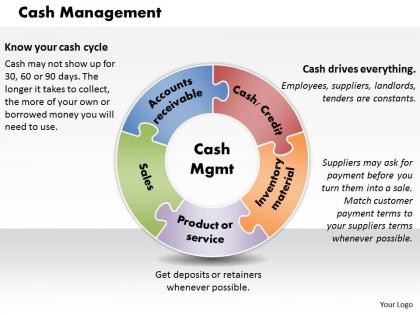
Cash management powerpoint presentation slide template




Try Before you Buy Download Free Sample Product
 Impress Your
 Audience
 100%
100% Editable
 Save Hours
 of Time


Our Cash Management Powerpoint Presentation Slide Template will do your bidding. Your thoughts will command respect.
People who downloaded this PowerPoint presentation also viewed the following :
Cash management powerpoint presentation slide template with all 5 slides:
Presentations should highlight your great ideas. Let our Cash Management Powerpoint Presentation Slide Template highlight your presentations.



FAQs for Cash management powerpoint
Honestly, cash forecasting is everything - start with a 13-week rolling forecast so you can actually see what's coming. Track your inflows and outflows religiously, but also get those credit lines set up way before you think you'll need them (learned that one the hard way). Your working capital cycle matters more than most people realize. Speed up collections where you can, maybe slow down payments a bit if vendors are cool with it. Keep some emergency cash around, but don't go crazy sitting on piles of money earning nothing. Oh, and definitely nail down policies for what to do with excess cash - you'd be surprised how quickly that becomes a real problem to have.
Ditch the manual spreadsheets first - they're error magnets. Get your bank accounts, invoicing, and payment platforms feeding data automatically. Rolling 13-week forecasts work best in my experience, good balance of accuracy without getting too speculative. Break your cash flows into buckets: definite, probable, and possible. Makes scenario planning way easier. Update weekly, not monthly - cash moves too fast these days. Oh, and set alerts when you're getting close to your minimum cash levels. Being caught off-guard with cash flow is the worst feeling ever.
Dude, cash management is completely different now with all the tech stuff. Real-time visibility across accounts, automated forecasting that doesn't suck, APIs linking everything together. Manual cash management? That's like using a calculator when you've got Excel. The AI analytics are actually pretty solid for predicting cash flows - way better than those messy spreadsheets we used to rely on. Digital payments move money instantly too, which is clutch. Oh and if you haven't automated your daily cash positioning yet, start there. That'll give you the biggest bang for your buck right away.
So basically you want different buckets for different timelines. Keep 3-6 months of expenses in super liquid stuff - money market, short CDs, whatever. Then spread the rest across longer terms, maybe 6-12 months and beyond. Match your timeline to when you'll actually need the cash, you know? I swear half the companies I see totally botch this - they either chase returns and can't access money when they need it, or they're way too conservative. Set up quarterly check-ins to rebalance based on your real cash patterns. It's honestly not rocket science but somehow everyone overthinks it.
Honestly, you gotta get way more aggressive about this stuff. Send those invoices the second you finish work - don't wait around. I'd push for 15-day payment terms if possible, though 30 is still workable. Most people just need a nudge when they're late, so follow up consistently. Maybe throw in a 2% discount for paying within 10 days? That usually works. The real trick is checking your aging reports every week and actually picking up the phone when someone hits 30+ days overdue. I know calling feels awkward, but it's surprisingly effective.
Honestly, small businesses are just trying to survive week to week - literally watching every dollar to make sure bills get paid. Big corporations? They've got whole teams doing fancy forecasting and managing money across different countries. It's wild how different it is. For us little guys, cash management is basically personal budgeting but way more stressful. We're tracking everything coming in and going out, while Fortune 500s are making millions in interest and hedging risks I don't even understand. Start with simple cash flow forecasting and save up a buffer. That'll put you ahead of most small businesses already.
Honestly, economic ups and downs mess with your cash planning big time. You need way more cushion during rough patches - revenue gets sketchy and banks tighten up (2020 was brutal for this). But when things are good? You can take more risks with investments since cash flows easier. The trick is staying flexible with your forecasting so you can pivot fast. I'd probably start by stress-testing what you've got now against different scenarios - like what happens if sales drop 30% or whatever. Building that safety net based on economic signals is clutch.
Honestly, cash management is everything when stuff hits the fan. Gives you options while everyone else is scrambling. You can cover weird expenses that pop up, keep things running when sales tank, and skip those brutal emergency loans. I've watched solid companies with decent products just... die because they couldn't pay bills at the worst possible moment. Track your cash weekly (not monthly - that's way too slow). Build up 3-6 months of expenses as a buffer. Oh, and forecasting helps you see problems coming instead of getting blindsided by them.
Start with your cash conversion cycle - basically how long it takes to turn inventory into actual cash in your bank. Current ratio and quick ratio are clutch too since they show if you can handle short-term bills. Days sales outstanding tracks customer payment speed (fair warning: this metric can be brutal if you've got slow payers). Cash flow forecast accuracy matters - compare what you thought would happen vs reality. Honestly though? Pick 2-3 of these max. Trying to track everything right away just makes your head spin.
Honestly, just automate whatever you can - cash recyclers, deposit machines, stuff that cuts down on manual counting. Keep smart limits too so you're not sitting on dead money. Security used to cost a fortune but now digital tracking and dual-control access is actually cheaper than old school methods, which is kinda wild. I'd start by figuring out where you're wasting the most time on manual handling. Then tackle those areas first instead of trying to fix everything at once.
Dude, these systems are seriously worth it. Real-time reporting lets you catch problems early instead of scrambling later. Your team stops wasting hours on data entry and reconciliations - month-end close becomes so much smoother. The forecasting features help optimize your cash position too. Honestly, the visibility alone is huge for making quick decisions. Your people can actually do strategic work instead of shuffling spreadsheets all day (which they'll thank you for). I'd map out what manual stuff you're doing now first. That way you know exactly where you'll save the most time.
Honestly, cross-border stuff is such a pain because exchange rates can just wreck your margins out of nowhere. Settlement takes forever too, which makes cash flow planning a nightmare. And don't even get me started on banking fees - correspondent banks basically rob you blind. What's worked for me is getting serious about FX hedging early on. Opening local accounts in your biggest markets helps cut down transfer costs too. I'd map out where you're bleeding the most money first - usually it's either fees or currency swings doing the damage.
So here's the deal with inventory - it literally eats your cash until you sell it. Too much stock? Your money's just sitting there collecting dust while you're trying to pay bills. Super annoying honestly. But go too lean and you'll miss out on sales when customers actually want to buy. You gotta find that middle ground where you have enough to cover demand but aren't drowning in product. Oh, and definitely track your turnover ratio - shows you how fast you're actually moving stuff and turning it back into cash.
Honestly, good cash management is like finding free money. Track your receivables and payables better so you're not paying unnecessary interest or overdraft fees. Weekly cash flow forecasting instead of monthly? Game changer - you'll spot so many opportunities you missed before. Early payment discounts from suppliers, faster customer payments, better timing on everything. It adds up fast. The visibility thing is huge too - suddenly you can see where money's sitting around doing nothing when it could be working for you. Even small improvements compound over time, which is pretty cool when you think about it.
Focus on three main things: basic accounting principles, your specific cash procedures, and fraud prevention. Cash flow forecasting and reconciliation processes are fundamental - you'd be surprised how many people mess up the basics. Train them on whatever software you're using plus your approval workflows. Fraud training is huge since cash makes such an easy target. Honestly, I'd set up quarterly refreshers because people forget this stuff fast. Industry webinars help too. Oh, and create reference guides they'll actually keep at their desks instead of filing away somewhere.
-
Design layout is very impressive.
-
Much better than the original! Thanks for the quick turnaround.