


CIO IT Strategic Plan Framework




Try Before you Buy Download Free Sample Product
 Impress Your
 Audience
 100%
100% Editable
 Save Hours
 of Time


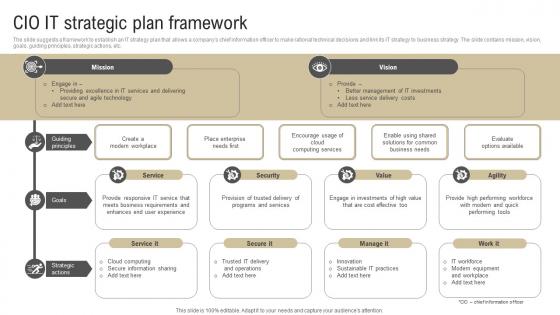
The slide suggests a framework to establish an IT strategy plan that allows a companys chief information officer to make rational technical decisions and link its IT strategy to business strategy. The slide contains mission, vision, goals, guiding principles, strategic actions, etc.
People who downloaded this PowerPoint presentation also viewed the following :
CIO IT Strategic Plan Framework with all 9 slides:
Use our CIO IT Strategic Plan Framework to effectively help you save your valuable time. They are readymade to fit into any presentation structure.








FAQs for CIO IT
Okay so you need five main things for a solid IT strategic plan. First, make sure your tech goals actually match what the business wants to achieve. Then do a honest assessment of your current tech situation - like, what's actually working and what's a mess. Build out your future vision with concrete outcomes, not just fluffy buzzwords. The roadmap piece is probably the most critical because it turns those massive projects into bite-sized chunks with real timelines. Don't skip the governance structure either - someone needs to make decisions when things get hairy. Honestly though, getting stakeholder buy-in is like 80% of the work. Without regular check-ins and metrics, your plan just collects dust.
Dude, you've gotta dig deeper than the obvious stuff they tell you. Sit down with the department heads regularly and figure out what's actually keeping them up at night. Their strategy IS your strategy - just tech-flavored. Don't get trapped thinking IT exists in some bubble. Set up KPIs that tie your projects directly to things like revenue or customer happiness. Oh, and here's the big one - when you update people on progress, talk money and results, not servers and code. Nobody cares about your infrastructure upgrades if they can't see how it helps them win.
Dude, you absolutely have to talk to people before writing that plan. Business leaders, actual users, department heads - get their input early or you're screwed. I've watched so many IT strategies crash and burn because someone thought they could figure it out alone in their office. Map out your key stakeholders first, then do discovery sessions and workshops. Surveys work too, honestly whatever gets people talking. The whole point is aligning your tech spending with what the business actually needs (not what you think they need). Trust me, getting buy-in upfront saves you massive headaches later.
Pick KPIs that actually connect to business results - revenue, cost savings, customer satisfaction, that kind of stuff. You'll need both the quick wins (project milestones, staying on budget) and the bigger picture stuff (uptime, how many people are actually using the system). Honestly, your first dashboard is gonna look like a hot mess. That's totally normal though. Focus on what your stakeholders care about, not just the fancy IT metrics that make us feel smart. I'd start with maybe 5-7 things you can realistically track each month - you can always add more later. The real trick? Make sure everything tells a clear story that the non-tech executives can actually understand and do something with.
Honestly, I'd go with AI/ML automation first - that's where you'll see real impact. Cloud-native infrastructure and cybersecurity mesh are your other big ones. Edge computing's blowing up too if you're doing IoT stuff. Look, everyone's obsessed with generative AI right now, but half these companies are just throwing money at shiny objects. Make sure it actually fixes something broken. Zero-trust security isn't optional anymore, and API-first development will save you headaches later. Oh, and audit your current setup first - I learned that the hard way. Map everything to actual problems instead of implementing random tech.
Don't treat risk assessment like some boring checkbox at the end - weave it into every step of your IT planning. Figure out what could tank each initiative first: cyber attacks, blown budgets, tech going obsolete, whatever. Score them by how likely they are and how bad the damage would be. I swear, I've watched so many solid plans completely fall apart because teams just assumed everything would go smoothly. Build backup plans from day one and schedule regular check-ins. Oh, and make sure someone actually owns each risk - otherwise it just becomes everyone's problem, which means nobody's problem.
Build flexibility into your planning from the start - seriously, this will save your sanity later. Modular architectures let you swap pieces without starting over. Go with shorter planning cycles too, like quarterly check-ins instead of those brutal year-long plans. Cloud strategies are clutch because you can scale fast when things change. I've watched so many companies waste money on rigid 5-year plans that became useless overnight. Always pad your budget and timeline for surprises. Oh, and treat your IT plan like it's alive - it should grow with your business, not fight against it.
Look, data analytics basically replaces guessing with actual facts when you're planning IT stuff. You can see how your current systems are performing and figure out what you'll need down the road. Track which tech investments are worth it vs. total money pits - honestly this part alone saves so much headache. Set up some dashboards that pull everything automatically so you're not scrambling when your boss suddenly wants numbers. Oh, and you can compare your metrics against industry benchmarks to see if you're actually improving or just spinning wheels. Game changer once you get it running.
Honestly, start with making sure people aren't scared to mess up - that's like innovation killer
-
The content is very helpful from business point of view.
-
“Love it! I was able to grab an exciting proposal because of SlideTeam.”