

Company net promoter score survey analysis ppt slide





Try Before you Buy Download Free Sample Product
 Impress Your
 Audience
 100%
100% Editable
 Save Hours
 of Time


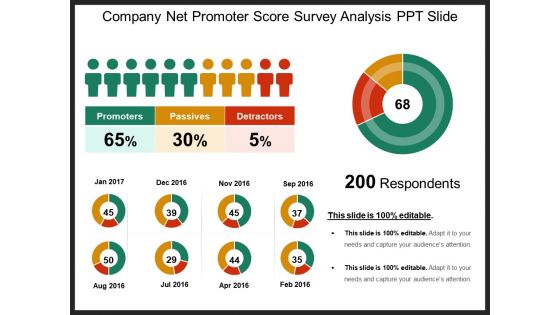
Choose this company net promoter score survey analysis PPT slide Powerpoint presentation which can be used as a management tool by the user to gauge the loyalty of a firm's customer relationships and serve as an alternative to traditional customer satisfaction research. Put on this NPS survey structure research PowerPoint shape which has been designed in such a manner so that the same can be correlated with revenue growth and to measure the loyalty that exists between a provider and a consumer. Select the net promoter score benchmarks survey PowerPoint presentation which works as a gauge of customer satisfaction and loyalty and can be used to measure the willingness of your customers to recommend your company, product or services to others based on their experience. The usage of the template will help you to collect in-depth customer insights and to identify the exact customers who are more likely to offer actionable feedback. The framework of the slideshow make your customer success team can reach out and do their best to convert these customers into brand advocates. Get your brains brimming with excitement due to our Company Net Promoter Score Survey Analysis Ppt Slide. It generates an invasion of ideas.
People who downloaded this PowerPoint presentation also viewed the following :
Company net promoter score survey analysis ppt slide with all 5 slides:
Educate them on your dissertation. Highlight the critical aspects of your work.
FAQs for Company net promoter score survey
So NPS is this customer loyalty thing where you ask people "How likely are you to recommend us?" on a 0-10 scale. Pretty basic stuff. Anyone who gives 9-10 is a "Promoter," 7-8 are "Passives," and 0-6 are "Detractors." Here's where it gets interesting - you calculate your score by taking Promoter percentage minus Detractor percentage. The Passives? They just sit there doing nothing in the calculation, which honestly makes zero sense to me. Your final score lands somewhere between -100 and +100. I'd track it monthly so you can actually see what's happening with your customers over time.
Keep those NPS surveys super short - just the 0-10 recommendation question plus a quick "why" follow-up. Send them right after key moments like purchases or support calls when everything's still fresh. Don't spam everyone at once though, that's annoying as hell. Space them out and segment your list properly. The timing really makes or breaks these things, honestly. Oh and here's the big one - actually do something with the feedback you get. Customers can tell when you're just collecting responses versus when you're genuinely listening and making changes based on what they say.
NPS beats regular satisfaction surveys because it actually predicts what people will do, not just how they felt. Someone might rate their experience a 7/10 but still tell their friends to avoid you - that's the difference. It's just one simple question so tracking trends is way easier. I've seen companies get obsessed with complex metrics that nobody understands, but NPS? Your whole team gets it immediately. The score moves with your revenue too, which is honestly pretty satisfying to watch. Start checking it monthly and you'll see patterns you missed before.
So NPS is all about loyalty - like would customers actually recommend you to friends? CSAT just measures if someone's happy with one specific thing that happened. CES is different though, it's asking how much effort something took on their end. Honestly, I think of it like this: "how happy were you?" vs "how hard was that?" vs "would you tell others about us?" You'll want all three but for different reasons. Use NPS maybe quarterly to see the bigger loyalty picture. The other two? Perfect for fixing stuff that's broken in real-time.
Don't just stare at that overall NPS number - it's pretty useless on its own. Break it down by customer segments, products, whatever makes sense for your business. The real gold is in comments from detractors and passives. Promoters will just tell you everything's great (which, yeah, feels good but doesn't help much). Look for patterns in the negative feedback and pick your top 2-3 issues to actually tackle. Oh, and definitely follow up with people who took time to write detailed responses - shows you're not just collecting data for fun and sometimes flips unhappy customers around.
Honestly, just Google "[your industry] NPS benchmark 2024" first - you'd be surprised how much free data is out there. Compare yours to industry averages since what's good for banks would suck for tech companies. NPS varies like crazy by sector. Bain & Company has this database, plus there's tons of research reports floating around. But here's the thing - don't get too hung up on one score. Track it over time instead. Your improvement trend matters way more than hitting some random number. I spent way too long obsessing over benchmarks when I should've just focused on month-to-month progress.
Honestly, it's all about actually wowing people instead of just checking boxes. Survey regularly and act on what you hear - especially the harsh feedback (that's where the gold is). Train your team to solve problems on the spot, don't make customers jump through hoops. Oh, and here's something most people miss: reach out to your detractors directly. Fix their issues and half the time they'll flip to being your biggest fans. Focus on the whole journey, not just one moment. Exceed expectations consistently - sounds obvious but most companies still suck at this basic thing.
Yeah, so NPS scores can swing wildly based on demographics - we're talking 20-30 point differences sometimes. Older customers usually rate way higher than younger ones, who honestly just seem more critical about everything these days. Income and education matter too, plus where people live. Don't just look at your overall NPS though - that's pretty useless. Break it down by different groups so you can actually see what's happening. Maybe millennials hate your app interface or something. Geographic stuff gets weird too - I've seen West Coast vs East Coast customers rate the exact same service totally differently.
NPS is like having a crystal ball for churn - it tells you who's about to bail before they actually do. Those detractors (0-6 scores) are your red flags. Reach out fast and fix whatever's bugging them. Your promoters though? Pure gold. They'll stick around forever and drag their friends along too. Here's the thing - most companies just collect the scores and do nothing with them, which is insane. Set up something where you're hitting up detractors within a day or two max. Trust me, your retention numbers will thank you for it.
Look, you can't just track NPS in a vacuum - it's pretty useless that way. Connect it to stuff that actually moves the needle, like how much revenue you're keeping or what customers are worth over time. Say you notice high-value clients giving you terrible scores before they bail - that's your wake-up call right there. I'd set targets around the segments that matter most to your business, maybe cutting detractor rates by 15% or whatever makes sense. The whole point is making those survey responses mean something you can actually act on. Otherwise you're just collecting numbers that look nice in presentations but don't help anyone.
Don't get stuck staring at just the NPS number - that's like judging a movie by its Rotten Tomatoes score without reading any reviews. Break it down by customer segments, products, whatever makes sense for your business. That's where you'll actually find useful stuff. Oh, and resist the urge to cherry-pick good months when reporting (guilty as charged). Most importantly though? Talk to your detractors. I know it's painful, but their feedback is worth its weight in gold. Your score could be improving while you're still missing major issues. The comments section is honestly more valuable than the number itself.
Honestly, NPS feedback is basically free user research if you dig into the comments. Detractors will straight-up tell you what's broken - boom, there's your bug priority list. Promoters show you what's working, so don't mess with those features. The passives are actually clutch because they're right on the edge and usually give really specific ideas for improvement. What I'd do is group all the feedback by common themes, then tie those directly to your roadmap. It's way better than guessing what users want. Plus the "why" behind each score is where the real gold is - not just the number itself.
Timing is everything - hit them right after they interact with your business while it's still fresh. Mobile-friendly surveys are a must since nobody checks email on desktop anymore, honestly. Throw in some small incentives too - maybe a discount or contest entry. People eat that stuff up. Your subject line can't be boring corporate garbage either, make it personal. Oh, and here's the big one everyone screws up: actually respond to the feedback you get. Customers will keep participating if they see you're listening and making changes. It's like relationship building but for surveys.
Honestly, treat each group totally differently. Promoters are gold - keep them happy and get testimonials from them. They'll do your marketing for free. Passives are where the real opportunity is though, since they're sitting on the fence. Figure out what's missing for them and you could easily win them over. Detractors? Act fast. Reach out personally, fix their problems before they start trashing you online. The biggest mistake people make is collecting all these scores and then... doing nothing with them. Follow-up is everything.
Yeah, NPS totally works in B2B! Maybe even better than B2C honestly since your relationships are way more valuable. Focus on the people who actually make decisions and use your product daily - not just random contacts in their system. But here's the thing: B2B is messy, so that score alone won't tell you much. You need to dig into WHY someone gave you a 6 instead of a 9. Ask follow-ups about renewals, expansion plans, whatever. Break it down by account size and industry too. Those patterns will actually show you what's working and what isn't.
-
Unique and attractive product design.
-
Editable templates with innovative design and color combination.