

Competitive Landscape Analysis Market Share And Customer Launching Retail Company




Try Before you Buy Download Free Sample Product
 Impress Your
 Audience
 100%
100% Editable
 Save Hours
 of Time


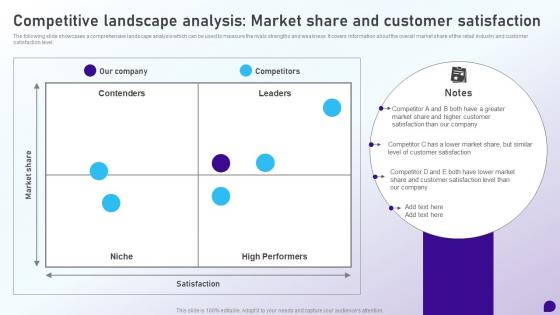
The following slide showcases a comprehensive landscape analysis which can be used to measure the rivals strengths and weakness. It covers information about the overall market share of the retail industry and customer satisfaction level.
People who downloaded this PowerPoint presentation also viewed the following :
Competitive Landscape Analysis Market Share And Customer Launching Retail Company with all 6 slides:
Use our Competitive Landscape Analysis Market Share And Customer Launching Retail Company to effectively help you save your valuable time. They are readymade to fit into any presentation structure.





FAQs for Competitive Landscape Analysis Market Share And Customer
Key factors include market share distribution, competitor pricing strategies, product differentiation levels, customer acquisition methods, and technological capabilities within the industry. These elements enable organizations to identify strategic opportunities, competitive gaps, and positioning advantages, with many companies finding that comprehensive landscape analysis ultimately delivers better market positioning, informed strategic decisions, and sustainable competitive advantage.
SWOT analysis enhances competitive landscape analysis by systematically evaluating internal strengths and weaknesses against external market opportunities and threats for each competitor. This strategic combination enables organizations to identify competitive gaps, anticipate market shifts, and develop targeted responses, with many businesses finding that integrated SWOT assessments deliver clearer positioning strategies and sustainable competitive advantages.
Market share serves as a critical metric for assessing competitive positioning, revealing market leaders, emerging challengers, relative company performance, and growth opportunities within specific sectors. Through market share analysis, organizations can identify strategic gaps, benchmark against competitors, and develop targeted approaches to capture additional market segments, ultimately enabling data-driven decisions that enhance competitive advantage.
Emerging technologies disrupt competitive landscapes by enabling new business models, automating traditional processes, and creating direct-to-consumer channels that bypass established intermediaries. Companies leveraging AI, blockchain, or IoT can deliver faster services, reduce operational costs, and enhance customer experiences, while traditional players struggle to adapt, ultimately reshuffling market leadership and competitive advantages.
**INPUT**: What metrics are most effective in evaluating competitor performance? **OUTPUT**: Effective competitor performance metrics include market share, revenue growth, customer acquisition costs, pricing strategies, and digital engagement rates across platforms. These indicators enable organizations to benchmark operational efficiency, identify strategic gaps, and uncover market opportunities, with many businesses finding that combining financial metrics with customer sentiment data ultimately delivers comprehensive competitive intelligence and actionable strategic insights. **Word count: 59 words**
Competitive landscape analysis informs startup strategic planning by revealing market gaps, identifying differentiation opportunities, and understanding competitor pricing strategies, funding patterns, and customer acquisition approaches. Through comprehensive competitor mapping, startups can position their offerings strategically, avoid saturated market segments, and develop unique value propositions that capitalize on underserved niches, ultimately enabling more informed resource allocation and accelerated market entry.
Leading competitive analysis tools include SEMrush, Ahrefs, SimilarWeb, Buzzsumo, and Brandwatch, along with social listening platforms like Hootsuite Insights and Sprout Social. These technologies streamline market intelligence by tracking competitor keywords, analyzing traffic patterns, and monitoring brand mentions, with many organizations finding that combining multiple tools delivers comprehensive insights, ultimately enabling faster strategic decisions and sustainable competitive advantage.
Consumer behavior trends significantly reshape competitive landscapes by altering demand patterns, channel preferences, purchasing criteria, and service expectations across industries. Companies that quickly adapt to emerging behaviors, such as increased digital engagement in retail or sustainability preferences in manufacturing, gain substantial market advantages while slower competitors lose relevance, ultimately forcing industry-wide strategic pivots.
**INPUT**: What information sources are crucial for conducting accurate competitive intelligence? **OUTPUT**: Crucial competitive intelligence sources include public financial reports, industry publications, customer reviews, social media monitoring, patent databases, and regulatory filings. These sources enable organizations to track competitor strategies, market positioning, and performance metrics across sectors like retail, technology, and financial services, ultimately delivering strategic insights that enhance decision-making and competitive advantage. [Word count: 55 words]
Companies should reassess their competitive landscape quarterly for comprehensive reviews, with monthly monitoring of key competitors and real-time tracking of major market shifts. In rapidly evolving sectors like technology and retail, more frequent assessments enable organizations to identify emerging threats, capitalize on competitor weaknesses, and adjust strategic positioning, ultimately maintaining competitive advantage through proactive market intelligence.
Businesses can differentiate through innovative product features, superior customer service, strategic pricing models, unique brand positioning, and specialized market niches. These approaches enable companies to stand out by delivering exceptional value propositions, building stronger customer relationships, and creating competitive advantages, with many organizations finding that combining multiple differentiation strategies yields the most sustainable market success.
Global economic changes influence local competitive landscapes by shifting consumer spending patterns, altering supply chain costs, and creating new market entry opportunities for international competitors. Through currency fluctuations and trade policy adjustments, local businesses must adapt pricing strategies, operational efficiency, and service delivery models, with many finding that economic volatility ultimately rewards the most agile and strategically positioned organizations.
Ethical competitive analysis involves respecting intellectual property rights, avoiding deceptive information gathering, maintaining data privacy compliance, and focusing on publicly available information rather than industrial espionage. Organizations should establish clear guidelines that balance competitive intelligence needs with legal boundaries, ensuring their research methods enhance strategic decision-making while preserving industry relationships and regulatory compliance.
Competitive landscape insights guide product development by identifying market gaps, revealing customer pain points competitors miss, and highlighting emerging technology trends shaping industry direction. These insights enable organizations to prioritize features that differentiate their offerings, accelerate time-to-market through strategic positioning, and develop innovative solutions that address unmet needs, ultimately delivering competitive advantage and stronger market positioning.
Regulatory changes reshape competitive dynamics by creating new barriers to entry, altering cost structures, and redefining operational requirements across industries. These shifts often favor established players with compliance resources while creating opportunities for innovative firms, with sectors like financial services, healthcare, and energy frequently finding that regulatory evolution drives market consolidation and strategic repositioning.
-
“You have the structure in place that are easy to explore new opportunities.I will be recommending your services to other people.”
-
SlideTeam was so customer-centric and quick service-provider that I doubted the amount I was paying and literally re-checked the transaction.