


Consolidated Profit And Loss Financial Statement




Try Before you Buy Download Free Sample Product
 Impress Your
 Audience
 100%
100% Editable
 Save Hours
 of Time


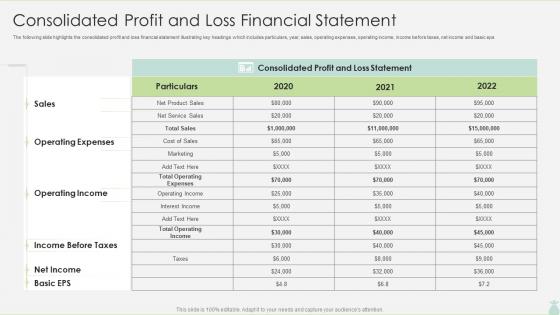
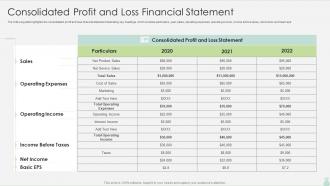
The following slide highlights the consolidated profit and loss financial statement illustrating key headings which includes particulars, year, sales, operating expenses, operating income, income before taxes, net income and basic eps.
People who downloaded this PowerPoint presentation also viewed the following :
Consolidated Profit And Loss Financial Statement with all 6 slides:
Use our Consolidated Profit And Loss Financial Statement to effectively help you save your valuable time. They are readymade to fit into any presentation structure.





FAQs for Consolidated Profit And
The primary purpose of a consolidated P&L statement is to present the combined financial performance of a parent company and its subsidiaries as a single economic entity, eliminating intercompany transactions and providing stakeholders with comprehensive revenue, expense, and profitability insights. This strategic financial tool enables investors, creditors, and management to assess overall group performance, make informed decisions about resource allocation, and ultimately deliver enhanced transparency and accountability across complex organizational structures.
A consolidated P&L statement combines financial results from a parent company and all its subsidiaries into one comprehensive report, while an individual P&L shows only one company's performance. Consolidated statements eliminate intercompany transactions, provide investors with complete group performance visibility, and enable better strategic decision-making, with many multinational corporations finding that consolidated reporting delivers enhanced transparency and regulatory compliance across diverse business operations.
A consolidated P&L statement includes revenue from all subsidiaries, cost of goods sold, operating expenses, depreciation, interest expenses, and taxes across the entire corporate group. These components enable organizations to assess overall profitability, identify cross-subsidiary synergies, and streamline financial reporting, with many multinational corporations finding that consolidated statements deliver enhanced transparency and strategic oversight for stakeholders.
Businesses eliminate intercompany transactions in consolidated P&L statements by removing all internal revenue, expenses, and profits between subsidiary entities to prevent double-counting. This involves adjusting sales transactions, management fees, and interest payments between related companies, while ensuring accurate elimination entries maintain proper accounting controls, ultimately delivering transparent financial reporting that reflects true external business performance.
Consolidated P&L preparation faces challenges including intercompany transaction elimination, currency translation differences, varying accounting standards across subsidiaries, complex revenue recognition timing, and consolidation adjustment errors. These complications can significantly delay financial reporting cycles and impact accuracy, with many multinational corporations finding that standardized systems and automated reconciliation processes ultimately streamline consolidation while ensuring regulatory compliance.
Consolidated P&L statements provide investors with comprehensive financial performance across all subsidiaries, enabling accurate assessment of total revenue streams, cost structures, and profitability patterns. Through consolidated reporting, investors can evaluate true operational efficiency, identify cross-business synergies, and make informed decisions about portfolio allocation, with many finding that this complete picture delivers superior investment insights and strategic advantage.
Accounting standards like IFRS and GAAP provide essential frameworks for consolidated P&L preparation, ensuring consistent revenue recognition, expense classification, intercompany elimination procedures, and subsidiary integration methods. These standards enable organizations to deliver transparent, comparable financial reporting across jurisdictions, with multinational corporations finding that standardized consolidation processes streamline audits, enhance investor confidence, and ultimately support strategic decision-making in increasingly complex business environments.
A consolidated P&L statement significantly influences financial strategy by revealing cross-subsidiary performance patterns, identifying underperforming divisions, and highlighting strategic investment opportunities across the entire organization. This comprehensive view enables executives to reallocate resources more effectively, streamline operations between entities, and make informed decisions about acquisitions or divestitures, ultimately delivering enhanced operational efficiency and competitive advantage.
Common misconceptions about consolidated P&L statements include believing they show individual subsidiary performance, that intercompany transactions appear separately, that minority interests represent actual ownership costs, and that consolidated figures simply add all subsidiary revenues together. These misunderstandings often lead organizations to misinterpret financial health and operational efficiency, with many finance teams finding that proper consolidation training significantly enhances strategic decision-making and investor communication.
Currency fluctuations impact multinational companies' consolidated P&L statements through translation adjustments when converting foreign subsidiary results, transactional gains or losses from cross-border operations, and hedging costs or benefits. These currency movements can significantly affect reported revenues, expenses, and net income, with many global corporations finding that foreign exchange volatility creates both earnings risks and strategic opportunities for competitive positioning.
Companies typically present non-consolidated P&L statements when showcasing parent company standalone performance, meeting regulatory requirements for specific entities, or providing transparency during acquisitions and divestitures. This approach enables stakeholders to evaluate individual entity profitability, assess parent company operational efficiency separate from subsidiaries, and analyze specific business unit contributions, with many investors finding that non-consolidated statements deliver clearer insights into core business performance.
Changes in ownership stakes significantly impact consolidation by altering control levels, requiring adjustments to subsidiary income recognition, goodwill calculations, and non-controlling interest allocations. When ownership increases or decreases, companies must recalculate proportionate consolidation percentages, reassess acquisition accounting, and adjust equity method applications, ultimately affecting reported revenues, expenses, and subsidiary valuations across consolidated financial statements.
**INPUT**: What software tools can assist in the preparation of consolidated P&L statements? **OUTPUT**: Software tools for consolidated P&L preparation include SAP S/4HANA, Oracle Hyperion, IBM Cognos, Microsoft Dynamics 365, and Workiva. These platforms streamline financial consolidation by automating currency translations, eliminating intercompany transactions, and ensuring regulatory compliance, with many multinational corporations finding that integrated solutions significantly reduce month-end closing times while enhancing accuracy. **Word count: 54 words**
EBITDA in a consolidated P&L statement is calculated by taking net income and adding back interest, taxes, depreciation, and amortization across all subsidiary entities. This metric provides investors and stakeholders with a clearer view of operational performance by eliminating financing decisions and accounting methods, enabling more accurate cross-company comparisons and acquisition valuations in complex organizational structures.
Investors should examine revenue growth patterns, margin stability, expense ratios, and earnings consistency when analyzing consolidated P&L statements across periods. These trends reveal operational efficiency, market positioning, and financial discipline, with many investors finding that companies demonstrating steady margin improvement and controlled expense growth often deliver superior long-term performance and competitive advantage.
-
The slides are remarkable with creative designs and interesting information. I am pleased to see how functional and adaptive the design is. Would highly recommend this purchase!
-
The visual appeal of the templates is just unparalleled! I was so worried about the design of my presentation but SlideTeam made it all so easy.