

Consolidation Of Companies Powerpoint Presentation Slides





Try Before you Buy Download Free Sample Product
 Impress Your
Audience
 100%
Editable
 Save Hours
of Time


Showcase the process of business amalgamation with the Consolidation of Companies PowerPoint Presentation Slides PPT. Take the assistance of this professionally designed amalgamation of companies PPT templates to show the steps of M & A like understating business, determination of market/services, etc. Use our content ready business mergers PPT slideshow to reveal inorganic opportunities like a horizontal merger, vertical merger, product extension amongst others. Identify the targets of your company and portray financial data through statements such as cash flow statements and balance sheets. Illustrate the M&A synergy framework and show company valuation methodologies like asset-based method, income-based method, market-based method, etc. Unveil the challenges that may arise post mergers like inadequate integration, data amalgamation, investment community, compliance & regulation, etc. using the mergers & acquisitions PPT graphics. Present the business regulations that should be followed by organizations. Thus download our visually appealing business acquisitions PowerPoint complete deck to develop M & A strategy.
People who downloaded this PowerPoint presentation also viewed the following :
Content of this Powerpoint Presentation
Slide 1: This slide introduces Consolidation of Companies. State your Company name and begin.
Slide 2: This slide showcases M&A – Key Steps.
Slide 3: This slide showcases Company Overview.
Slide 4: This slide showcases Business & Financial Overview.
Slide 5: This slide depicts Requirement for Inorganic Opportunity.
Slide 6: This slide discusses about Determining New Growth Market/Services.
Slide 7: This slide showcases Types of Inorganic Opportunities.
Slide 8: This slide showcases Types of Inorganic Opportunities with- Horizontal, Merger, Market, Extension Merger, Conglomerate, Product, Extension Merger, Acquisition, Vertical, Merger.
Slide 9: This slide showcasing Setting the M&A Criteria.
Slide 10: This slide describes Identifying Targets.
Slide 11: This slide showcases Balance Sheet - KPIs in Tabular Form.
Slide 12: This slide displays Balance Sheet - KPIs in Tabular Form. Details of the shortlisted Target Company will be entered here.
Slide 13: This slide showcases Cash Flow Statement - KPIs.
Slide 14: This slide displays Cash Flow Statement - KPIs in Tabular Form.
Slide 15: This slide showcases Financial Projections – P&L.
Slide 16: This slide displays Financial Projections – P&L.
Slide 17: This slide showcases Key Financial Ratios.
Slide 18: This slide showcases Key Financial Ratios with- Liquidity Ratio, Profitability Ratio, Activity Ratio, Solvency Ratio.
Slide 19: This slide describes Liquidity Ratios with- Current Ratio, Quick Ratio.
Slide 20: This slide showcases Profitability Ratios with- Net Profit Ratio, Gross Profit Ratio.
Slide 21: This slide showcases Profitability Ratios. Details of the shortlisted Target Company will be entered here.
Slide 22: This slide also showcases Profitability Ratios. Details of the shortlisted Target Company will be entered here.
Slide 23: This slide showcases Activity Ratios with- Inventory Turnover, Receivables Turnover.
Slide 24: This slide showcases Activity Ratios with- Total Asset Turnover.
Slide 25: This slide showcases Solvency Ratios containing- Debt-Equity Ratio, TIE Ratio.
Slide 26: This slide showcases M&A Synergy Framework.
Slide 27: This slide depicts Company Valuation Methodologies.
Slide 28: This slide displays Discounted Free Cash Flow (DCF) Technique – Data Set.
Slide 29: This slide depicts Determining Free Cash Flow.
Slide 30: This slide showcases Valuation Results.
Slide 31: This slide showcases Relative Valuation.
Slide 32: This slide presents Business Due-Diligence Process.
Slide 33: This slide showcases Strategic Due-Diligence Methodology.
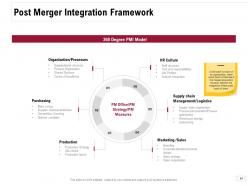
Slide 34: This slide presents Post Merger Integration Challenges.
Slide 35: This slide also showcases Post Merger Integration Challenges.
Slide 36: This slide displays M&A Performance Tracker. These key indicators can only be measured after some duration when the merger/acquisition process is closed.
Slide 37: This is Consolidation of Companies Icons Slide
Slide 38: This slide is titled as Additional Slides for moving forward.
Slide 39: This slide displays the time for Coffee Break.
Slide 40: This slide displays Stacked Area-Clustered Column chart with product comparison.
Slide 41: This slide displays the Column Chart with product comparison.
Slide 42: This is Our Mission slide with Mission, Vision and Goal.
Slide 43: This is Our Team slide with names and designation.
Slide 44: This is Our Target slide. Showcase the targets of the company.
Slide 45: This is Idea Generation slide to highlight facts, information etc.
Slide 46: This is Financial slide. Showcase the finance related stuff here.
Slide 47: This is Thank You slide with address, contact number and email address.
Consolidation Of Companies Powerpoint Presentation Slides with all 47 slides:
Belief is guaranteed with our Consolidation Of Companies Powerpoint Presentation Slides. They will demonstrate full faith in you.





FAQs for Consolidation Of Companies
Honestly, you'll save money and cut down on so much hassle. No more dealing with a million different vendors or drowning in paperwork from five different systems. Your team will thank you for the simplified reporting alone - trust me on that one. Plus when you're buying in bigger volumes, suppliers actually listen to you during negotiations. Start with just one department though, don't try to overhaul everything at once. Once people see how much smoother things run, they'll be begging you to consolidate their area next.
Oh man, get your financial records sorted out ASAP - trust me on this one. Messy books will make you want to cry later. Standardize how you're doing accounting across all your entities first. Excel might seem tempting but honestly? It's just asking for mistakes and you'll be up all night fixing them. Get some actual consolidation software if you've got multiple subsidiaries. Set clear deadlines and make sure everyone knows what they're responsible for. Run through everything a couple times before the real deadline hits - you don't want surprises when it's crunch time.
Dude, tech is what makes consolidation actually doable. Data analytics help you spot duplicate systems, cloud platforms merge infrastructures without everything crashing. Automation handles the boring migration stuff your team would hate doing manually. Oh and APIs are clutch - they keep disparate systems talking during transitions so nothing explodes. I learned this the hard way last year. Without proper tech tools, you're basically moving with a bicycle instead of a truck. Check what integration stuff you've already got first, then plan your timeline around that.
Oh man, where do I start? Data never syncs up between systems the way it's supposed to - that's always a nightmare. People absolutely hate change too, so expect pushback from your team. Technical stuff will break in weird ways you didn't see coming. Timeline pressure is brutal, especially when you're trying to keep normal operations running. Plus there's never enough budget or resources, obviously. Teams don't communicate well during transitions either, which makes everything more chaotic. Honestly, whatever timeline you're thinking? Double it. And talk to everyone constantly - like, annoyingly often.
Oh man, consolidations are rough - your team's gonna be stressed about jobs, role changes, all that stuff. Productivity will probably tank for a bit and yeah, some people will bail (which honestly sucks but happens every time). Be super upfront about what's going down, even when you're still figuring things out yourself. People hate the rumor mill way more than bad news delivered straight. Just keep talking to them regularly. I'd focus on admitting things are uncertain while making it clear you've got their backs through this mess.
Check the debt-to-equity ratios first - that's your reality check. Cash flow patterns matter way more than fancy projections, trust me. EBITDA margins will show you if they actually run things efficiently. I've watched so many deals crash because people got starry-eyed over revenue growth while completely ignoring how much cash they're bleeding. Working capital needs are sneaky expensive, and integration costs? They always end up higher than you think. Build out three scenarios in your model - optimistic, realistic, and the "oh shit" version. Revenue synergies sound sexy but focus on whether the numbers actually work day-to-day.
So consolidation basically cuts out all the duplicate stuff you're doing - same processes running in different departments, overlapping teams, that kind of mess. When you combine those redundant systems, the waste that gets exposed is honestly crazy. Your purchasing power goes way up too, so vendor negotiations get a lot easier. Training becomes simpler once you standardize everything across units, plus fewer errors. I'd start by figuring out where functions overlap the most - that's your low-hanging fruit. The workflow improvements happen pretty fast once you streamline things. Oh, and overhead costs drop significantly when you're not paying for the same work twice.
Dude, seriously - map out EVERYTHING first. All your systems, data, processes, the whole mess. I can't tell you how many teams skip this step and then wonder why everything's on fire. Communication is huge too. People freak out when they don't know what's happening, and angry stakeholders will kill your project faster than bad code. Test stuff in small chunks instead of one giant switchover. That rollback plan? You'll probably need it, so make it bulletproof. Oh, and document your decisions or you'll be sitting there six months later going "why the hell did we do it this way?"
Ugh, this stuff gets messy depending on how you set it up. Asset purchases hit you with taxes right away, but stock swaps? Those can usually be deferred if you're smart about it. Timing is huge here - like, recognizing gains in the wrong year could totally screw your tax bill. You'll probably end up filing different returns and dealing with depreciation recapture (which is honestly annoying). The IRS treats mergers, asset deals, and stock purchases completely differently too. Seriously though, call your tax guy before you do anything. This isn't worth trying to figure out yourself.
Look, fewer touchpoints usually helps customers out - they won't have to tell their whole sob story to like 5 different people anymore. Plus you get way more consistent service when systems are merged properly. The tricky part? You might lose that personal touch people actually liked. My advice: get ahead of it with communication. Train your new consolidated team on all the different customer types they'll be dealing with now (because that's gonna be messy at first). Map out their whole experience so nothing falls through the cracks during the transition.
Honestly, the communication piece is massive - you can't overdo it there. Get mixed teams going right away with people from both companies so issues surface early instead of later when they're messy to fix. Map your processes now before things get weird. Look for where stuff overlaps or clashes. The culture thing though? That takes time and you can't force it. Let people actually get to know each other's styles. Set some 90-day checkpoints so you're not flying blind. Oh, and transparency about timelines saves so much headache down the road.
Honestly, start with the money stuff - compare what you spent before vs after on infrastructure, licenses, staff costs. Processing speed and data quality improvements matter too. Employee morale is huge though, I've seen consolidations tank just because people hated the new system. Set your baselines before you do anything, then check in every quarter or so. Focus on maybe 3-4 metrics that actually tell you something meaningful. Oh, and don't forget customer experience - they'll let you know real quick if things aren't working.
Honestly, just be super upfront from day one - nobody likes getting blindsided by this stuff. Explain why you're doing the consolidation first, then walk through timelines and what's actually changing. Here's the thing though: don't just talk about all the amazing benefits while pretending there won't be any headaches (learned that one the hard way). Tell people about the rough patches they'll hit and how you plan to help. Also, your customers don't care about the same things your team does, so tailor your messages accordingly. Set up regular updates so everyone stays in the loop throughout the whole mess.
Consolidation basically means fewer companies fighting for the same pie, so prices usually go up and the survivors get more market control. Think musical chairs for businesses. The remaining players can charge more and grab bigger chunks of market share. Downside? Less innovation since there's not as much pressure to stand out anymore. Your company needs to pick a lane - either get big enough to buy others, become an attractive buyout target, or find some niche the big guys can't touch. Honestly, sitting in the middle is probably the worst spot to be in.
Disney buying Marvel and Pixar totally changed entertainment. Amazon grabbed Whole Foods and suddenly they're everywhere in groceries. JPMorgan swooped up Bear Stearns during the financial mess - honestly pretty smart timing on their part. Facebook's Instagram and WhatsApp deals? That basically built their whole social empire. The thing is, these worked because they kept what made each company special instead of just crushing them. Tech acquisitions are wild though - half of them seem to disappear completely. Bottom line: the best deals happen when companies actually fit together, not just eliminate competition.
No Reviews