


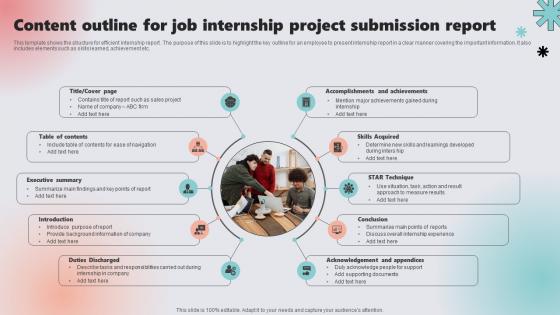
Content Outline For Job Internship Project Submission Report




Try Before you Buy Download Free Sample Product
 Impress Your
 Audience
 100%
100% Editable
 Save Hours
 of Time


This template shows the structure for efficient internship report . The purpose of this slide is to highlight the key outline for an employee to present internship report in a clear manner covering the important information. It also includes elements such as skills learned, achievement etc.
People who downloaded this PowerPoint presentation also viewed the following :
Content Outline For Job Internship Project Submission Report with all 6 slides:
Use our Content Outline For Job Internship Project Submission Report to effectively help you save your valuable time. They are readymade to fit into any presentation structure.





FAQs for Content Outline For Job Internship
So for your internship report, you'll want to hit the main stuff: executive summary of what you did, company background, your actual projects, and what you learned. The reflection section is honestly where you can shine - employers love seeing you can actually think about your experience, not just list tasks. Include specific examples with real numbers if you can. Oh and start writing it early! I made the mistake of waiting until the end and totally forgot half the cool stuff I worked on. Keep notes as you go - trust me on this one.
Honestly, just start by giving them the basics - what company you were at and what your role was. People need that context upfront. After that, lay out what you actually did and what you'll be covering in the report. Think of it like a movie trailer (but less dramatic lol) - you want to grab their attention without spoiling everything. Mention your main goals and maybe drop a hint about what you discovered or accomplished. Don't drag it out though. Wrap up by giving readers a quick roadmap so they know what's coming in the rest of your report.
Honestly, just start a simple daily log - bullet points are totally fine. Jot down what you actually did, who you worked with, any roadblocks you hit. I'm terrible at remembering stuff by Friday if I don't write it down! Skip the vague "attended meetings" nonsense and get specific about tasks. Also write down new skills or tools you picked up. Your wins matter too, even tiny ones - they're lifesavers when you're scrambling to write that final report later. I'd spend maybe 10 minutes updating notes before logging off each day. Trust me on this one.
Numbers are your best friend here! Instead of "I helped with marketing," go with something like "I boosted social media engagement by 25% and brought in 150 new leads." Even projects that seem impossible to measure usually have something you can count. Before/after comparisons work great, or survey feedback, efficiency improvements - whatever you can grab. Oh, and don't ignore the softer stuff either: how many people you presented to, training sessions you ran, stakeholders you dealt with. Honestly, most people skip this step and regret it later. Write this stuff down now while you actually remember the details.
Honestly, reflection is what makes your internship report actually worth reading instead of just being a boring task list. Don't just write what you did - dig into what you learned. That presentation that totally bombed? Probably taught you way more about talking to stakeholders than any project that went smoothly. Connect your daily stuff to bigger professional insights. Employers want to see you can think critically about your experiences and grow from them. Don't skip over the mistakes or tough moments either - that's where the real learning happened. Makes your whole report feel genuine instead of like you're just checking boxes.
Don't just dump all your skills in one boring section - sprinkle them throughout the whole thing. Like when you talk about project tasks, connect the dots: "I built Python scripts for data analysis, which really boosted my coding skills and taught me how to handle massive datasets." Show before/after examples too. I know it feels weird to brag about yourself, but you gotta do it! Also throw in soft skills with real examples - maybe how you problem-solved when everything went sideways, or how you presented to stakeholders without completely bombing. Each skill needs a concrete story behind it from your actual experience.
Honestly, weekly check-ins with your supervisor are a game-changer - way better than waiting until you're done and finding out you went the wrong direction. For colleagues, shoot them specific questions about their areas instead of vague "thoughts?" emails. Those never work well anyway. One-on-one meetings give you the most honest feedback, but surveys work too if people are swamped. Sometimes I'll just grab someone for coffee and pick their brain informally. Quick team review sessions are solid for getting multiple perspectives at once. Just be specific about what you need help with.
So basically you're gonna want to switch up your tone depending on who's reading it. Academic advisors eat up all that theoretical stuff - hit them with learning outcomes and how it connects to your coursework. But for employers? They want the hard facts. Skip the "organizational behavior theories" and go straight to "I boosted efficiency by 15%." Same experience, totally different angle. Honestly, I'd just write two versions if you're applying to both types of places. Way easier than trying to make one work for everyone. The business world and academia speak completely different languages anyway.
Dude, never use real names - that's like rule
-
I am glad to have come across Slideteam. I was searching for some unique presentations and templates for my business. There are a lot of alternatives available here.
-
Based on my personal experience, I would recommend other people to subscribe to SlideTeam. No one can be disappointed here!