

Project Activity Report With Completion Status




Try Before you Buy Download Free Sample Product
 Impress Your
 Audience
 100%
100% Editable
 Save Hours
 of Time


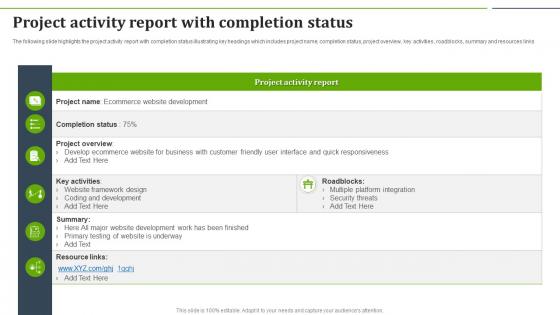
The following slide highlights the project activity report with completion status illustrating key headings which includes project name, completion status, project overview, key activities, roadblocks, summary and resources links.
People who downloaded this PowerPoint presentation also viewed the following :
Project Activity Report With Completion Status with all 6 slides:
Use our Project Activity Report With Completion Status to effectively help you save your valuable time. They are readymade to fit into any presentation structure.





FAQs for Project Activity Report
A comprehensive project activity report includes project objectives, milestone progress, resource utilization, budget status, risk assessments, team performance metrics, and stakeholder communications. These elements work together by providing transparency across all project dimensions, enabling managers to identify bottlenecks early, optimize resource allocation, and maintain strategic alignment, with many organizations finding that comprehensive reporting significantly enhances project success rates and stakeholder confidence.
Project activity reports enhance communication and transparency by providing centralized progress updates, milestone tracking, resource allocation details, and risk assessments in a standardized format. Through regular reporting cycles, teams can identify bottlenecks early, coordinate dependencies more effectively, and maintain stakeholder alignment, with many organizations finding that consistent reporting reduces miscommunication and accelerates project delivery timelines.
Project activity reports enhance stakeholder engagement by providing transparent communication, regular progress updates, clear milestone tracking, and proactive risk identification. Through structured reporting, organizations streamline stakeholder relationships, minimize uncertainty, and build trust across project teams, with many finding that consistent communication ultimately delivers higher satisfaction rates and stronger project buy-in.
**INPUT**: What tools or software can simplify the creation of project activity reports? **OUTPUT**: Project management software like Microsoft Project, Asana, Trello, Monday.com, and Smartsheet streamline activity report creation through automated tracking, real-time updates, and customizable templates. These platforms enhance efficiency by consolidating task progress, resource allocation, and timeline data into comprehensive dashboards, with many organizations finding that automated reporting reduces administrative overhead while delivering greater project transparency and stakeholder communication. [Word count: 60 words]
Project activity reports should typically be generated weekly for most projects, with daily reports for critical phases and monthly summaries for long-term initiatives. The frequency depends on project complexity, stakeholder requirements, and risk levels, with many organizations finding that consistent weekly reporting strikes the optimal balance between maintaining visibility and avoiding administrative overhead, ultimately enabling faster decision-making and proactive issue resolution.
Common challenges include data fragmentation across multiple systems, inconsistent reporting formats, manual compilation errors, delayed stakeholder updates, and difficulty tracking real-time progress. These obstacles can be overcome by implementing centralized project management platforms, standardizing reporting templates, automating data collection processes, and establishing regular communication protocols, ultimately delivering enhanced transparency and streamlined project oversight across organizations.
KPIs can be effectively integrated into project activity reports through dashboard visualizations, milestone tracking matrices, performance trend analysis, and variance reporting against baseline targets. These integration methods streamline project monitoring by providing real-time visibility into critical metrics, enabling proactive decision-making, and delivering comprehensive stakeholder updates, with many organizations finding that strategic KPI integration enhances project transparency and accelerates successful outcomes.
Visuals enhance project activity reports by transforming complex data into digestible charts, graphs, timelines, and dashboards that stakeholders can quickly interpret. Through strategic visual elements, project managers streamline communication, reduce review time, and improve decision-making accuracy, with many organizations finding that visual reports increase stakeholder engagement and facilitate faster project approvals.
Project activity reports support post-project evaluation by providing comprehensive documentation of timelines, resource utilization, milestone achievements, budget performance, and team contributions throughout the project lifecycle. These detailed records enable organizations to conduct thorough retrospective analyses, identify successful strategies and improvement opportunities, and compile actionable lessons learned for future projects, ultimately enhancing project management capabilities.
Project activity reports should follow clear formatting with standardized sections including executive summary, milestone progress, resource utilization, risk assessment, and next steps, while maintaining consistent visual hierarchy through headers, bullet points, and charts. These structured approaches streamline stakeholder communication, enhance project transparency, and enable faster decision-making, with many organizations finding that standardized templates ultimately deliver improved accountability and more efficient project oversight across departments.
Project managers ensure data accuracy through systematic validation processes, standardized data collection protocols, regular audits, automated reporting tools, and cross-verification with multiple sources. These approaches streamline information gathering while minimizing human error, with many organizations finding that combining real-time dashboards with periodic stakeholder reviews delivers enhanced transparency and ultimately enables more informed decision-making across project lifecycles.
Valuable metrics include task completion percentages, milestone achievements, budget utilization rates, resource allocation efficiency, and timeline adherence indicators. These measurements enable project managers to identify potential bottlenecks, optimize resource distribution, and maintain stakeholder transparency, with many organizations finding that combining quantitative progress data with qualitative risk assessments ultimately delivers enhanced project visibility and strategic decision-making capabilities.
Feedback from project activity reports enhances future project performance by identifying recurring bottlenecks, resource allocation inefficiencies, and successful methodologies that can be replicated across teams. These insights enable organizations to refine planning processes, streamline workflows, and develop standardized best practices, with many companies finding that systematic report analysis reduces project timelines by 15-20% while improving delivery quality.
Tailoring project activity reports to different audiences ensures stakeholders receive relevant information aligned with their decision-making needs, responsibilities, and expertise levels. Executives require high-level summaries focusing on budget and timeline impacts, while technical teams need detailed progress metrics and resource allocation data, ultimately enhancing communication effectiveness and enabling informed strategic decisions across organizational levels.
Project activity reports serve as critical compliance documentation by tracking regulatory requirements, audit trails, risk assessments, and adherence to industry standards throughout project lifecycles. These comprehensive records enable organizations in heavily regulated sectors like healthcare, finance, and manufacturing to demonstrate compliance transparency, streamline regulatory audits, and maintain accountability, ultimately reducing compliance risks while ensuring consistent adherence to governance frameworks.
-
Eye-catching PPT designs, outstanding team, and best customer service. I’m a super satisfied customer here!
-
Happy to found you SlideTeam. You guys are value for money. Amazing slides.