


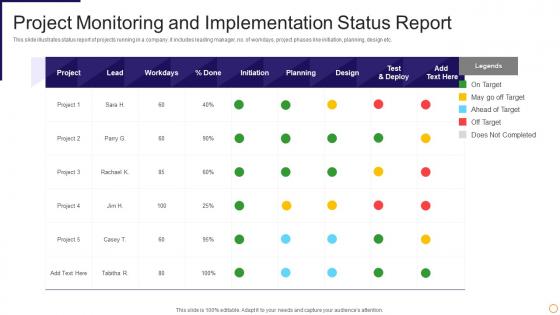
Project Monitoring And Implementation Status Report




Try Before you Buy Download Free Sample Product
 Impress Your
 Audience
 100%
100% Editable
 Save Hours
 of Time


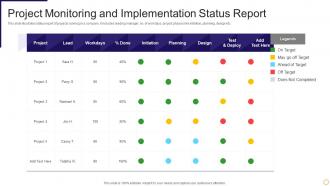
This slide illustrates status report of projects running in a company. it includes leading manager, no. of workdays, project phases like initiation, planning, design etc.
People who downloaded this PowerPoint presentation also viewed the following :
Project Monitoring And Implementation Status Report with all 6 slides:
Use our Project Monitoring And Implementation Status Report to effectively help you save your valuable time. They are readymade to fit into any presentation structure.





FAQs for Project Monitoring And
Key project monitoring metrics include schedule variance, budget variance, resource utilization, quality indicators, scope creep measurements, and stakeholder satisfaction scores. These metrics enable project managers to identify potential issues early, optimize resource allocation, and maintain project alignment, with many organizations finding that consistent tracking ultimately delivers improved project success rates and enhanced operational efficiency.
Project monitoring tools enhance team collaboration by providing centralized dashboards, real-time progress tracking, automated notifications, and shared document repositories that keep everyone aligned on objectives and timelines. These platforms streamline communication workflows, eliminate information silos, and enable transparent resource allocation, with many organizations finding that integrated monitoring systems significantly reduce project delays while improving cross-functional coordination and accountability.
Stakeholder feedback provides critical insights into project performance, identifies emerging risks, validates deliverable quality, and ensures alignment with evolving business requirements throughout the project lifecycle. Through regular feedback loops, project managers can address concerns proactively, adjust timelines strategically, and maintain stakeholder engagement, with many organizations finding that systematic feedback collection ultimately delivers improved project outcomes and stronger stakeholder satisfaction.
Risk management integrates into project monitoring through continuous risk assessment, real-time tracking of risk indicators, regular stakeholder communication, and automated alert systems for threshold breaches. These approaches enable project managers to identify potential issues early, adjust mitigation strategies dynamically, and maintain stakeholder confidence, ultimately delivering improved project outcomes and reduced unexpected costs.
Best practices for setting up a project monitoring dashboard include defining clear KPIs, implementing real-time data integration, creating role-based access levels, establishing automated alerts, and ensuring mobile compatibility. These dashboards enhance project visibility by centralizing progress tracking, resource allocation monitoring, and risk identification, with many organizations finding that strategic dashboard design ultimately delivers faster decision-making and improved project outcomes.
Project progress should be reviewed weekly for tactical updates, monthly for comprehensive assessments, and quarterly for strategic alignment, with daily stand-ups for agile methodologies. This structured approach enables project managers to identify risks early, adjust resource allocation efficiently, and maintain stakeholder transparency, with many organizations finding that regular review cycles ultimately deliver improved project outcomes and enhanced team accountability.
Common project monitoring challenges include scope creep, resource allocation issues, communication gaps, timeline deviations, and inadequate data tracking systems. These obstacles can be overcome by implementing robust project management software, establishing clear communication protocols, conducting regular stakeholder reviews, and maintaining flexible yet structured monitoring frameworks, with many organizations finding that proactive monitoring ultimately delivers improved project outcomes and enhanced operational efficiency.
Data visualization transforms complex project metrics into clear, actionable insights by converting spreadsheets into charts, dashboards, and interactive displays that highlight trends, bottlenecks, and performance patterns. Through visual tools, project managers can quickly identify resource allocation issues, timeline deviations, and budget variances, while stakeholders gain immediate understanding of progress status, ultimately enabling faster decision-making and enhanced project outcomes.
Techniques for accurate and timely reporting include automated data collection systems, standardized reporting templates, real-time dashboards, milestone-based checkpoints, and regular stakeholder communication protocols. These methods streamline information gathering, minimize manual errors, and enhance transparency, with many organizations finding that integrated project management platforms ultimately deliver faster decision-making and improved accountability.
Project variances indicate the need for corrective actions by revealing significant deviations from planned budgets, timelines, resource allocation, and performance targets. When variances exceed predetermined thresholds, project managers can implement strategic adjustments, reallocate resources, and modify approaches, ultimately preventing cost overruns and delivery delays while maintaining project objectives.
Agile methodologies revolutionize project monitoring through continuous feedback loops, sprint-based tracking, real-time collaboration tools, and iterative performance assessments that replace traditional milestone approaches. These adaptive strategies enable organizations to identify issues faster, respond to changes more effectively, and maintain transparency across teams, with many businesses finding that Agile monitoring ultimately delivers improved project outcomes and enhanced stakeholder satisfaction.
The most effective communication strategies include regular status dashboards, stakeholder-specific reports, visual progress tracking, automated alerts for critical issues, and structured meeting cadences. These approaches enhance transparency by providing real-time visibility, tailored information delivery, and proactive issue escalation, with many organizations finding that consistent communication rhythms ultimately deliver improved project outcomes and stronger stakeholder confidence.
Technology and automation streamline project monitoring through real-time dashboards, automated progress tracking, predictive analytics, AI-powered risk detection, and integrated communication platforms. These solutions enhance operational efficiency by eliminating manual data collection, providing instant visibility into project health, and enabling proactive decision-making, with many organizations finding significantly faster issue resolution and improved resource allocation.
Project monitoring holds critical importance in ensuring quality by enabling early detection of deviations, maintaining adherence to standards, and facilitating timely corrective actions throughout the project lifecycle. Through continuous tracking and assessment, organizations streamline quality control processes, minimize costly reworks, and enhance stakeholder confidence, with many finding that systematic monitoring ultimately delivers superior outcomes and competitive advantage.
Project monitoring contributes to success by enabling early issue detection, maintaining budget control, ensuring timeline adherence, and facilitating stakeholder communication throughout project lifecycles. Through continuous tracking and performance analysis, organizations streamline resource allocation, minimize costly delays, and enhance delivery predictability, with many companies finding that systematic monitoring reduces project failure rates while ultimately delivering improved client satisfaction and competitive advantage.
-
Amazing product with appealing content and design.
-
“I've always gotten excellent slides from them and the customer service is up to the mark.”