


Consulting Project Weekly Status Report




Try Before you Buy Download Free Sample Product
 Impress Your
 Audience
 100%
100% Editable
 Save Hours
 of Time


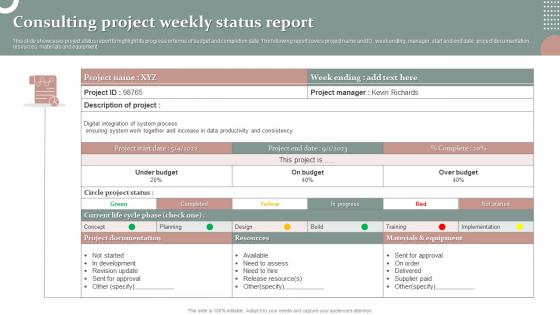
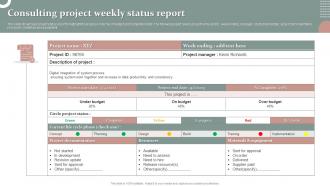
This slide showcases project status report to highlight its progress in terms of budget and completion date. The following report covers project name and ID, week ending, manager, start and end date, project documentation, resources, materials and equipment.
People who downloaded this PowerPoint presentation also viewed the following :
Consulting Project Weekly Status Report with all 6 slides:
Use our Consulting Project Weekly Status Report to effectively help you save your valuable time. They are readymade to fit into any presentation structure.





FAQs for Consulting Project
So honestly, you'll live and die by your analytical skills - clients pay big bucks for you to untangle their messy problems. PowerPoint becomes your best friend (I know, sounds boring but it's true). Communication matters more than anything since you're always pitching ideas to executives. Every project's different so adaptability is key. Oh, and people skills - you've got to build trust fast with total strangers. Excel wizardry doesn't hurt either. The whole thing's pretty intense at first, but if you can think critically and present well, you'll crush it. Definitely start practicing presentations now though.
Start your kickoff meeting by nailing down exactly what you're delivering and when. Write it all down too - trust me, memories get fuzzy fast. Keep sending updates even during quiet weeks because silence freaks clients out way more than you'd think. When problems pop up (and they will), jump on them right away. Don't just dump bad news though - always come with at least one potential fix. I learned this the hard way on my last project. Honestly? You can't communicate too much early on. Just make sure you actually do what you say you'll do.
Lead with your big finding right off the bat - don't make people wait through endless methodology slides. Tell a story with the data, walking them through how you reached that conclusion. One key point per slide keeps things clean and visual. The "so what does this mean for business?" question always comes up, so be ready for it. Honestly, I've seen too many presentations die because someone buried their insight on slide 15. Practice those transitions between sections - makes a huge difference. End with concrete next steps and assign owners. Vague recommendations just sit there and collect dust.
Honestly, just check if you actually fixed what they hired you for in the first place. Hard numbers are your friend - real cost savings, revenue bumps, whatever the goal was. Client satisfaction surveys are nice but kinda fluffy sometimes. They'll say they loved you even when results were just okay, you know? What really tells the story is whether they're still using your recommendations six months later. Track the concrete stuff AND get their honest feedback. Compare your promised ROI to what actually happened. Oh, and save all this for your next pitch deck - future you will thank you.
Honestly, start with issue trees and MECE thinking - that stuff will change how you break down problems. Issue trees help you map everything out, and MECE (mutually exclusive, collectively exhaustive) keeps your thinking organized. I use it literally every day. The classic frameworks like Porter's Five Forces are solid too, though sometimes they feel a bit textbook-y. Root cause analysis and "5 whys" are clutch for getting to the real problem. Don't sleep on stakeholder mapping either since you're constantly managing different people. Master the issue tree approach first though - it'll make everything else click way faster.
Honestly, the key is doing your homework on their industry first. Every sector has different priorities and weird jargon, so learn it before you walk in. Listen way more than you talk early on - that's how you figure out what actually matters to them. Being genuinely curious helps too (it's kinda fun once you get the hang of it). Show up when you say you will, deliver on time, and don't BS about stuff you don't know. Oh, and ask each new client straight up what good partnership looks like from their end.
Honestly, you can't make decent recommendations anymore without backing them up with actual data. Clients want real numbers, not just your best guess or some outdated playbook from years ago. You'll be digging into their systems, spotting trends they missed, and proving your ideas actually work before pitching solutions. Excel's your best friend here - learn those functions inside and out. Python's worth picking up too if you're feeling ambitious. Trust me, the consultants who can crunch numbers are the ones getting ahead. It's just how the game works now.
Oh man, you absolutely can't just use the same approach everywhere - learned that one the hard way during my first project in Japan! Communication styles are totally different. What flies in direct American business culture will crash and burn in relationship-focused Asian markets. Hierarchy matters way more in some places. Decision-making processes? Completely different timelines and who gets involved. Even your presentation format needs to change. I'd start by looking up stuff like power distance and individualism vs collectivism for whatever market you're targeting. Saves you from looking like a complete amateur, trust me.
Honestly, conflicts of interest are huge - always tell clients if you're working with their competitors or have financial ties that might mess with your judgment. Keep their data secure because one breach will destroy your reputation fast. Don't oversell what you can do just to get the contract (I've seen people crash and burn doing this). Scope creep is tricky too. You want to help but not at your client's expense. Document conversations so there's no confusion later. Look, sometimes doing right by your client means less profit for you, but that's the trade-off for long-term success.
Honestly, LinkedIn is your best bet here. That's where decision-makers actually spend time, not scrolling Instagram or whatever. Share stuff from your projects (keep it vague to protect clients), jump into conversations on posts, maybe write an article about what you're seeing in the industry. Twitter works if your people are there, but I'd put like 80% of my energy into LinkedIn. Don't be that person who's constantly pitching though - just be helpful. Answer questions, drop some frameworks, give away your good stuff sometimes. I started with one solid post per week and honestly that was plenty to figure out what people cared about.
Dude, don't underprice yourself just to get clients - it backfires so hard. They'll expect dirt-cheap work forever. Scope creep is brutal too. Clients start with "oh just one tiny thing" and suddenly you've done 10 hours of free work. Never skip contracts even if they seem super trustworthy! Made that mistake once, not fun. Also random tip - charge what you're actually worth, not what you think they'll pay. Get everything written down before you touch anything. Boundaries from day one or you're screwed.
Figure out who you're talking to before you even touch PowerPoint. The C-suite only cares about ROI and big picture stuff, but ops teams want the nitty-gritty details about resources and implementation. I totally bombed a finance presentation once because I went in with way too much fluff - they hated it. So dig into their actual problems and speak their language. Structure everything around outcomes they actually give a damn about. Oh, and always have 2-3 backup versions of your main slides ready. Trust me, you'll need to switch gears mid-presentation more often than you think.
Mix formal stuff with casual chats - that's where the real gold is. Coffee break conversations? Way more honest than surveys sometimes. Skip the generic "how's it going" questions and get specific about deadlines or what's bugging them. I'd set up regular check-ins but also throw a shared doc where they can vent whenever. The trick is making it feel collaborative, not like you're grading them. Oh, and actually ask what sucks - people won't volunteer criticism unless you make it clear you want to hear it.
Honestly, I'd start with solid frameworks that work, then customize from there. Don't reinvent everything for each client - that's exhausting. But you can't just copy-paste either, ya know? A tech startup is gonna need totally different stuff than some old-school manufacturer. I usually tell clients upfront what parts are my standard process versus what I'll tweak for them specifically. Document your core methods internally. Then figure out where flexibility makes sense. Oh, and build in those customization points from the start - way easier than trying to force it later. You'll stay efficient but clients still feel like they're getting something made just for them.
Honestly, AI's eating up all the boring analysis stuff now. Clients want specialists, not generalists who know a little about everything. Hourly billing is dying - everyone wants results-based pricing instead. Remote work stuck around (thank god, because Zoom meetings are way more focused than those marathon conference room sessions). Oh, and forget those 80-slide PowerPoint monsters. People want real-time dashboards and actual data insights. The consultants killing it right now? They're mixing tech tools with strategic thinking. My advice - pick one tech niche and go deep on it.
-
Helpful product design for delivering presentation.
-
“Ample and amazing variety of templates available, really helpful for making professional PPT for day to day workings.”