

Contingency Plan Powerpoint Presentation Slides





Try Before you Buy Download Free Sample Product
 Impress Your
 Audience
 100%
100% Editable
 Save Hours
 of Time


Our Contingency Plan Powerpoint Presentation Slides are topically designed to provide an attractive backdrop to any subject. Use them to look like a presentation pro.
People who downloaded this PowerPoint presentation also viewed the following :
Content of this Powerpoint Presentation
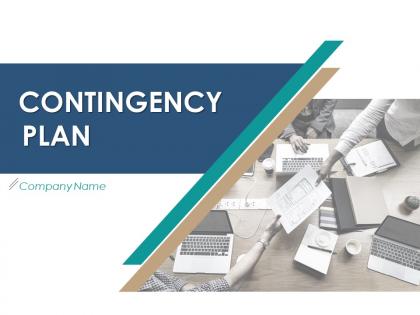
Slide 1: This slide introduces contigency plan. State your Company Name and begin.
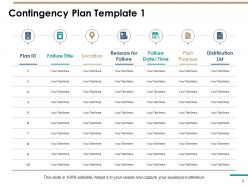
Slide 2: This slide shows Contingency Plan Template 1 with related table and text boxes.
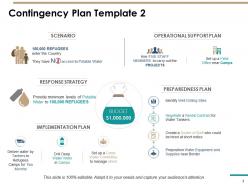
Slide 3: This slide presents Contingency Plan Template 2 describing- Scenario, Response strategy, implementation plan, operational support plan, preparedness plan.
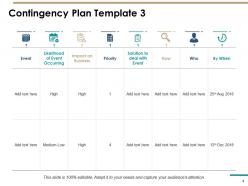
Slide 4: This slide represents Contingency Plan Template 3 with related icons and text. You may add or edit text as per requirement.
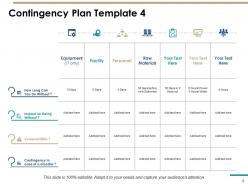
Slide 5: This slide showcases Contingency Plan Template 4 describing- How Long Can You Do Without, Impact on Doing Without, Vulnerabilities, Contingency in case of a disaster.
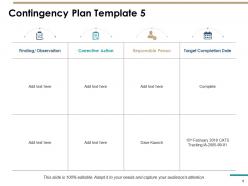
Slide 6: This slide displays Contingency Plan Template 5 describing- Finding / Observation, Corrective Action, Responsible Person, Target completion date.
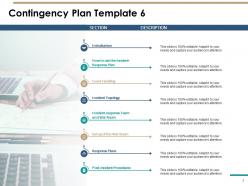
Slide 7: This slide shows Contingency Plan Template 6 which describes- Introduction, How to use the Incident-Response Plan, Event Handling, Incident Topology, Incident-response Team and War Room, Setup of the War Room, Response Plans, Post-Incident Procedures.
Slide 8: This slide reminds about 30 Minutes Coffee Break. You may alter the slide as per need.
Slide 9: This slide displays Graphs And Charts. This indicates that further slides are about graphs and charts.
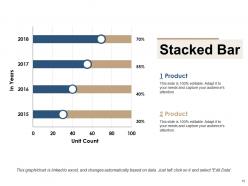
Slide 10: This slide shows Stacked Bar chart with 2 products comparison.
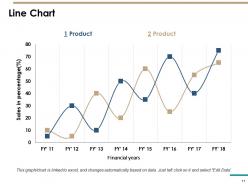
Slide 11: This slide presents Line Chart. With this you can compare products.
Slide 12: This slide says Additional Slides. You can change the title and slide content.
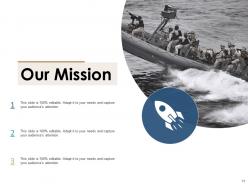
Slide 13: This slide represents Our Mission slide. You can write your company's mission, vision and goal.
Slide 14: This slide represents about our team. You can enter name, designation and images of the team members.
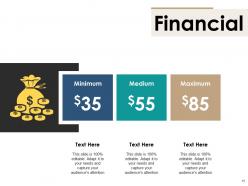
Slide 15: This slide is titled as Financials. Show finance related stuff here.
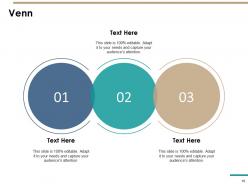
Slide 16: This is a VENN slide with text boxes to show information.
Slide 17: This is a Thank You slide with Address# street number, city, state, Contact Number, Email Address.
Contingency Plan Powerpoint Presentation Slides with all 17 slides:
Use our Contingency Plan Powerpoint Presentation Slides to effectively help you save your valuable time. They are readymade to fit into any presentation structure.



FAQs for Contingency Plan
You'll want to nail down four main things: risk assessment, trigger points, response steps, and who does what. Figure out what could realistically go wrong first - most people get paralyzed here because they try to plan for every possible disaster. Map out your actual response procedures and make sure everyone knows their role. Communication plans and resources matter too, obviously. Here's the thing though - keep it stupidly simple or nobody will follow it when stuff goes sideways. Test it out regularly and tweak based on what doesn't work.
Start by brainstorming everything that could tank your business - natural disasters, cyber attacks, losing key people, the usual suspects. Get different departments involved since they'll catch stuff you missed. Finance people are weirdly good at spotting operational weak spots, btw. Check what's gone wrong in your industry before, both for you and competitors. Don't forget regulatory stuff and supply chain issues. Here's the thing though - do this quarterly, not just once. Your risks change constantly, so your backup plans need to stay fresh too.
Honestly, communication can make or break your whole contingency plan. Map out who needs what info and how they'll get it during a crisis. Your brilliant plan means nothing if nobody knows about it when things go south - learned that one the hard way. Set up clear channels, pick your spokespersons, build in regular updates. Oh, and definitely test your communication methods ahead of time. Trust me, you don't want to be frantically trying to figure out how to reach people during an actual emergency.
Honestly, just think about two things: how likely is this to happen, and how screwed would we be if it did? Map out your risks and score them both ways. Those high-probability, high-impact nightmares? Yeah, those get handled first - no brainer. But also keep an eye on the rare stuff that could totally wreck you, even if it's unlikely. I always make a simple grid to see everything visually. Start with the scary top-right corner and work down from there. It's not rocket science, but you'd be surprised how many companies skip this step entirely.
Oh man, there's tons of stuff that'll help with this. Monday.com and Asana are solid for mapping out who does what when things go sideways. Microsoft Project works too but it's kinda overkill sometimes. RiskWatch is decent for the actual risk assessment part - though I've never used LogicGate personally. Honestly? A shared Google Drive with some templates can work just as well if you're not trying to spend money. The real trick is finding something everyone will actually use instead of ignoring it. Start with whatever you've already got, then upgrade later once you figure out what you really need.
At minimum once a year, but that's honestly pretty bare bones. Any big changes - new tech, staff shakeups, moving offices - should automatically trigger a review. Most places do quarterly check-ins which seems about right. Don't let these become dusty binders on a shelf though. After any incident (even small stuff), take a quick look at what worked and what didn't. Oh, and definitely set a calendar reminder now or you'll totally forget. I learned that one the hard way.
Honestly? Most people plan for crazy scenarios that'll never happen while completely missing the obvious stuff. I learned this the hard way - spent weeks mapping out these elaborate "what if" situations, then got blindsided by something super basic. Keep your plans simple enough that you can actually use them when you're stressed. Three realistic risks max to start with. Build responses you can test easily. Oh, and don't just write plans and stick them in a drawer somewhere - your business evolves, so should your backup strategies. The whole point is having something that actually works when things go sideways.
Honestly, training is what separates plans that actually work from ones that just look good on paper. Your team needs to practice this stuff regularly - otherwise they'll be scrambling around during a real crisis trying to figure out who's supposed to do what. I've seen it happen and it's not pretty. Regular drills help everyone build that muscle memory so responses become automatic. Plus you'll catch weird gaps or confusing sections that seemed fine when you wrote them but make zero sense in practice. Do it quarterly at least, and make the scenarios as realistic as possible. Trust me on this one.
So for crisis metrics, focus on the basics first - response time, whether your comms actually reached people, how well you used resources. The stuff that really matters though? Business continuity. Uptime, keeping customers, protecting revenue. Honestly, don't stress about perfect measurements since crises are chaos anyway. Stakeholder confidence surveys help too, plus watching for any compliance headaches. Oh, and set up some kind of simple dashboard beforehand - trust me, you don't want to be figuring out what to track while everything's falling apart. Way too stressful.
So regulatory stuff sets your bare minimum standards, but it's all over the place depending on your industry. Healthcare gets stuck with HIPAA in every disaster plan. Financial companies? They're dealing with SOX compliance for backups - total pain honestly. Manufacturing worries more about environmental safety rules, tech has GDPR breathing down their necks. You can't just grab some random template and call it good. Figure out what regs actually hit your sector first. Build around those requirements, then worry about the fancy extras later. Sounds boring but you'll thank yourself when audit time rolls around.
Honestly, the trick is making it feel like their problem to solve, not yours. Get them involved in spotting the risks that'd actually mess with their work - they know stuff you don't anyway. Those brainstorming sessions work way better than just handing people a manual. I'd explain upfront how this protects their jobs and keeps things stable. Run some practice drills, but don't go overboard and disrupt everything. People hate feeling like they're just taking orders when crisis hits. If they help build the plan, they'll actually care about following it.
Honestly, first figure out what actually scares you - floods, hackers, supply chain mess, whatever. Build response plans that you can mix and match depending on what hits. Like, your communication setup might work the same for fire or flood, but evacuation? Totally different story. Don't make everything super rigid - flexibility is way better than having some script nobody follows. Oh, and definitely run those tabletop exercises to test everything out. You'll find holes in your plan that you never saw coming, trust me.
Think of scenario planning like a crystal ball for your backup plans. You brainstorm different "what if" situations before they actually happen - minor issues, major disasters, whatever. This way you're not panicking when things go wrong (and they will). Having your team think through multiple futures is honestly where the magic happens. You end up with specific strategies instead of some useless generic emergency plan. I'd start with your 3-5 biggest risks and build actual response plans around those. Way better than winging it when stuff hits the fan.
Yeah, global business makes contingency planning a total headache. You're juggling different regulations, currencies going crazy, and supply chains that can break in like 5 different countries. Cultural stuff matters too - what works in Germany won't fly in Japan. One mess-up in Asia and suddenly your whole operation's scrambled. Honestly, the ripple effects happen way faster than you'd think. Best bet? Map out your biggest global weak spots first. Build some wiggle room into everything and get solid local contacts who actually know their turf. They'll save you from making stupid assumptions about their markets.
Honestly, COVID taught me that backup plans are basically useless if they're too rigid. You can't just prepare for one scenario - you need like 3-4 different "what if" situations mapped out. Communication always gets messy during actual emergencies (learned that the hard way), so have backup ways to reach people. Those tabletop exercises aren't just corporate BS either - they actually show you where your plan breaks down before it matters. Oh, and question your assumptions constantly. Ask yourself "what if I'm totally wrong about this?" Most crisis plans fall apart because we assume too much.
-
Unique and attractive product design.
-
Excellent template with unique design.
-
Understandable and informative presentation.
-
Unique design & color.