

Creating Value With Machine Learning Powerpoint Presentation Slides




Try Before you Buy Download Free Sample Product
 Impress Your
 Audience
 100%
100% Editable
 Save Hours
 of Time


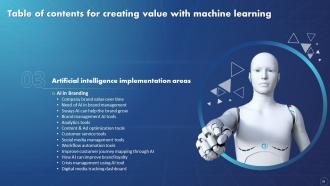
Artificial Intelligence is intelligence demonstrated by machines instead of humans and is a growing force in the technology industry. AI devices can recognize the environment and take action that maximizes the chances of successfully achieving the companys goals. Check out our efficiently designed Creating Value with Machine Learning template. It is going to have a transformational impact on business. We have covered the current state analysis wherein the current challenges faced by the company, the need for AI in business, and the AI competitive landscape are analyzed. We have also covered AI in branding, wherein company brand value has been evaluated over time, the need for AI in brand management, and how AI can grow a business brand. Different brand management AI tools such as analytics, content and optimization, customer service, social media management, and workflow automation have been depicted here. We have also discussed AI in finance, wherein the need for AI for financial activities and ways AI will transform the finance department is focused. Different management systems like cloud based ERP and treasury management systems will be introduced in the business. Get access now.
People who downloaded this PowerPoint presentation also viewed the following :
Content of this Powerpoint Presentation
Slide 1: This slide introduces Creating Value with Machine Learning. State your company name and begin.
Slide 2: This slide states Agenda of the presentation.
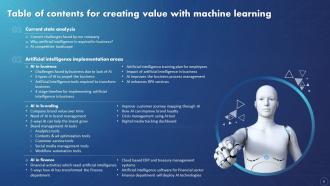
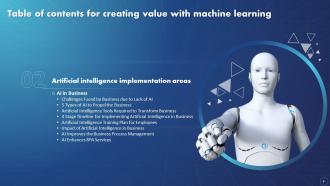
Slide 3: This slide shows Table of Content for the presentation.
Slide 4: This slide depicts title for four topics that are to be covered next in the template.
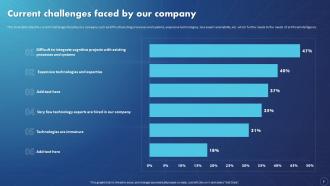
Slide 5: This slide describes the current challenges faced by our company such as difficult existing processes and systems, expensive technologies, etc.
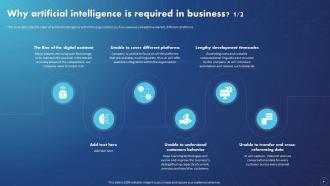
Slide 6: This slide describes the need of artificial intelligence within the organization such as issues as competitive market, different platforms.
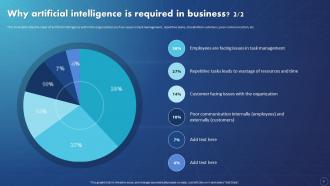
Slide 7: This slide describes the need of artificial intelligence within the organization such as issues in task management, repetitive tasks, etc.
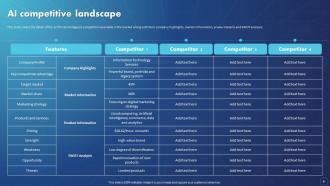
Slide 8: This slide covers the detail of the artificial intelligence competitors available in the market along with their company highlights.
Slide 9: This slide depicts title for eleven topics that are to be covered next in the template.
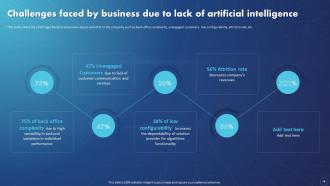
Slide 10: This slide covers the challenges faced by a business due to lack of AI in the company such as back office complexity, etc.
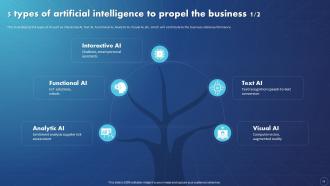
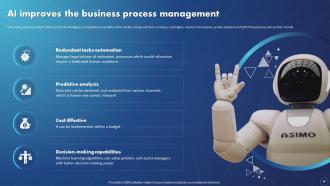
Slide 11: This slide depicts the types of AI such as interactive AI, Text AI, Functional AI, Analytic AI, Visual AI, etc.
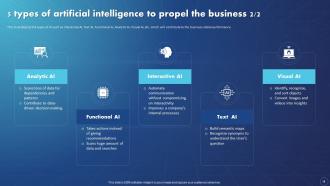
Slide 12: This slide depicts the types of AI such as interactive AI, Text AI, Functional AI, Analytic AI, Visual AI, etc.
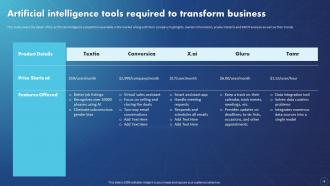
Slide 13: This slide covers the detail of the artificial intelligence competitors available in the market along with their company highlights, etc.
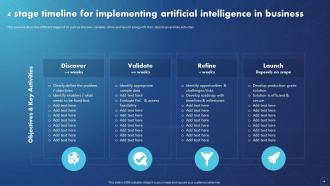
Slide 14: This timeline describes different stages of AI such as discover, validate, refine and launch along with their objectives and key activities.
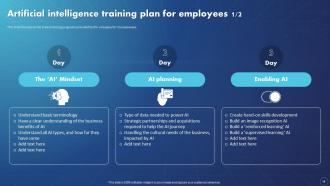
Slide 15: This slide focuses on the 3-day training programs provided by the company for its employees.
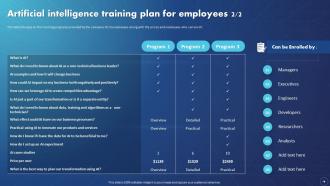
Slide 16: This table focuses on the training programs provided by the company for its employees along with the prices and employees who can enroll.
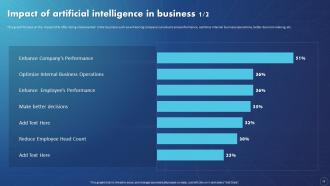
Slide 17: This graph focuses on the impact of AI after being implemented in the business such as enhancing company’s products and performance.
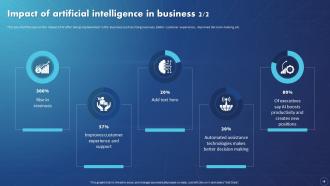
Slide 18: This pie chart focuses on the impact of AI after being implemented in the business such as rising revenues, better customer experience, etc.
Slide 19: This slide covers the detail of the artificial intelligence competitors available in the market along with their company highlights, etc.
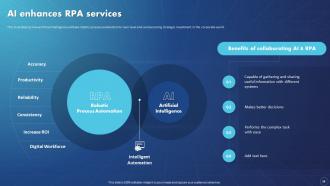
Slide 20: This slide depicts how artificial intelligence will take robotic process automation to next level.
Slide 21: This slide depicts title for thirteen topics that are to be covered next in the template.
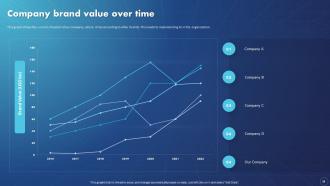
Slide 22: This graph shows the current situation of our company, where it lies according to other brands.
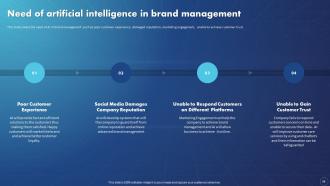
Slide 23: This slide covers the need of AI in brand management such as poor customer experience, damaged reputation, marketing engagement, etc.
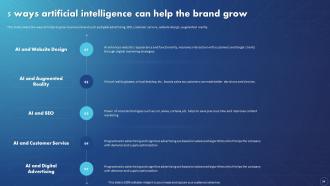
Slide 24: This slide covers the ways AI helps to grow business brand such as digital advertising, SEO, customer service, website design, augmented reality.
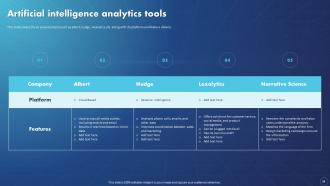
Slide 25: This slide covers the AI analytics tools such as albert, nudge, lexalytics, etc. along with its platform and feature details.
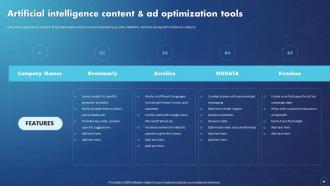
Slide 26: This slide covers the AI Content & Ad Optimization tools such as Grammarly, acrolinx, NGDATA, kenshoo along with its feature’s details.
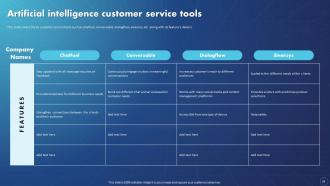
Slide 27: This slide covers the AI customer service tools such as chatfuel, conversable, dialogflow, emarsys, etc. along with its feature's details.
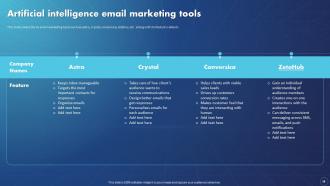
Slide 28: This slide covers the AI email marketing tools such as astro, crystal, conversica, zetahus, etc. along with its feature's details.
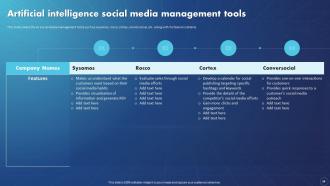
Slide 29: This slide covers the AI social media management tools such as sysomos, rocco, cortex, conversocial, etc. along with its feature's details.
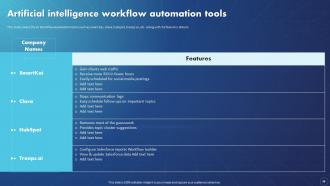
Slide 30: This slide covers the AI Workflow Automation tools such as smart kai, clara, hubspot, troops.ai, etc. along with its feature's details.
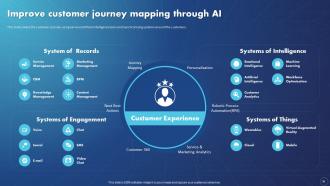
Slide 31: This slide covers the customer journey using various artificial intelligence tools and synchronizing systems around the customers.
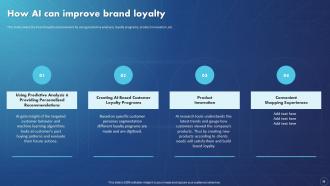
Slide 32: This slide covers the brand loyalty improvement by using predictive analysis, loyalty programs, product innovation, etc.
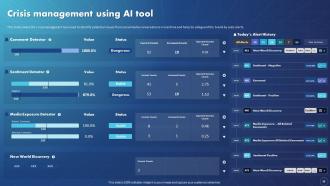
Slide 33: This slide covers the crisis management tool used to identify potential issues from social media conversations in real time.
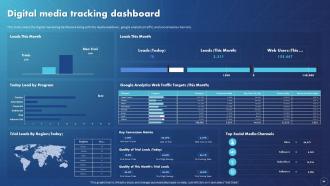
Slide 34: This slide covers the digital marketing dashboard along with the lead breakdown, google analytics traffic, and social media channels.
Slide 35: This slide depicts title for five topics that are to be covered next in the template.
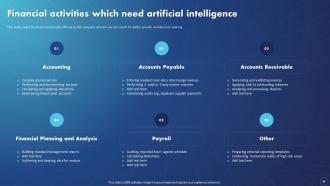
Slide 36: This slide covers the financial activities offered by the company wherein we can use AI for better growth and decision making.
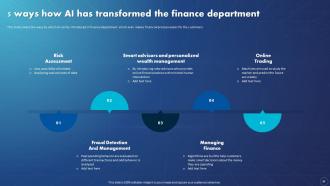
Slide 37: This slide covers the ways by which AI can be introduced in finance department which even makes financial process easier for the customers.
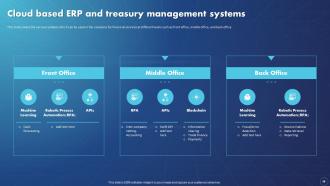
Slide 38: This slide covers the various systems which can be used in the company for financial services at different levels.
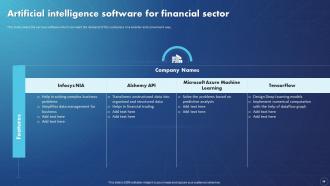
Slide 39: This slide covers the various software which can meet the demand of the customers in a smarter and convenient way.
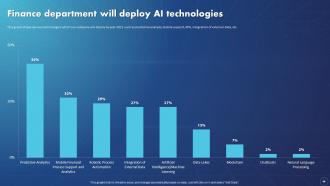
Slide 40: This graph shows various technologies which our company will deploy by year 2021 such as predictive analysis, mobile support, RPA, etc.
Slide 41: This slide contains all the icons used in this presentation.
Slide 42: This slide is titled as Additional Slides for moving forward.
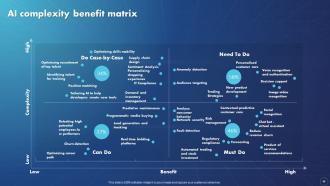
Slide 43: This slide illustrates AI Complexity Benefit Matrix.
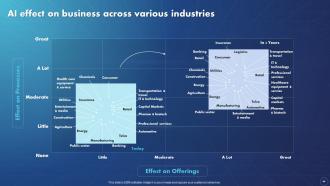
Slide 44: This slide highlights AI effect on Business Across Various Industries.
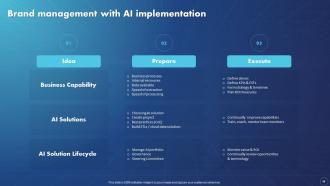
Slide 45: This slide shows Brand Management with AI Implementation.
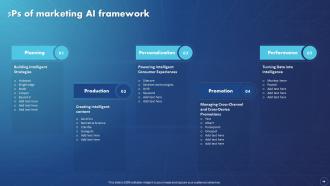
Slide 46: This slide exhibits 5Ps of Marketing AI Framework.
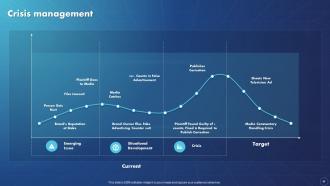
Slide 47: This slide presents Crisis Management.
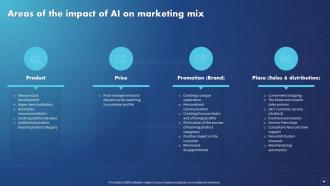
Slide 48: This slide displays Areas of the Impact of AI on Marketing Mix.
Slide 49: This is Our Mission slide with related imagery and text.
Slide 50: This slide provides 30 60 90 Days Plan with text boxes.
Slide 51: This slide shows Roadmap for process flow.
Slide 52: This slide shows Post It Notes. Post your important notes here.
Slide 53: This is a Timeline slide. Show data related to time intervals here.
Slide 54: This slide contains Puzzle with related icons and text.
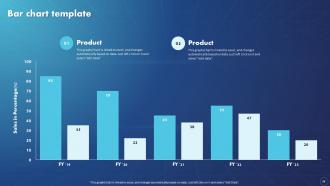
Slide 55: This slide presents Bar chart with two products comparison.
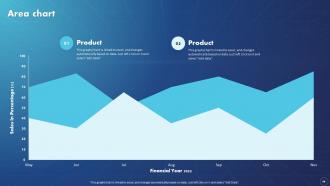
Slide 56: This slide depicts Area chart with two products comparison.
Slide 57: This is a Thank You slide with address, contact numbers and email address.
Creating Value With Machine Learning Powerpoint Presentation Slides with all 62 slides:
Use our Creating Value With Machine Learning Powerpoint Presentation Slides to effectively help you save your valuable time. They are readymade to fit into any presentation structure.














FAQs for Creating Value With Machine Learning
First thing - figure out exactly what problem you're trying to solve and what winning looks like. Don't just do ML because it's trendy. Your data quality matters way more than you think (garbage in, garbage out is painfully real). You'll need the right people on your team or find good partners. Pick algorithms that actually fit your problem, not the fanciest ones. Infrastructure for deployment is super boring but you'll regret skipping it. Honestly, just start with something small that shows clear ROI first. Scale up once you've proven it works.
So ML basically watches what customers do and figures out what they'll want next. Pretty crazy how good it gets at predicting stuff - like when Spotify nails your mood with some random playlist. You can start with simple things like product recommendations or personalized emails. The real magic happens when you use it for dynamic pricing, smarter chatbots, or content that actually makes sense for each person. Honestly, I'd just pick one thing first though - maybe recommendation engines since they're easier to set up and you'll see results fast.
Honestly, data quality makes or breaks everything. I've watched entire teams waste months building fancy models only to find out their training data was complete trash. Your algorithm doesn't matter if the data feeding it is biased or missing half the labels. Clean, representative data = models people actually trust and use. Messy data = expensive failures that sit on a shelf somewhere. Get your data pipeline sorted first - like, really look at your sources and clean them up early. Trust me, it's way less painful than rebuilding everything later when stakeholders start asking why your predictions are garbage.
Honestly, don't try automating everything right away - that's where most people crash and burn. Pick one boring process first. Also skip the fancy ML stuff that sounds impressive but doesn't actually fix anything (trust me, I've seen this happen). Your data's gonna be way messier than expected, so plan for tons of cleanup time. Most important thing? Get your team on board early. Best algorithm in the world means nothing if nobody wants to use it. Find something small with clear wins you can actually measure.
Honestly, just start with Zapier or Google's AutoML - no coding required. These tools let you automate stuff and build basic models without hiring expensive data scientists. Shopify already has solid analytics built in, and chatbots like ManyChat or Drift come with ML features ready to go. Pick one specific problem though - maybe figuring out which customers might bail or automating email replies. Don't get fancy right away. Test it for a month, see what actually works, then expand. Half these "AI" companies are just slick marketing anyway, but some tools genuinely help your bottom line.
Honestly, the big stuff to worry about is bias creeping into your data and algorithms - you really don't want to accidentally screw over certain groups of people. Privacy's huge too, obviously. Can you actually explain how your model makes decisions? Because if you're in a regulated industry, good luck if you can't. Jobs and broader social impact... yeah, that's worth thinking about too. Look, I'd set up some kind of ethics review thing early on, get different perspectives involved in building it. Audit regularly for fairness issues. Way better to find problems now than see your company on the news later.
So ML can actually help a lot with streamlining stuff. Automating the boring tasks like data entry and scheduling is huge - your team gets to focus on work that matters. Predictive maintenance is where it really shines though, catching equipment problems before everything breaks down. It's also great for figuring out demand patterns and optimizing how you allocate resources. The setup phase kinda sucks and takes forever, but the ROI afterward is honestly pretty solid. I'd say pick one digitized process that's already driving everyone crazy and start there. Way easier than trying to overhaul everything at once.
Honestly, it depends on what industry you're talking about. Healthcare sees crazy improvements - faster diagnosis from medical imaging, speeding up drug discovery, personalized treatments that actually save lives. Finance loves the real-time fraud detection and way better credit risk assessment than old-school methods. The trading algorithms are pretty wild too. What's smart about ML is how it molds itself to whatever data patterns and regulations each industry deals with. I'd say look at your most repetitive, data-heavy stuff first. That's usually where you'll see the biggest wins from automation and prediction.
Track business stuff first - revenue, conversions, whatever your ML thing was supposed to fix. Technical metrics like accuracy are cool but honestly mean nothing if users don't care. I've seen crazy accurate models that nobody actually uses, which is just sad. Also watch adoption rates because that tells you if people find it useful or not. Oh and set up dashboards so you're not scrambling to check everything manually later. Way easier than trying to piece things together after launch when everyone's asking questions.
So basically, ML can crunch through tons of data way faster than we ever could and spot patterns that would totally fly under our radar. You can throw everything at it - sales records, social media vibes, economic stuff, even how people browse websites. Honestly, it's kind of wild how good these algorithms get at connecting random dots. They'll catch emerging trends before they hit, predict when demand's gonna spike or drop, plus identify customers who are probably about to bail. My advice though? Don't go crazy right away. Just pick one forecasting headache you're dealing with and test it against whatever method you're using now.
Honestly, just focus on getting clean data first - that garbage in, garbage out thing is so real. Track your experiments like crazy and use cross-validation when training. Don't go crazy with some complex model right away either. I'd start super simple with an end-to-end pipeline that actually works, then make it better from there. Once you deploy, you'll want monitoring set up immediately so you can spot when your model starts acting weird. Oh and version literally everything - data, code, models, the whole mess. Set up automated retraining too because these things definitely get worse over time if you ignore them.
Honestly, explainable AI is a game-changer for getting buy-in. People actually trust recommendations when they understand the "why" behind them. You'll spot biases way earlier too - saved my butt on a project last year. Debugging becomes less of a nightmare when things break (and they will). Regulatory stuff gets easier to handle. Oh, and stakeholders are way more likely to actually use your model instead of ignoring it. My advice? Start with interpretable models from the get-go, then add explanation tools if you need them. Trust me on this one.
So everyone's obsessed with ChatGPT stuff right now, but honestly? The real money is in AI that automates your entire workflow. Three things to watch: generative AI integrations, automated ML pipelines, and edge computing for instant decisions. Companies are getting into federated learning too - lets you train models without exposing sensitive data, which is pretty smart. Oh, and explainable AI is huge now, especially if you're in a regulated space. My advice though - don't go crazy trying to transform everything at once. Pick one specific problem and nail that first.
Start by making failure totally okay - that's honestly where the good stuff happens. Give teams time to just mess around with ML ideas, even weird ones. Mix your data scientists with people who actually know the business because they'll catch things others don't. Oh and definitely celebrate the small wins! Share the failures too - like, openly. Regular demo sessions work great where teams show whatever they've been working on. Doesn't matter if it bombed. This whole approach helps people see ML as an actual problem-solving tool instead of just trendy tech speak.
Honestly, cross-department partnerships are where data science gets really exciting. Marketing has customer insights that'll blow your mind. Operations teams know exactly where workflows break down - perfect for algorithms to fix. Product people spot user frustrations that scream for ML solutions, and finance tells you which problems actually matter budget-wise. Legal's annoying but helpful for privacy stuff early on. Don't just sit in your corner throwing around technical terms though. Jump into their meetings and ask about their biggest daily frustrations. That's where you'll find the good problems to solve.
-
Thank you for offering such fantastic custom design services. The team is really helpful and innovative. In a very short time, I received my personalized template.
-
Love how there are no boring templates here! The design is fresh and creative, just the way I like it. Can't wait to edit and use them for my extended projects!