


Crm strategy presentation powerpoint templates




Try Before you Buy Download Free Sample Product
 Impress Your
 Audience
 100%
100% Editable
 Save Hours
 of Time


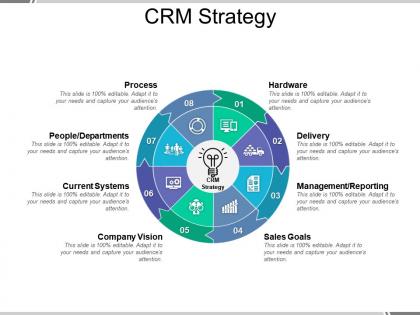
The CRM strategy PPT slide design represents customer relationship management steps as well as specific CRM strategies or tactics that the business or organization needs to adopt. You can make your viewers understand how essential is CRM planning as well as its implementation as it helps to guide an individual through emerging customer-centered sales and marketing trends by using the customer relationship management PowerPoint template diagram. A user can display the CRM building blocks infographic and planning resources as well through this readily available customer relationship management strategy PPT template design. The CRM strategy cycle slide for PowerPoint assist you to illustrate how to satisfy clients beyond developing good products or services. The customer relationship management system presentation template design can be used to retain the existing clients for maximizing efficiencies as well as reducing cost of acquisition. You can discuss that the overall relationship between the business entity and specific customers i.e. sales, marketing, support, etc. can be improved through the CRM strategy framework PPT template. Build your case on concrete facts alone with our Crm Strategy Presentation Powerpoint Templates. Discard insubstantial evidence.
People who downloaded this PowerPoint presentation also viewed the following :
Crm strategy presentation powerpoint templates with all 5 slides:
Initiate action for early diagnosis with our Crm Strategy Presentation Powerpoint Templates. It helps handle insidious diseases.

FAQs for Crm strategy
Honestly, start with your data first - if it's messy, everything else falls apart. You'll want clean, centralized info on who your customers actually are and what they've bought. Segment people based on behavior or where they are in their journey (way more useful than just age/location stuff). Automation handles the repetitive follow-ups and nurturing emails so nothing gets missed. But don't go full robot mode - your team still needs to jump in for the important conversations. Those three things - data, segments, automation - they're really the backbone of the whole thing. Get the data sorted first though, that's where I'd put my energy.
First thing - figure out what your company actually wants to achieve, then make your CRM support that. Growth mode? Focus on lead tracking and conversions. More about keeping customers happy? Track satisfaction scores and build loyalty stuff. Honestly, the hardest part is getting sales, marketing, and support to all use it the same way. I've worked places where CRM was basically an expensive rolodex - such a missed opportunity. Pick metrics that matter and check regularly if the data you're collecting actually moves the needle. Otherwise you're just creating busy work.
Look, data analytics is what separates the smart CRM moves from just guessing randomly. Track your customer behavior and you'll actually see who's profitable and who's about to bail on you. Which touchpoints convert? What messages work? Where are you bleeding money for no reason? I learned this the hard way tbh - spent months on campaigns that looked good but the numbers showed they sucked. Set up basic tracking on interactions and purchases first. That'll give you enough insights to stop wasting time on stuff that doesn't move the needle.
Look, get your team in the loop right away - nobody likes surprises with new software. Show them what's actually in it for them, like cutting down on boring admin stuff or hitting their numbers easier. Training's key but keep it short and tied to what they actually do daily. Generic demos are the worst, honestly. Find a couple people who are naturally into new tech - they'll convince the skeptics way better than you can. Oh and actually listen when they complain about features. People hate being forced into stuff they had no say in creating. Makes a huge difference.
Start with the basics - age, location, purchase history, how engaged people are. For B2B stuff, throw in industry and company size. Just don't go crazy with it. I've watched companies create these insanely complicated segments that sit unused in spreadsheets. RFM analysis is honestly your best friend for e-commerce (recency, frequency, monetary). Make sure your segments are big enough to actually matter but still specific enough for real personalization. Begin with maybe 3-5 segments, then tweak as you figure out what's working. Test different approaches and watch what actually moves your numbers.
So here's what I'd track - customer acquisition cost, lifetime value, and how long your sales cycles are. Compare those before and after. The math's simple enough: revenue gains plus cost savings vs what you spent on the system and training everyone. Honestly, retention is where you'll probably see the biggest impact. Your sales team closing deals faster? Support tickets getting resolved quicker? That's productivity gold right there. Oh, and don't overwhelm yourself - just pick 3 or 4 metrics that actually matter to your business and check them every quarter.
Honestly, AI and machine learning are crushing it right now. They're doing lead scoring automatically, personalizing everything for customers, and somehow predicting what people want before they even realize it themselves. Your sales team will love you because chatbots handle all those repetitive questions 24/7. Predictive analytics spots trends way faster than humans can. Plus integration platforms finally let you connect all your random tools instead of juggling five different systems (which is exhausting btw). Just pick stuff that actually fixes your daily headaches, not whatever's trending on LinkedIn.
Map out your current setup first and see how data moves around - you don't want to create silos that mess you up later. Make your CRM the center of everything. Connect it to email, social media, and analytics before anything else. Honestly, I've watched teams go nuts with integrations and create total chaos! Stick to what you actually use every day. Data should sync both directions, not just one way (learned that the hard way). Set up automated workflows so leads don't disappear. Oh, and test everything twice before launching.
Look, it's pretty straightforward - customers get happy when your CRM makes stuff easy for them. Quick responses? They love it. Remembering what they actually want instead of making them repeat everything? Even better. The absolute worst thing you can do is send someone a sales pitch for something they literally just bought (I swear companies do this all the time and it's so annoying). Make sure your data's actually accurate too, because nothing kills a conversation like calling someone by the wrong name. Train your team to use those insights properly so every interaction doesn't feel like starting from scratch.
Honestly, your CRM is sitting on a goldmine of personalization opportunities. All that customer data - purchases, preferences, support history - it's right there waiting to be used instead of sending the same boring emails to everyone. Set up some automated workflows that actually respond to what people do on your site. Segment your lists better. Oh, and make sure your team can see customer context before they jump on calls - that alone will make you look way more professional. I'd start by just looking at what data you're already collecting but totally ignoring. Most companies are surprisingly bad at this.
Honestly? Most people just use their CRM as an expensive contact book. Big mistake. You've got to actually train your team on it - like, really show them why this stuff matters for building relationships. Don't go crazy picking some overly complicated system either (learned that one the hard way). Your sales team needs to buy in first or they'll just ignore it completely. Also, clean your data regularly and make sure it talks to your other tools. Oh, and here's the thing - start simple. Focus on the actual relationships, not just having fancy tech sitting there collecting digital dust.
Think of customer feedback as your reality check for CRM stuff. Honestly, I've watched teams completely flip their lead scoring because they realized they'd been chasing the wrong people this whole time. When someone complains about timing or loves a specific interaction, that's your cue to adjust workflows and automation. The complaints are actually more valuable than the praise sometimes. You'll want to build in regular feedback collection so you're not just guessing what works. Feed it straight back into your processes - don't let it sit in some survey tool collecting dust.
Look, first thing - be upfront about what you're collecting and actually ask permission. None of that buried-in-fine-print nonsense. Only grab data you actually need, not everything possible. Security's obviously critical, so lock it down and limit access. Oh, and give people control - let them change or delete their stuff whenever. I mean, honestly? Half these companies say they care about privacy but clearly don't. Just treat their data how you'd want yours treated. That's really it.
Dude, your CRM is sitting on tons of missed sales opportunities. Check purchase histories first - someone buys a laptop, they'll probably want accessories or software next. Look at when customers usually upgrade too, the timing thing is actually huge. I'd segment by spending levels and hit up your high-value customers with premium stuff. Oh, and set up those automated triggers when people hit certain purchase amounts - saves you from manually tracking everything. Honestly just start with your top 20% customers and see what patterns pop up. You'll be surprised what's hiding in there.
Oh man, duplicates are the worst - you'll be dealing with those constantly. Sales people enter stuff however they want, so you get "Inc." mixed with "Incorporated" and random capitalization everywhere. Makes me want to scream sometimes lol. Then contacts change jobs or their emails go dead and suddenly half your database is useless. What really helps is creating validation rules from day one. Get someone on your team to check this stuff weekly, not just when everything's already a mess. Trust me, staying on top of it beats trying to fix thousands of bad records later.
-
Wonderful templates design to use in business meetings.
-
Great designs, Easily Editable.