

Cross Border Payment Flow Through Correspondence Bank




Try Before you Buy Download Free Sample Product
 Impress Your
Audience
 100%
Editable
 Save Hours
of Time


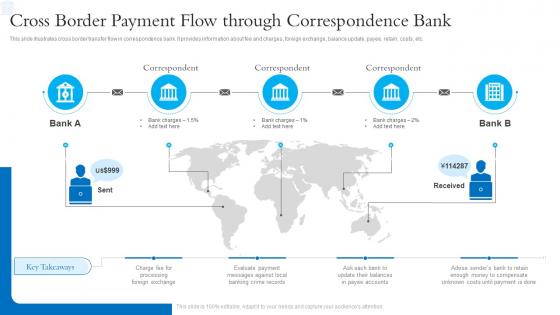
This slide illustrates cross border transfer flow in correspondence bank. It provides information about fee and charges, foreign exchange, balance update, payee, retain, costs, etc.
People who downloaded this PowerPoint presentation also viewed the following :
Cross Border Payment Flow Through Correspondence Bank with all 6 slides:
Use our Cross Border Payment Flow Through Correspondence Bank to effectively help you save your valuable time. They are readymade to fit into any presentation structure.






FAQs for Cross Border Payment Flow
Oh man, international payments are such a pain. Banks still take like 2-5 days because your money bounces through a bunch of middleman banks - seriously, how is this still a thing? Plus the fees are brutal and their exchange rates are garbage. Every country has different rules too, so compliance gets messy fast. Currency swings can screw you over if you're not careful. Honestly? Skip your regular bank and try Wise or Remitly instead. Way faster, way cheaper. I learned this the hard way last year sending money to my cousin overseas.
So basically, exchange rates totally mess with how much your person gets on the other end. The rate jumps around all day, which means what you send at 9am might be worth different money by the time it actually goes through - super annoying if you're trying to hit an exact amount. Plus most apps tack on their own fee by giving you a worse rate than the "real" one. I learned this the hard way lol. Your best move is finding services that lock in rates or at least show you exactly what they're charging. For big regular payments, those forward contract things can save you headaches.
Dude, cross-border payments are getting so much better now. Blockchain cuts out all those banking middlemen - you can send money directly instead of waiting forever. APIs let different systems actually talk to each other, which is huge. Real-time processing means transactions happen in minutes, not days. The fraud detection stuff has gotten really smart too, honestly saves so much headache with compliance. Oh and digital wallets make it super easy for customers to send money internationally without dealing with traditional banks. Start with blockchain solutions or maybe partner with some fintech companies - that's probably your best bet.
Dude, blockchain basically lets you skip all those middleman banks that usually slow everything down and charge crazy fees. Your money goes straight peer-to-peer in minutes instead of bouncing around for days. Fees drop from like 6-8% to under 1% - honestly kind of ridiculous how much banks were charging before. You can actually see where your payment is too, instead of just hoping it didn't vanish somewhere. If you're sending money internationally a lot, definitely check out stablecoins or those blockchain payment systems. Way better than traditional banking, trust me.
Honestly, it's a total mess of different rules depending on where you're sending money. US has FinCEN reporting for anything over $10K plus OFAC sanctions checks. EU's got similar limits but every country tweaks the rules their own way - such a headache. Customer verification and beneficial ownership stuff is pretty standard everywhere. Asia-Pacific tends to be way stricter with capital controls though. My advice? Map out your specific routes first and definitely get local compliance people in each place. This isn't something you want to figure out as you go.
Oh man, the fees are all over the place honestly. Traditional banks will hit you with like 3-5% plus random fixed fees - they're brutal. I've had way better luck with apps like Wise or Remitly, usually around 0.5-2%. The sneaky part? Banks hide their real profit in crappy exchange rates, not just the obvious fees. How fast you need it matters too - same day costs way more than waiting a few days obviously. Credit unions are decent, somewhere in between. But seriously, don't just look at the fee they show you upfront. Calculate what you'll actually get after everything, that's what counts.
Crypto is basically making banks panic and actually improve their game. SWIFT transfers that used to take forever? Now they're scrambling to match Bitcoin's speed. Western Union's crazy fees suddenly look ridiculous when you can send crypto across borders in minutes for way less money. Banks are throwing cash at blockchain tech now - probably should've done that years ago honestly. Real-time payment networks are popping up everywhere. If you're moving money internationally, definitely check crypto options first. Compare them with traditional methods though. You'll likely save both time and money, but always good to see what's cheapest for your specific situation.
Three big things to watch out for: compliance stuff, currency swings, and keeping payments secure. Honestly, just use established payment providers who already deal with all the regulatory headaches - trust me, you don't want to figure that out yourself. Currency fluctuations can bite you, so look into hedging or platforms that lock in rates. Always double-check recipient details through multiple ways before hitting send. Fraud detection is huge too. The whole thing gets way easier when you work with companies that actually specialize in international transfers instead of cobbling something together.
Honestly, the payment space is moving super fast right now. Real-time platforms like Wise are crushing traditional banks on fees and speed. Blockchain solutions are cutting out middlemen completely, though I'm still skeptical about adoption rates. Multi-currency wallets are probably the biggest game-changer - you can hold funds in different currencies without getting hit every time you convert. APIs are getting embedded everywhere too, so you can handle international stuff right in your existing software. Oh, and transparency is finally happening with fees. Check what your current processor already offers first though - might save you the headache of switching.
Dude, you can't just slap your usual payment methods onto other countries and call it a day. Germans are obsessed with bank transfers. Brazilians do this thing called boleto payments - honestly had to look that up myself when I first heard it. Southeast Asia? Digital wallets everywhere. The differences are crazy. Your cart abandonment will tank if you don't offer what people actually want to use. I'd start with your top 3 markets and figure out what payment options they expect. Trust me, it's worth the research upfront.
So payment gateways are like middlemen that connect different banking systems when you're dealing with international stuff. They do the currency conversion, make sure you're following all the random regulations each country has, and route everything through the right networks. Honestly, they're lifesavers because otherwise you'd need to set up banking relationships everywhere you want to sell - total headache. I learned this the hard way when I first started looking into selling overseas. The main thing is finding one that works in your target countries and doesn't kill you on exchange rates. Those fees really add up.
So basically, fintech companies just bypass all those middleman banks that slow everything down. Your money doesn't have to hop through 3-4 different banks anymore - blockchain and digital rails can move it in minutes instead of days. Ripple's probably the biggest name, but there are tons of stablecoins doing this now too. Real-time settlement systems are honestly pretty crazy when you see them work. Way better than that ancient SWIFT system banks still use. Oh, and if you're thinking about this for work, definitely look for ones with good API setups. Makes integration so much smoother.
Dude, you absolutely need end-to-end encryption and multi-factor authentication - that's your baseline. Cross-border stuff gets targeted constantly, so real-time fraud monitoring is critical. The regulatory nightmare is real though... AML and KYC requirements change depending on where you're operating and it's honestly a pain to track. API security and pen testing are obviously important too. But here's what I'd actually do - find a solid payment processor who's already built this stuff instead of DIYing it. Way less headache.
Yeah, cultural stuff makes a huge difference with international payments. Some places still don't trust digital wallets at all - they'd rather stick with cash or traditional bank transfers. Mobile payments though? Totally normal in other regions. Trust is weird too. Certain countries want crazy verification before you can send money abroad, but others just care about speed. Religious factors come into play as well, like Islamic banking rules. Oh, and family remittance habits vary everywhere. My advice? Actually research each market you're targeting. What works in one place definitely won't work everywhere else.
Honestly, the biggest headache is energy use and carbon emissions from payment networks. Bitcoin's proof-of-work system is absolutely terrible for the environment - like, shockingly bad. Traditional banking isn't great either with all those middleman processes eating up resources. Look for providers using renewable energy or carbon offset programs instead. Newer blockchain protocols are way more efficient too. When you're talking to vendors, just straight up ask about their sustainability stuff. Most people skip this step but it's worth knowing where your payments are actually going environmentally.
-
My search for complete decks ended with SlideTeam. Such a surplus collection of HD PowerPoints. Moreover, their standard and widescreen formats have helped me in delivering bullseye presentations.
-
The best collection of PPT templates!! Totally worth the money.