


Cyber Attacks On Ukraine Powerpoint Presentation Slides




Try Before you Buy Download Free Sample Product
 Impress Your
 Audience
 100%
100% Editable
 Save Hours
 of Time


This PowerPoint presentation gives a brief idea about the string of Russias cyber-attacks Against Ukraine 2022, including their impact on Ukraine and western countries. In this Cyber Attacks on Ukraine Presentation, we have covered the various Russian cyber-attacks such as Whisper Gate, Hermetic Wiper, Cyclops Blink, website defacement, DDoS attacks, and website clones. Furthermore, this Cyber Attacks on Ukraine template caters to the technical analysis of DDoS attacks against Ukrainian websites, the impact of Ukraine Russia warfare on Ukraine and western countries such as the United States, United Kingdom, and Estonia. In addition, this Wiper Malware Attack PPT contains the impact of defacement attacks and fake news on internet providers, banks, social media users, etc. Lastly, this Cyber Attacks on Ukraine deck talks about if people should worry about these cyberattacks, steps to prepare for cyberattacks by Russia, if any international laws are established for cyber warfare, and the weaknesses of Russian Cyber cells. Download our 100 percent editable and customizable template, which is also compatible with Google Slides.
People who downloaded this PowerPoint presentation also viewed the following :
Content of this Powerpoint Presentation
Slide 1: This slide introduces Cyber Attacks on Ukraine. State Your Company Name and begin.
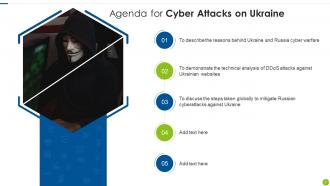
Slide 2: This slide states Agenda of the presentation.
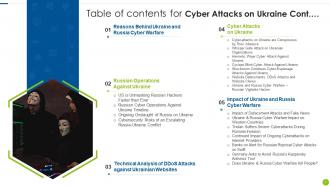
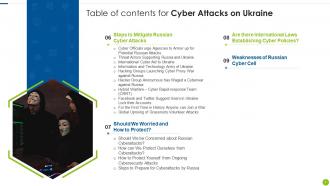
Slide 3: This slide presents Table of Content for the presentation.
Slide 4: This is another slide continuing Table of Content for the presentation.
Slide 5: This slide highlights title for topics that are to be covered next in the template.
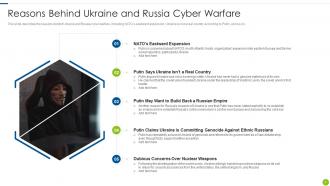
Slide 6: This slide shows Reasons Behind Ukraine and Russia Cyber Warfare.
Slide 7: This slide highlights title for topics that are to be covered next in the template.
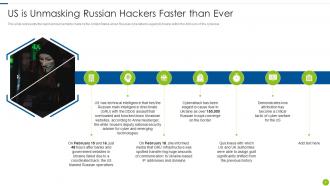
Slide 8: This slide presents US is Unmasking Russian Hackers Faster than Ever.
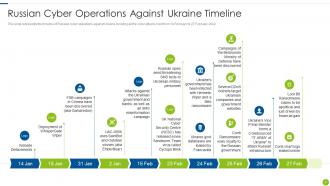
Slide 9: This slide displays Russian Cyber Operations Against Ukraine Timeline.
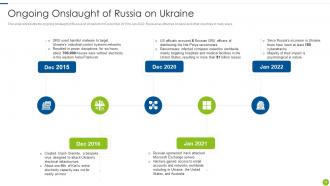
Slide 10: This slide represents the ongoing onslaught of Russia on Ukraine from December 2015 to Jan 2022.
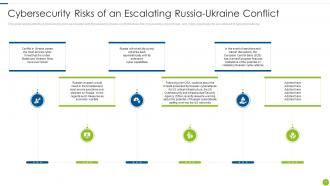
Slide 11: This slide showcases Cybersecurity Risks of an Escalating Russia-Ukraine Conflict.
Slide 12: This slide highlights title for topics that are to be covered next in the template.
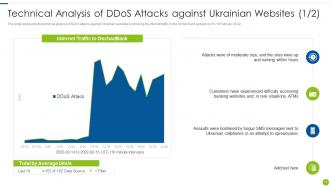
Slide 13: This slide represents the technical analysis of DDoS attacks against Ukrainian websites.
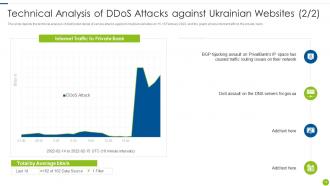
Slide 14: This slide depicts the technical analysis of distributed denial of service attacks against Ukrainian websites.
Slide 15: This slide highlights title for topics that are to be covered next in the template.
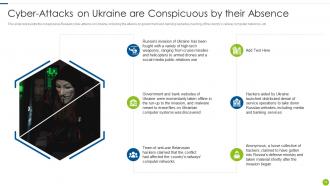
Slide 16: This slide represents the conspicuous Russian cyber-attacks on Ukraine.
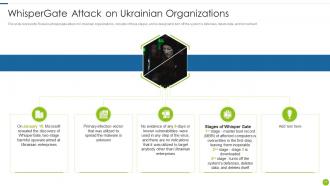
Slide 17: This slide showcases WhisperGate Attack on Ukrainian Organizations.
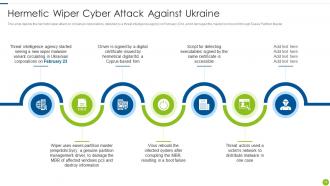
Slide 18: This slide depicts the hermeticwiper attack on Ukrainian corporations, detected by a threat intelligence agency.
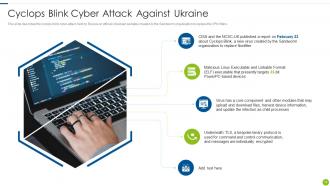
Slide 19: This slide describes the cyclops blink cyber-attack held by Russia on official Ukrainian websites.
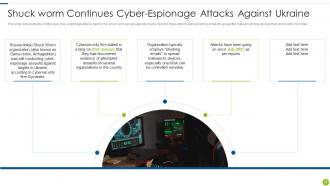
Slide 20: This slide represents the continuous cyber-espionage attacks held by the shuckworm group against Ukraine.
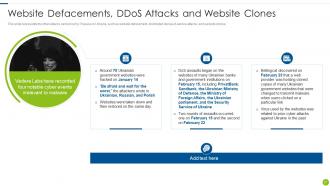
Slide 21: This slide showcases Website Defacements, DDoS Attacks and Website Clones.
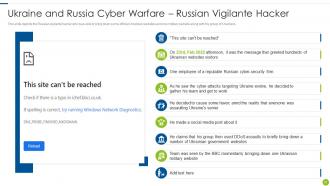
Slide 22: This slide shows Ukraine and Russia Cyber Warfare Russian Vigilante Hacker.
Slide 23: This slide highlights title for topics that are to be covered next in the template.
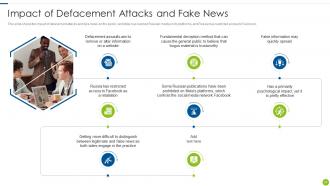
Slide 24: This slide presents Impact of Defacement Attacks and Fake News.
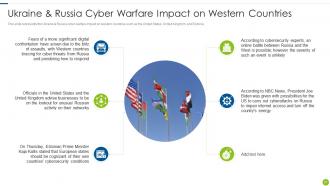
Slide 25: This slide represents the Ukraine & Russia cyber warfare impact on western countries.
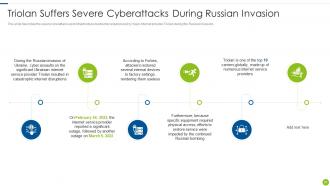
Slide 26: This slide describes the severe cyberattacks and infrastructure destruction experienced by major internet provider.
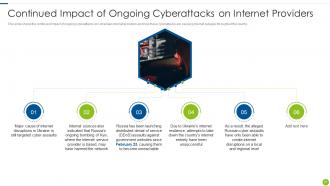
Slide 27: This slide represents Continued Impact of Ongoing Cyberattacks on Internet Providers.
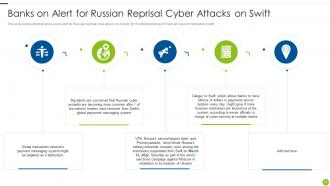
Slide 28: This slide represents that banks are on alert for Russian reprisal cyber attacks.
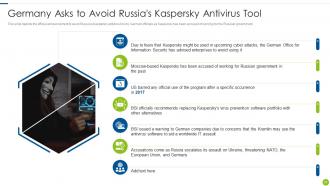
Slide 29: This slide depicts the official announcement to avoid Russia’s Kaspersky antivirus tool.
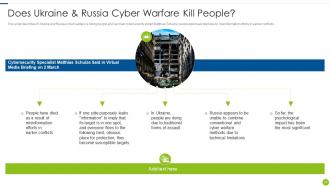
Slide 30: This slide describes if Ukraine and Russia cyber warfare is killing people and German cybersecurity.
Slide 31: This slide highlights title for topics that are to be covered next in the template.
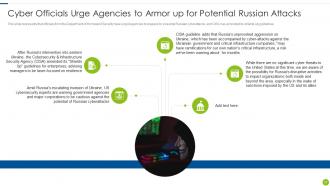
Slide 32: This slide displays Cyber Officials Urge Agencies to Armor up for Potential Russian Attacks.
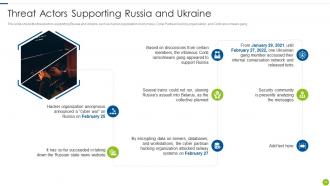
Slide 33: This slide represents Threat Actors Supporting Russia and Ukraine.
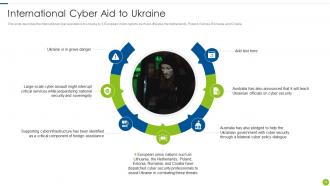
Slide 34: This slide describes the international cyber assistance to Ukraine by 6 European Union nations.
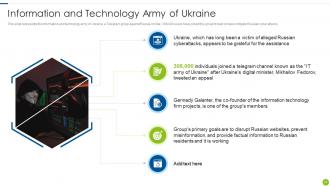
Slide 35: This slide represents the information and technology army of Ukraine, a Telegram group against Russia.
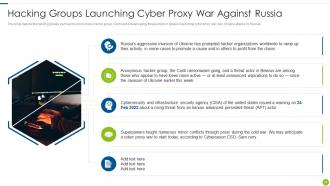
Slide 36: This slide depicts the hacking groups such as the Anonymous hacker group, Conti ransomware gang, etc.
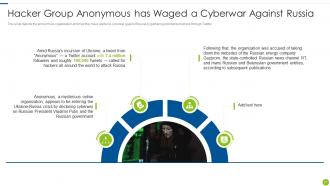
Slide 37: This slide represents anonymous organization and how they have started a cyberwar against Russia.
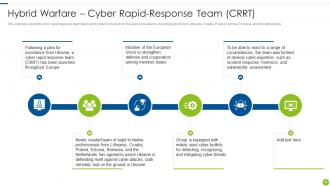
Slide 38: This slide talks about the cyber rapid response team deployed to protect Ukraine from Russian cyber attacks.
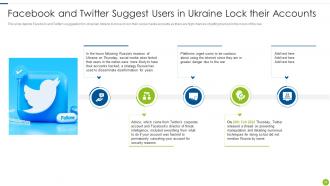
Slide 39: This slide showcases Facebook and Twitter Suggest Users in Ukraine Lock their Accounts
Slide 40: This slide represents the official announcement from Lotem Finkelstein, head of threat intelligence at Check Point Software.
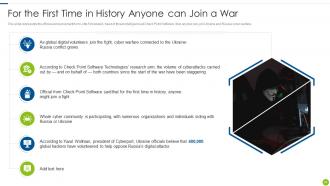
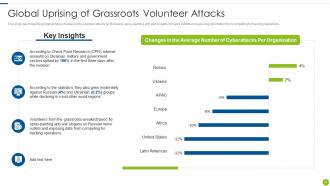
Slide 41: This slide showcases Global Uprising of Grassroots Volunteer Attacks.
Slide 42: This slide highlights title for topics that are to be covered next in the template.
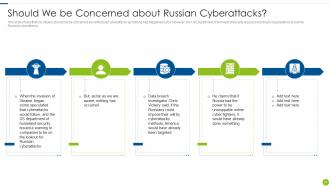
Slide 43: This slide shows that US citizens should not be concerned about Russian cyberattacks as nothing has happened so far.
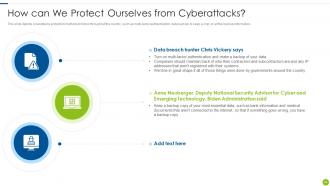
Slide 44: This slide depicts cyberattacks protection methods to follow throughout the country.
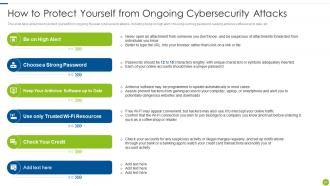
Slide 45: This slide showcases How to Protect Yourself from Ongoing Cybersecurity Attacks.
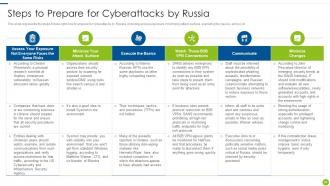
Slide 46: This slide shows Steps to Prepare for Cyberattacks by Russia.
Slide 47: This slide highlights title for topics that are to be covered next in the template.
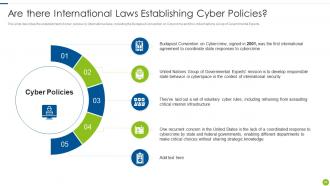
Slide 48: This slide describes the establishment of cyber policies by international laws.
Slide 49: This slide highlights title for topics that are to be covered next in the template.
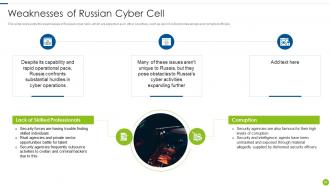
Slide 50: This slide represents the weaknesses of Russian cyber cells, which are expected as in other countries.
Slide 51: This slide displays Icons for Cyber Attacks on Ukraine.
Slide 52: This slide is titled as Additional Slides for moving forward.
Slide 53: This is Our Target slide. State your targets here.
Slide 54: This slide presents Roadmap with additional textboxes.
Slide 55: This slide shows Post It Notes. Post your important notes here.
Slide 56: This is a Timeline slide. Show data related to time intervals here.
Slide 57: This slide provides 30 60 90 Days Plan with text boxes.
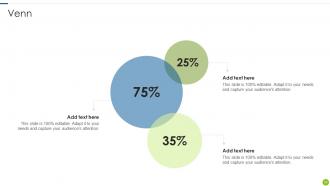
Slide 58: This slide depicts Venn diagram with text boxes.
Slide 59: This slide displays Mind Map with related imagery.
Slide 60: This slide contains Puzzle with related icons and text.
Slide 61: This is a Thank You slide with address, contact numbers and email address.
Cyber Attacks On Ukraine Powerpoint Presentation Slides with all 66 slides:
Use our Cyber Attacks On Ukraine Powerpoint Presentation Slides to effectively help you save your valuable time. They are readymade to fit into any presentation structure.








FAQs for Cyber Attacks On Ukraine
Dude, cyber warfare has been huge in this conflict. Russia started hammering Ukraine's power grid and government systems months before they even invaded - pretty scary how digital attacks are now just part of regular war strategy. They're using everything from ransomware to completely wiping data from critical services people rely on daily. Ukraine's fighting back online too, plus they've got cyber help from allies. Honestly makes you think about how exposed we all are digitally. Might be worth checking if your company's defenses are actually solid, because this conflict's showing how vulnerable our infrastructure really is.
Dude, Ukraine's cyber folks have had to completely flip their playbook since the war started. Instead of just playing defense, they're actively hunting threats now. They've teamed up with tons of international partners and private firms for real-time intel sharing - which honestly makes total sense given what they're facing. Smart move was decentralizing all their critical systems since Russia keeps going after infrastructure. They even got regular civilian hackers helping monitor stuff, which is pretty wild. Their whole approach now is basically "assume we're already hacked" and build defenses from there. Worth looking into if you're dealing with any infrastructure security work.
Ransomware's hitting power grids and government stuff hard right now. DDoS attacks are everywhere too - just trying to crash networks basically. But honestly? The wiper malware is what's really nasty. It doesn't even steal your data, just wipes everything out completely. Phishing campaigns are through the roof, going after officials and regular people to get that first foothold. Oh, and those wiper variants are popping up in other regions now which is... not great. I'd probably start there if you're doing threat modeling stuff.
So basically Russia's hitting Ukraine with cyber attacks to mess up their infrastructure without actually bombing stuff. They're going after power grids, government networks, that kind of thing. Way scarier than I initially thought, honestly. What makes it brutal is they can hit multiple targets at once nationwide - imagine trying to coordinate that many airstrikes simultaneously. You'll notice cyber incidents usually happen right before ground operations too. It's like their go-to move now. Creates total chaos and blackouts while their troops are moving in.
Yeah, so Ukraine's getting tons of cyber help from allies. The US is sharing real-time threat intel and defensive tools. NATO's handing over advanced detection systems. EU set up these cyber rapid response teams which is honestly pretty smart. Microsoft and Google jumped in too with free security services - didn't expect the private sector to go that hard but here we are. UK and other countries are training their cyber defenders, plus helping fix vulnerabilities in critical infrastructure. Keep an eye out for more of these coordinated partnerships popping up.
Dude, the cyber stuff in Ukraine has been absolutely wild. Power grids, water systems, internet - all getting hammered constantly. Entire cities lost electricity and heating in the middle of winter, which is just brutal. They've hit everything from hospitals to banks to transportation. It's like watching the playbook for modern warfare unfold in real time - combining traditional attacks with digital ones to mess up civilian life. Honestly makes me paranoid about our own infrastructure here. If you're working anywhere near critical systems, you'd better be paying attention to this mess.
Honestly, these cyber attacks are completely screwing with Ukraine's economy. Infrastructure repair costs are gonna be insane, plus they'll be dumping money into cybersecurity for years. Energy and banking got hit hard - that mess trickles down everywhere through supply chains. Running a country while constantly watching for the next attack? Brutal. Foreign investors are definitely staying away until Ukraine can show their systems won't get hacked again. Oh, and if you're monitoring this stuff, keep an eye on how fast their financial sector bounces back. That'll tell you everything about whether they can actually recover long-term.
Fake news on social media is absolutely wrecking Ukrainian morale right now. It spreads lies about military defeats, corrupt officials, and whether Western countries actually care. People start doubting their leaders when they need to stick together most. Social media makes it worse - I swear false info travels ten times faster than real news. These disinformation campaigns deliberately target trust in government and allies. Makes it way harder to keep public support strong. My advice? Always double-check sources before sharing anything, especially posts designed to make you angry or scared.
Dude, the Ukraine situation has really changed how cyberattacks work. Hackers are using wiper malware differently now - instead of just stealing stuff, they're completely nuking data to create chaos. What's wild is how coordinated everything is. They'll hit power grids and government networks at the same time, which is honestly terrifying when you think about it. Plus they're hiding behind legitimate IT tools, making detection way harder. The scariest part? They're timing cyber hits right before physical strikes. Definitely worth checking your backup systems because this stuff is spreading fast beyond just Ukraine.
So there's the UN Charter, laws of armed conflict, plus the Tallinn Manual (though that one's not actually binding). When cyber attacks cause real physical damage or kill people, they get treated like regular warfare. Targeting civilian stuff - hospitals, power grids - violates international humanitarian law. Ukraine's a perfect example, honestly. Russia's cyber hits on their infrastructure would totally break these rules if you can prove attribution. Which is always the hard part with cyber operations, right? But yeah, cyber warfare during conflicts isn't just anything-goes chaos. Same civilian protection rules apply, even if actually enforcing them is nearly impossible.
Dude, Ukraine's been killing it with their cybersecurity partnerships. Microsoft, Google, CrowdStrike - they're all basically acting like Ukraine's extended IT department, sharing threat intel and helping with incident response in real time. Pretty wild to see how tight that collaboration got. They're not just patching holes either, these companies are helping rebuild infrastructure from scratch. I mean, who would've thought wartime cyber defense could work this well? If you're setting up incident response for your company, definitely get those relationships sorted beforehand. You don't want to be scrambling when things hit the fan.
Honestly? Redundancy is everything - backup comms, power, internet, all of it. Ukraine nailed this. Having backups for your backups isn't crazy, it's smart. They also crushed it with public-private partnerships. When government actually collaborates with tech companies (instead of just pretending to), response times are insane. Oh, and a tech-savvy population helps massively - people who can pivot fast when shit hits the fan. Start building those private sector relationships now, not when you're scrambling. Trust me on this one.
So these hacktivist groups are basically acting like unofficial cyber armies right now. Anonymous keeps going after Russian infrastructure and dumping their data everywhere. Then you've got pro-Russian hackers hitting back at Ukrainian and Western websites. The coordination is actually insane when you look at how they operate. They're doing all the messy stuff governments can't officially touch - psychological ops, website defacements, that whole thing. Oh and if you're curious about what's coming next, their Telegram channels usually give away their plans beforehand.
Honestly, Russia's cyber attacks on Ukraine show how broken our international cyber rules are. They're hitting hospitals, power grids, civilian stuff - which obviously violates the whole "don't target civilians" principle. But there's zero enforcement. Like having a referee who just watches fouls happen and shrugs. The attacks mix military and civilian targets in ways nobody planned for when writing these rules. Here's what matters though: watch how other countries react. Their responses will probably shape cyber governance way more than any fancy new treaty ever could. Wild how much this conflict is changing the game.
Ukraine's gotten really good at cyber defense out of necessity. They built these distributed networks that keep running even when chunks get attacked - smart move honestly. AI threat detection helps them catch stuff way faster than old-school methods. Starlink was huge for them when regular internet got hammered. Blockchain keeps their comms secure, and they've got volunteers helping spot threats which is pretty cool. The big lesson? Design systems expecting parts to break instead of trying to make everything indestructible. Way more realistic approach if you ask me.
-
This design is not only aesthetically pleasing but it has many uses making the cost worthwhile. The graphics look stunning, and you can edit them as per your needs.
-
Excellent products for quick understanding.