


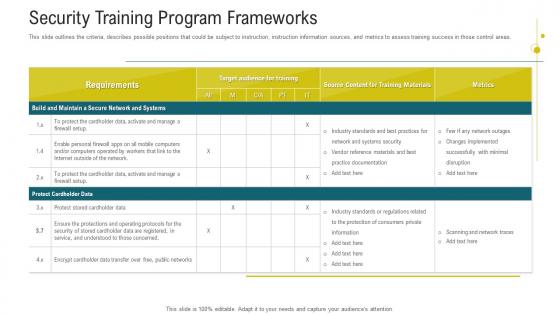
Cybersecurity awareness training security training program frameworks ppt powerpoint format




Try Before you Buy Download Free Sample Product
 Impress Your
 Audience
 100%
100% Editable
 Save Hours
 of Time


This slide outlines the criteria, describes possible positions that could be subject to instruction, instruction information sources, and metrics to assess training success in those control areas.
People who downloaded this PowerPoint presentation also viewed the following :
Cybersecurity awareness training security training program frameworks ppt powerpoint format with all 2 slides:
Use our Cybersecurity Awareness Training Security Training Program Frameworks Ppt Powerpoint Format to effectively help you save your valuable time. They are readymade to fit into any presentation structure.
FAQs for Cybersecurity awareness training security training program frameworks
Start with phishing simulations - seriously, nothing wakes people up like falling for a fake email. Add some interactive training on social engineering and ransomware, plus clear steps for reporting sketchy stuff. Monthly security tips help too, though honestly people tune out if you overdo it. Track your metrics like phishing click rates and training completions so you know what's working. The whole point is making it actually useful, not just another boring compliance thing. Oh, and do a quick assessment first to see what gaps you're dealing with.
Quarterly at minimum, but monthly is way better if you can swing it. That whole "once a year and we're good" thing? Total waste of time honestly. People forget everything within like two weeks anyway. Mix it up with regular phishing tests and quick security updates when new threats pop up. The trick is keeping content fresh - nobody wants to sit through the same boring password lecture again. Start with whatever you're doing now and ramp it up based on how your team responds. If they're actually engaging (not just clicking through), you're on the right track.
Definitely hit the big ones - phishing, malware, and social engineering. Those get everyone. Password security is obvious but still necessary because people are terrible at it. Ransomware's exploding right now, so cover that plus basic safe browsing stuff. Oh, and don't skip physical security - tailgating, random USBs in parking lots, that kind of thing actually works on people. Business email compromise is targeting finance teams hard lately. The key thing though? Use examples from your actual industry instead of generic corporate nonsense that makes everyone zone out.
Yeah so basically tailor it to what each team deals with every day. Finance should get hammered on wire fraud and fake invoices. HR needs social engineering stuff since they're swimming in employee data all the time. Your IT people? They probably already know this stuff better than whoever's teaching it, but give them the advanced threat detection training anyway. Sales teams need to focus on client data protection and those sneaky business email scams. Don't do the boring generic "phishing is bad" presentations - nobody remembers that crap. Use real examples from your industry and run simulations that actually match what they'd see.
Honestly, ditch those PowerPoint death marathons. People learn way better with short 5-10 minute modules they can knock out quickly. Phishing simulations are gold – way more effective than lectures about "don't click suspicious links." I'd throw in some competition too, like leaderboards or badges since people get weirdly competitive about that stuff. Use real examples from your actual industry instead of generic scenarios. Mix things up with videos, quick quizzes, hands-on practice. Oh, and start with a phishing test next week to see where everyone's at baseline-wise.
Honestly, gamification is a game-changer for cybersecurity training. People actually want to do it when there's points and leaderboards involved - way better than those awful slide decks everyone ignores. You can set up phishing simulations where employees "level up" their detection skills, which is pretty satisfying. Badges work great too. The whole thing just makes people competitive in a good way, you know? When they're actively solving problems instead of zoning out, they actually remember stuff later. Start simple with points for finishing modules. Trust me, you'll see way more people participating once there's some friendly competition happening.
Track your pre/post test scores first, but honestly? The behavioral stuff matters way more. Watch those phishing sim click rates and see how fast people actually report sketchy emails. Training completion rates tell you if your content sucks or not. Security incident reports are gold too - fewer successful social engineering attacks over time is what you're really after. Oh, and time-to-completion data helps spot if people are just clicking through mindlessly. You can get into fancy risk scoring later, but start with these basics.
Honestly, the biggest thing is getting everyone to actually care about security, not just dump it on IT. Skip those awful PowerPoint trainings - nobody learns anything from those anyway. Make it relevant to what people actually do every day. When someone reports a sketchy email, celebrate it instead of making them feel dumb. Your executives need to follow the same rules too, because people definitely notice when the CEO ignores security stuff. Keep policies simple so people will actually follow them. And don't make it a once-a-year thing - weave it into regular conversations and reward people who do it right.
Dude, real scenarios make all the difference in cybersecurity training. Nobody remembers boring theory, but show them that sketchy email accounting got hit with last month? Suddenly they're paying attention. You want stuff that actually mirrors what happens at your workplace - like fake social engineering calls or phishing attempts targeting your industry specifically. When people can connect it to their actual job, they'll spot the red flags way better under pressure. It's honestly the only training method that works because abstract concepts just go in one ear and out the other.
Your training's gotta hit home network security and device management first. Then focus on the phishing stuff - remote workers get way more targeted with fake "urgent" emails that play on working alone. VPN usage, securing home WiFi, all that practical stuff matters more now. Social engineering has gotten insane since everyone went remote, honestly. Include scenarios about hijacked video calls and those sketchy IT support calls - I swear everyone's gotten one. Oh, and make it interactive with real examples they'd see at home. Generic office threats won't cut it anymore when people are dealing with totally different security challenges.
Honestly, there's a bunch of good stuff out there for this. KnowBe4 has free phishing templates and posters that work pretty well. Canva and PowerPoint both have decent security awareness templates too. Real breach case studies are where it's at though - people actually pay attention when you show them what happened to other companies. SANS has solid free materials you can grab and customize. Oh, and definitely throw in some interactive stuff like quizzes or polls so people don't just zone out. I'd probably start with KnowBe4's free resources and see how those work for your team first.
Honestly, treat it like software updates - little and often beats those marathon annual training sessions that everyone zones out during. Every quarter, have your security team scan for new threats or policy changes that people actually need to know about. Then break it into small chunks through whatever channels you're already using - emails, team meetings, your LMS if you have one. Nobody wants to sit through hours of cybersecurity content (been there). Make a simple template so you can quickly turn new security stuff into bite-sized training that people might actually remember. The trick is keeping it urgent but not overwhelming.
Don't make it generic and boring - people will just zone out and click through. Regular training beats those once-a-year compliance things nobody remembers. Also, track if people actually change their behavior, not just completion rates (those numbers are basically useless). Skip the scare tactics too - they just stress people out instead of helping. Keep sessions short and interactive, make scenarios feel real to your workplace. Oh, and honestly? The fear approach is so outdated. You want people feeling confident about spotting threats, not paranoid about every email.
Honestly, success stories are way more effective than those boring security lectures. When you share real examples - like how Sarah from accounting spotted that sketchy email last month - people actually pay attention. Near-miss stories hit different too. There's something about "we almost got hacked but Jim caught it" that makes everyone realize how close we always are to disaster. Throw in some industry examples where companies saved millions. I'd use these in training or newsletters, whatever works. Don't forget to celebrate your own people though - makes others want to be the hero next time.
Honestly, most companies screw this up by doing one big training session and thinking they're done. You've got to make it ongoing - monthly phishing tests work great for keeping people alert. Drop quick security reminders in team meetings, post about new threats on company channels. Quarterly refreshers are solid too, especially when there's new stuff to cover. Oh, and definitely celebrate when people actually report sketchy emails - makes them feel good about doing the right thing. My old job was terrible at this, just did annual training and wondered why people kept clicking bad links. Start monthly and see how it goes.
-
Use of different colors is good. It's simple and attractive.
-
Easy to edit slides with easy to understand instructions.