


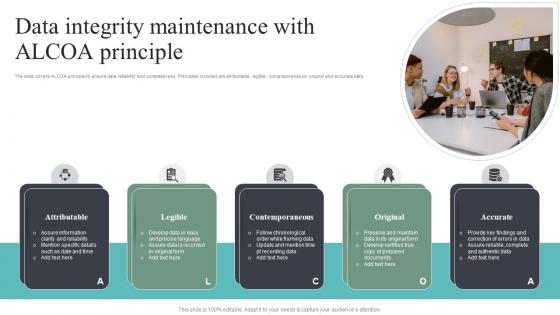
Data Integrity Maintenance With Alcoa Principle




Try Before you Buy Download Free Sample Product
 Impress Your
 Audience
 100%
100% Editable
 Save Hours
 of Time


The slide covers ALCOA principle to ensure data reliability and completeness. Principles included are attributable, legible, contemporaneous, original and accurate data.
People who downloaded this PowerPoint presentation also viewed the following :
Data Integrity Maintenance With Alcoa Principle with all 6 slides:
Use our Data Integrity Maintenance With Alcoa Principle to effectively help you save your valuable time. They are readymade to fit into any presentation structure.





FAQs for Data Integrity Maintenance
Look, data integrity boils down to four things: accuracy, consistency, completeness, and validity. Basically your data can't be wrong, contradictory, missing chunks, or formatted weird. Sounds simple but honestly it's where most companies screw up. When your data's bad, everything falls apart - analytics become useless, compliance gets complicated, and you're making business calls blindfolded. Customers notice when glitchy data messes with their experience too. Oh, and regulators hate data problems - fines add up quick. Start with validation rules when people enter data, then audit regularly. Catches issues early.
Start with database constraints - primary keys, foreign keys, check constraints. They'll block garbage data from getting in. Set up automated backups but actually test restoring them (trust me on this one). Only give data access to people who really need it. Hash functions or checksums catch corruption during transfers. Oh, and monitoring is huge - set alerts for weird stuff like duplicate records. Document what counts as valid data so everyone's on the same page. Honestly the backup testing thing can't be stressed enough.
So data validation is like having a bouncer for your database - it stops bad stuff before it gets in. You'll want to check everything coming through forms, APIs, file uploads, whatever. Set up rules for format, data types, ranges, all that good stuff. Honestly, I've seen too many apps break because someone skipped this step. Make sure you validate on both frontend AND backend though. Frontend gives users nice error messages, but backend is where the real security happens. Never trust what's coming from the client side - users can bypass that stuff pretty easily if they know what they're doing.
Dude, bad data is like driving with a cracked windshield - you're gonna crash eventually. Your team starts targeting wrong customers, wasting budget on stuff that doesn't work, missing actual opportunities. Then everyone stops trusting the reports (rightfully so). Meetings turn into arguments about whether numbers are even real instead of making actual decisions. I learned this the hard way at my last job - we spent months chasing fake trends. Get your validation processes sorted early because cleaning up bad choices later? Way more expensive and honestly pretty soul-crushing.
Ok so there's four types you gotta know: entity integrity makes sure each row has a unique primary key, referential integrity means foreign keys have to match existing primary keys. Then there's domain integrity - basically your data fits the rules like data types and stuff. User-defined integrity is just custom business rules you set up. I always got confused between entity and referential at first lol. Entity = keeping rows unique, referential = maintaining table relationships. Domain handles basic constraints, user-defined is your specific business logic. Honestly just focus on the first two initially - they'll save you from most headaches.
Checksums are gonna be your best bet here - basically like giving each file a unique fingerprint so you can tell if anything got messed up. MD5 or SHA-256 work great for this. Set up validation on both ends of the transfer to catch problems early. SFTP or HTTPS connections will encrypt everything too, which is clutch. Oh, and definitely keep transaction logs running. Trust me on this one - when stuff breaks at 2am, you'll be thanking yourself for having a paper trail of what moved where. Start simple with basic hash checking, then you can always add more fancy stuff later if needed.
Database monitoring is your first line of defense - Datadog or New Relic will catch weird stuff as it happens. Great Expectations and Deequ are solid for pipeline validation too. Kafka with schema registry is honestly incredible for real-time checks, especially if you're pushing serious volume. Oh, and don't forget basic checksums for corruption detection - super simple but they work. I'd probably start with whatever plays nice with your existing setup first. You can always expand later once you see what gaps you're actually dealing with.
Data integrity is basically required for both GDPR and HIPAA compliance - you can't really get around it. GDPR gives people the right to fix wrong info about them, and healthcare regs need data to stay unchanged unless authorized. Honestly, this is where so many companies mess up without realizing it. You need audit trails showing who touched what data and controls that prevent random changes. I'd start by mapping out how your data moves around - wherever it could get corrupted or changed unexpectedly, that's your compliance headache waiting to happen.
Honestly, the worst mistake is thinking data integrity is something you just "fix" once and move on. Teams not being on board kills projects fast - sales will hate you if validation rules slow down their deals. Been there! Also watch out for crappy backup plans and nobody actually owning the data quality piece. Documentation always gets forgotten too, then six months later you're like "where did this data even come from?" Start with your most important stuff first. Don't try to boil the ocean right away.
Oh man, data corruption is the worst. First thing - cut off those affected systems before it spreads. Then figure out how bad the damage actually is. Your backup plan better be solid here because that's basically your lifeline. Restore from your most recent clean backup, but double-check everything works properly afterward. Honestly, I've seen too many people discover their backups were trash right when they needed them most. Test that stuff regularly! Once you're back up, add some extra protection so this nightmare doesn't happen again.
Look, you can't just write up some policy and call it a day. Train your people with real examples from your actual industry - generic stuff is useless honestly. Give specific team members ownership of different data sets and tie it to their reviews so they actually give a damn. Run regular audits, but here's the thing - create a culture where people can flag problems without getting thrown under the bus. I've seen too many places where only IT cares about data quality. Make it everyone's job, not just the tech team's headache.
So data integrity is basically making sure your data stays accurate and doesn't get messed up over time. Quality is more about whether that data is actually useful for making decisions - like, is it complete, does it make sense, that kind of thing. Honestly, integrity comes first because if your data keeps getting corrupted, nothing else matters. Bad data = bad decisions, every time. I'd start with validation rules and controlling who can access what. Then work on cleaning up the actual content. My old boss used to say "garbage in, garbage out" and he wasn't wrong.
So basically ML can spot weird outliers and anomalies in your data that you'd never catch manually - like values way outside normal ranges or strange patterns. Pretty cool actually. It'll also predict when data quality problems might happen based on what's happened before. Plus all that boring validation stuff gets automated instead of you doing it by hand. I'd honestly start with anomaly detection on whatever data matters most to your business. Way easier to fix problems early than after they've screwed things up downstream.
So basically encryption is like putting a tamper-proof seal on your data. If someone messes with it while it's stored or being sent around, the encryption breaks and you'll know right away. Most encryption methods also have these built-in checksums that double-check everything's legit when you decrypt it. It's not just about hiding stuff from hackers - though that's obviously important too. The cool part is it also works like a digital signature, proving your data is exactly what it's supposed to be. Definitely stick with strong encryption standards for anything sensitive.
Think of data audits like getting your car serviced - you don't wait for it to break down on the highway, right? Regular checkups catch the small stuff before it turns into expensive disasters. I'd suggest doing these quarterly, maybe monthly if your data's really critical. What you're looking for is whether people are actually following your quality standards or just ignoring them. Human error sneaks in everywhere, plus your automated systems might be silently screwing up without anyone noticing. The whole point is being proactive instead of scrambling to fix things after they've already gone sideways.
-
Innovative and creative templates with high-quality designs. Helped me with my presentation as the slides were easy to edit.
-
Crisp and neat slides. Makes it fun and easier to curate presentations.