

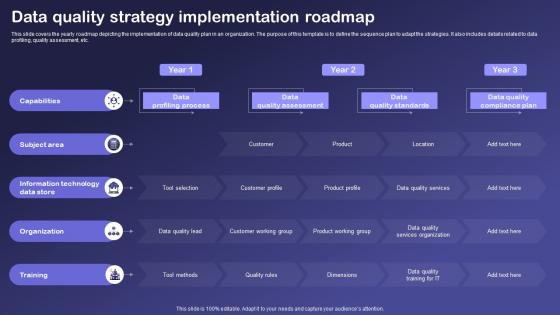
Data Quality Strategy Implementation Roadmap




Try Before you Buy Download Free Sample Product
 Impress Your
 Audience
 100%
100% Editable
 Save Hours
 of Time


This slide covers the yearly roadmap depicting the implementation of data quality plan in an organization. The purpose of this template is to define the sequence plan to adapt the strategies. It also includes details related to data profiling, quality assessment, etc.
People who downloaded this PowerPoint presentation also viewed the following :
Data Quality Strategy Implementation Roadmap with all 6 slides:
Use our Data Quality Strategy Implementation Roadmap to effectively help you save your valuable time. They are readymade to fit into any presentation structure.





FAQs for Data Quality
So you'll want four main things: data governance (basically who's in charge and what the rules are), quality metrics that actually make sense for your business, automated monitoring to spot problems early, and solid processes for when stuff breaks. Honestly, the monitoring piece is huge - can't fix what you don't see coming. Regular data profiling helps too so you know what you're dealing with. Start small though - pick your most critical datasets, define quality standards there first, then grow it out. Don't try to tackle everything at once or you'll go crazy.
Track error rates, completeness, and consistency - that's your baseline technical stuff. But honestly? The real gold is measuring business impact. How's it affecting decision speed or customer satisfaction? I'd start with maybe 3-4 metrics that actually matter to your stakeholders instead of drowning in data about your data (if that makes sense). Set up dashboards showing trends over time, not just random snapshots. The technical metrics are fine but they won't tell you if leadership thinks you're moving the needle on what counts.
So here's the thing - data governance is what makes good data quality actually happen. It's the framework for who owns what data and how they're supposed to handle it. Most teams I've seen completely skip figuring out data ownership, which is honestly where everything falls apart. You need clear rules about quality standards, validation processes, and who's monitoring what. Otherwise people just wing it and your data becomes a mess. Start by mapping out who's responsible for each dataset - that alone will solve like 80% of your headaches. Short version: governance = the structure that keeps your data from turning into garbage.
Bad data totally kills your decision-making confidence. You'll either make terrible calls or get stuck endlessly double-checking everything. Wrong insights mean you're flying blind - or honestly, flying in the completely wrong direction. I've watched teams waste entire weeks questioning their own reports because the data was sketchy. The damage spreads fast too. Decisions get delayed, opportunities slip by, and eventually your whole team stops trusting the data-driven approach. My advice? Focus on your most important datasets first and build quality checks around those.
Honestly, I'd check out Talend or Informatica if you've got the budget - they're solid for the whole data quality pipeline. Great Expectations is decent too. Apache Griffin works if you want something free, though pandas scripts can get you started quick (just gets ugly when things scale, trust me). AWS Glue has some nice built-in stuff if you're already using their platform. But here's the thing - figure out what's actually broken with your data first. Like, are you dealing with duplicates? Missing fields? Then pick something that tackles those specific problems instead of buying some massive enterprise solution right away.
ML can handle so much of the tedious data quality stuff your team probably hates doing. Anomaly detection is huge - it'll catch weird outliers way faster than anyone manually checking. Duplicate identification too. The models actually get better over time, which is honestly the best part. Data profiling becomes way more useful when you can predict where problems might show up before they hit. I'd start with something simple like duplicate detection first. Oh, and validation rules that adapt to your actual patterns instead of static ones? Game changer. Build from there once you see results.
Four main things to track: completeness (missing data), accuracy (formats/ranges look right), consistency (no dupes or weird contradictions), and timeliness (how fresh is it). Validity checks are solid too - just confirms your data types aren't wonky. Set alerts when stuff hits your thresholds. Like if completeness drops under 95% or data's over an hour stale. Honestly, defining "good enough" for each metric is half the battle - depends totally on what you're building. Don't do batch checks. Monitor constantly or you'll miss the important breaks when they happen.
Look, compliance basically forces you to stop treating data quality like some optional thing. GDPR accuracy rules, SOX financial stuff - you need documented processes and audit trails that actually prove your data's legit. Yeah, it's annoying at first (total headache honestly), but your whole data strategy gets way more solid. No more winging it. Map out which regulations hit your data first, then build quality controls around those. You'll want systematic monitoring and clear ownership too. Short answer: it sucks initially but makes everything better long-term.
Honestly, the biggest mistake is trying to fix everything at once - classic "boil the ocean" scenario. Most teams totally underestimate how much people hate changing their data habits too. New validation rules? Good luck with that pushback. Leadership usually gives you lip service but no real support, which kills everything fast. Plus there's this weird belief that data quality tools just magically run themselves forever. Super annoying. Start with your most critical datasets first, nail down executive buy-in early (like really lock it down), and build ongoing governance into your plan. Don't skip that last part.
Honestly, training your team is huge for data quality. When people actually understand what good data looks like, they're way more careful with how they enter stuff. Basic training on data entry and catching common mistakes can cut errors by like 40% - I've seen it happen. The trick is making it ongoing, not just some one-time workshop everyone forgets about. Figure out where your biggest data headaches are first, then train around those specific problems. Oh, and make it relevant to what they deal with every day, not some generic boring presentation. Short sessions work better anyway.
First thing - profile your data so you actually know what mess you're dealing with. Missing values, outliers, all that fun stuff. Then set up validation rules at entry points and standardize formats for dates, phone numbers, addresses. Automated checks will save your sanity, but you'll still need manual reviews for weird edge cases. Document everything you do (trust me on this one). Future you will thank you when someone asks "why did we transform this field?" Most importantly, track your data quality metrics regularly. You can't fix what you don't measure consistently.
Bad data is honestly such a pain - it'll mess up everything from shipping wrong orders to billing people incorrect amounts. Customers hate getting called by the wrong name or having stuff sent to their old address. Trust me, nothing kills relationships faster than that kind of mess-up. When your data's actually clean though, you can personalize things properly and fix issues before they blow up. You'll start seeing patterns in what people want and can get ahead of problems. I'd focus on auditing whatever customer-facing stuff first since that's where screw-ups hurt the most.
Okay so metadata is basically your cheat sheet for understanding what your data actually means and where it came from. Without it? You're just guessing about data quality. It shows you stuff like where data flows, what business terms mean, how things get transformed, quality rules - all that good stuff. Honestly, most people ignore it until everything breaks (guilty as charged). But here's the thing - you can't really measure or fix data quality issues if you don't know what the data's supposed to represent or how it should work. My advice? Start with your most important datasets first and work from there.
Start with the data that actually moves the needle on your key metrics. Like if customer retention is your thing, focus on cleaning up contact info and purchase history first. Don't fall into the trap of fixing random data just because it's messy - I've watched teams waste months doing that. Talk to stakeholders about what data issues are genuinely blocking their work. Then build metrics showing how cleaner data creates real business value. Time your data quality work around major business projects so you're solving problems exactly when they'll make a difference.
Honestly, automated data profiling is a game changer - it'll catch weird stuff before it breaks everything. ML models learn your patterns and flag outliers in real-time, which is actually pretty satisfying to watch. Data lineage tracking helps too since you can trace problems back to where they started. Oh, and don't sleep on crowd-sourcing validation from your actual users. They're weirdly good at spotting when something's off. Just pick one important dataset first and automate the monitoring. You'll see results immediately and can build from there. Way less stressful than playing whack-a-mole with data issues.
-
The content is very helpful from business point of view.
-
I am so thankful for all of the templates I've found on your site. They have saved me hours every week and helped make my presentations come alive. Keep up with these amazing product releases!