


Decision Making Process Flow For Vulnerability Management




Try Before you Buy Download Free Sample Product
 Impress Your
 Audience
 100%
100% Editable
 Save Hours
 of Time


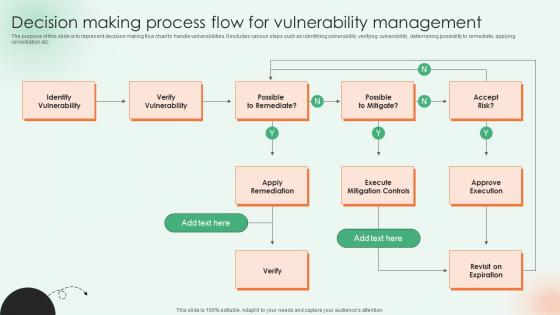
The purpose of this slide is to represent decision making flow chart to handle vulnerabilities. It includes various steps such as identifying vulnerability, verifying vulnerability, determining possibility to remediate, applying remediation etc.
People who downloaded this PowerPoint presentation also viewed the following :
Decision Making Process Flow For Vulnerability Management with all 6 slides:
Use our Decision Making Process Flow For Vulnerability Management to effectively help you save your valuable time. They are readymade to fit into any presentation structure.





FAQs for Decision Making Process Flow
Honestly, most vuln management programs crash and burn on prioritization. Sure, you need the basics - asset discovery, regular scanning, risk prioritization, and remediation workflows. Scanning's the easy part though, any decent tool handles that. But then you're drowning in thousands of vulns and can't possibly fix everything. Focus on what actually threatens your specific business first. Different risk levels need different SLAs, and your remediation process has to track everything through completion. Oh, and start with nailing down your asset inventory - sounds boring but you can't protect systems you don't even know exist.
Honestly, you need a risk-based approach that combines CVSS with real threat intel. Active exploits in the wild? Those go straight to the top. Asset criticality matters too - a medium vuln on your payment server beats a critical one on some random test box. Check out EPSS for exploitation likelihood. Also think about your setup: internet-facing systems vs internal ones, what controls you already have in place. I usually do a simple impact vs exploitability matrix and hit the high-high stuff first. Way more effective than just chasing CVSS scores blindly.
Threat intel is like having a cheat sheet for vulnerability management. You can see which CVEs are actually getting exploited right now instead of just blindly patching everything. Attackers targeting your industry? You'll know about it. Working exploits floating around? That too. Honestly, most security teams waste time on theoretical risks when real attacks are happening elsewhere. Start by hooking threat feeds into your vuln scanner - totally changes your perspective on what needs fixing first. Way better than the spray-and-pray approach most places use.
So automation basically takes care of all the tedious scanning stuff automatically - way faster than doing it by hand. The cool part is it prioritizes threats by how dangerous they actually are, so you're not getting bombarded with every tiny issue. Some tools will even fix the minor problems without bothering you. I'd definitely start with automating your scan schedules first. Then you can work up to having it handle basic fixes too. Trust me, when you're managing tons of systems, it'll save your sanity. Plus you get to focus on the actually interesting security work instead of clicking through endless vulnerability lists.
Start with MTTR - that's your core metric right there. Also track how fast you're finding vulns and what percentage of critical ones you're actually patching on time. The "days to patch" thing might sound super dry, but honestly it's where you'll see if things are actually getting better. Keep an eye on repeat vulns too since those tell you if your fixes are sticking or just band-aids. Oh, and don't forget remediation coverage by severity - that one's clutch. Begin with MTTR and patch rates, then build out from there once you've got those dialed in.
Dude, compliance frameworks basically run the show now when it comes to patching. PCI DSS, HIPAA, SOX - they all have these strict deadlines you can't ignore. Critical vulns? You're looking at days, not weeks to fix them. It's annoying but honestly keeps teams from dragging their feet. I learned the hard way to map vulnerabilities against regulatory requirements right away - saves you from scrambling later. You can't just wing it anymore and patch whatever seems interesting. The frameworks tell you exactly what's non-negotiable and when it needs to be done.
Honestly, make it everyone's problem, not just IT's headache. Ditch those awful PowerPoint sessions - nobody learns from those anyway. Real examples from your industry work way better, and phishing simulations are gold because people actually remember almost falling for it! Clear policies are fine, but explain why they matter. Oh, and definitely celebrate when teams catch sketchy stuff or report vulnerabilities. The biggest thing though? Don't do one lunch training and think you're done. Build it into regular meetings and onboarding. Consistency beats perfection every time - trust me on this one.
Build a framework that ranks stuff by both how bad the vulnerability is and what it'd break business-wise. Sort your systems into buckets - mission-critical vs everything else. Emergency patches for nasty vulns hitting production, but medium-risk things can wait for your normal maintenance windows. Getting stakeholders on board is honestly the hardest part since they freak out about any downtime. Set up regular check-ins with ops so they're not blindsided. Oh, and write down your criteria - you'll thank yourself later when you're not figuring this out from scratch every single time.
Don't try fixing everything at once - your team will hate you and nothing gets done. Map out what you actually have first because you can't protect mystery assets. CVSS scores are pretty much useless on their own, honestly. I've watched teams waste weeks patching random stuff while their main systems stay broken. Business impact matters way more than some arbitrary severity number. Oh and don't promise crazy timelines without checking if your tools can handle it. Focus on your critical stuff first, then work outward based on what actually hurts if it breaks.
You know how vuln scanners just dump a million CVEs on you? Threat modeling fixes that mess. Map out your critical stuff first - what data actually matters, which systems face the web. Then look at realistic attack paths instead of every theoretical vulnerability. CVSS scores are whatever honestly, but knowing an attacker would hit your payment system before some random dev server? That's gold. You'll end up fixing things that could genuinely hurt your business rather than playing whack-a-mole with every new CVE. Way more efficient than the usual fire drill approach.
You'll want a vulnerability scanner like Nessus or Qualys to start. Then grab a centralized tracker - Rapid7 InsightVM works great, though honestly even Jira can do the job if you set it up right. Asset discovery tools like Lansweeper help keep your inventory fresh. Your SIEM should connect to all this stuff for alerts. The real trick isn't which tools you pick - it's making them actually talk to each other. Set up executive dashboards so you're not stuck building reports from scratch every month. Trust me on that one.
Dude, you've gotta build this stuff right into your vendor contracts upfront. Specific SLAs for patches, mandatory security assessments, regular vuln reports - the whole deal. We got totally burned last year when our vendor just disappeared during a critical disclosure. That was a fun conversation with my boss, let me tell you. Set up quarterly reviews where they actually prove what they're doing, not just promise stuff. Don't forget audit rights so you can verify they're not BS-ing you. Oh and treat it seriously - like any other contract requirement. Never just take their word for anything security-related.
Your incident response team is gold for vuln management - they've seen what attackers actually do, not just what's theoretically possible. CVSS scores are fine but IR folks know which exploits are trending in real attacks. They'll tell you "hey, we're seeing tons of lateral movement through X vulnerability" or "attackers love this particular vector right now." Super valuable intel. Also they catch when your patches might mess up their forensics tools (learned that one the hard way). I'd definitely loop them into your prioritization meetings. Their war stories beat scanner reports any day.
Dude, dig into your old vuln data - it's seriously useful stuff. Which vulnerability types keep showing up? How long do patches actually take you to roll out? Some systems are just troublemakers, honestly. MTTR trends will show you if specific vendors or asset types are consistent pain points. Then you can tweak your scanning schedules and set realistic SLAs based on what actually happens, not wishful thinking. Pull the last 6-12 months of reports and find your top 3 patterns first. You might even want to rethink some tech choices down the road.
Honestly, just do the math on remediation costs vs actual risk. Check your CVSS scores and whether there's real exploits happening. Asset criticality matters too - don't treat everything like it's mission-critical when it's not. Sometimes a quick WAF rule buys you way more time than scrambling to patch everything immediately. Downtime costs can be brutal, so factor that in. Simple patches beat complicated workarounds every time though - learned that the hard way! Start with a basic risk vs cost matrix for your worst vulns. Makes the decisions way clearer when you can actually see the tradeoffs.
-
Huge collection of high-quality templates. Worth each penny.
-
SlideTeam is my one-stop destination for templates. Highly recommended!