


Devising Essential Business Strategy Build Buy Partner Decision Framework To Manage Strategic Alliance




Try Before you Buy Download Free Sample Product
 Impress Your
 Audience
 100%
100% Editable
 Save Hours
 of Time


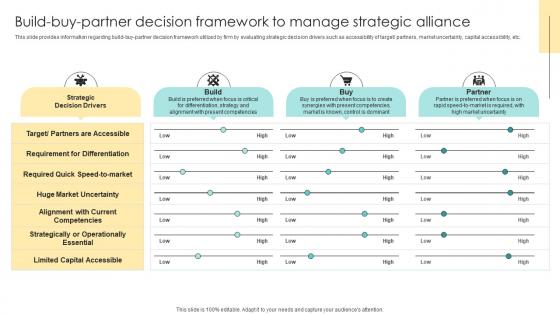
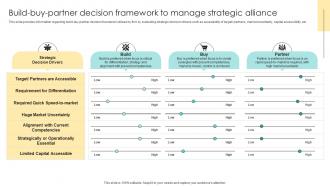
This slide provides information regarding build buy partner decision framework utilized by firm by evaluating strategic decision drivers such as accessibility of target or partners, market uncertainty, capital accessibility, etc.
People who downloaded this PowerPoint presentation also viewed the following :
Devising Essential Business Strategy Build Buy Partner Decision Framework To Manage Strategic Alliance with all 6 slides:
Use our Devising Essential Business Strategy Build Buy Partner Decision Framework To Manage Strategic Alliance to effectively help you save your valuable time. They are readymade to fit into any presentation structure.





FAQs for Devising Essential Business Strategy Build Buy Partner Decision Framework To
A successful business strategy includes clear vision and mission statements, comprehensive market analysis, competitive positioning, resource allocation plans, and measurable performance metrics. These components work together by aligning organizational goals with market opportunities, optimizing operational efficiency, and establishing sustainable competitive advantages, with many companies finding that strategic integration ultimately delivers enhanced profitability and long-term growth.
Companies can effectively analyze their competitive landscape through market research, competitor profiling, SWOT analysis, customer feedback evaluation, and financial benchmarking. These strategic approaches enable businesses to identify market gaps, assess competitor strengths and weaknesses, and understand customer preferences, with many organizations finding that comprehensive competitive intelligence ultimately delivers better positioning strategies and sustainable competitive advantages.
Market research serves as the foundation for informed business strategy development by providing critical insights into customer needs, competitive landscapes, market trends, and growth opportunities. Through comprehensive data analysis, businesses can identify target segments, assess market viability, and minimize strategic risks, while many organizations finding that robust research enables more accurate forecasting, better resource allocation, and ultimately stronger competitive positioning in increasingly dynamic markets.
Companies align their business strategy with their mission and vision by establishing clear strategic objectives, developing measurable goals that reflect core values, and creating accountability frameworks that ensure consistent decision-making. This alignment enables organizations to maintain strategic focus, enhance stakeholder trust, and drive sustainable growth, with many finding that integrated mission-driven strategies deliver stronger employee engagement and competitive differentiation.
Successful product differentiation strategies include unique feature development, superior quality positioning, exceptional customer service, innovative design approaches, and targeted niche marketing. These methods enable businesses to command premium pricing, reduce direct competition, and build stronger customer loyalty, with many companies in sectors like technology, automotive, and consumer goods finding that strategic differentiation ultimately delivers sustainable competitive advantages and improved market positioning.
SWOT analysis forms business strategies by identifying internal strengths and weaknesses alongside external opportunities and threats, enabling organizations to leverage competitive advantages while addressing vulnerabilities. Through strategic alignment of these factors, companies can develop targeted approaches like market expansion, product diversification, or operational improvements, with many finding that systematic SWOT evaluation ultimately delivers more focused resource allocation and sustainable competitive positioning.
Digital transformation fundamentally reshapes traditional business strategies by accelerating decision-making processes, enabling data-driven operations, and creating new customer engagement channels. Organizations across retail, banking, and manufacturing find that digital integration streamlines operational efficiency, reduces costs, and delivers competitive advantages, while requiring strategic pivots toward agility and continuous innovation.
Businesses measure strategic effectiveness through key performance indicators, financial metrics, market share analysis, customer satisfaction scores, and operational efficiency benchmarks. These measurement frameworks enable organizations to track progress against strategic objectives, identify areas requiring adjustment, and demonstrate ROI to stakeholders, with many companies finding that regular strategic reviews ultimately deliver improved decision-making and sustained competitive advantage.
Startups should consider strategies like market diversification, strategic partnerships, customer retention programs, scalable technology infrastructure, and sustainable revenue models. These approaches enable companies to expand systematically while maintaining operational efficiency, with many successful startups finding that combining organic growth with strategic acquisitions delivers competitive advantage and long-term market positioning.
Businesses foster innovation through dedicated R&D investment, cross-functional collaboration, strategic partnerships with startups, employee idea programs, and flexible resource allocation for experimental projects. These approaches enable organizations to systematically generate breakthrough solutions, accelerate product development, and maintain competitive advantage, with many companies finding that structured innovation processes ultimately deliver faster market responses and sustained growth.
Business strategy adapts to consumer behavior shifts through continuous market research, agile operational frameworks, and data-driven decision making. Companies like retail giants and financial services firms leverage real-time analytics, flexible supply chains, and digital transformation initiatives to pivot quickly, ultimately delivering personalized experiences while maintaining competitive advantage in increasingly dynamic markets.
Common business strategy execution pitfalls include inadequate communication, insufficient resource allocation, lack of employee buy-in, poor progress monitoring, and resistance to change management. These challenges can be avoided by establishing clear communication channels, securing appropriate funding and talent, involving teams in planning processes, and implementing regular performance reviews, ultimately ensuring alignment between strategic vision and operational execution across all organizational levels.
Global economic trends influence local business strategy development by shaping market conditions, consumer behavior, supply chain dynamics, and competitive landscapes that businesses must navigate. Companies increasingly adapt their strategies through diversified sourcing, flexible pricing models, and localized offerings, with many retail and manufacturing organizations finding that agile strategic planning enables sustained growth despite economic volatility.
Leadership plays a pivotal role in strategic implementation by setting clear vision, allocating resources effectively, driving organizational alignment, and maintaining momentum through challenges. Strong leaders communicate strategic priorities across all levels, adapt tactics while preserving core objectives, and foster accountability cultures, with many organizations finding that executive commitment directly correlates with implementation success and competitive advantage.
Businesses can leverage technology to enhance strategic initiatives by implementing data analytics for informed decision-making, automation to streamline operations, cloud computing for scalability, and AI-powered tools for competitive intelligence. These technologies enable organizations to accelerate market responsiveness, reduce operational costs, and optimize resource allocation, with many companies finding that strategic technology integration ultimately delivers sustained competitive advantage and improved customer experiences.
-
I've been looking for a good template source for some time. I'm happy that I discovered SlideTeam. Excellent presentations must try!
-
Wide collection of templates available. SlideTeam has made it easier to create presentations in just a few minutes.