


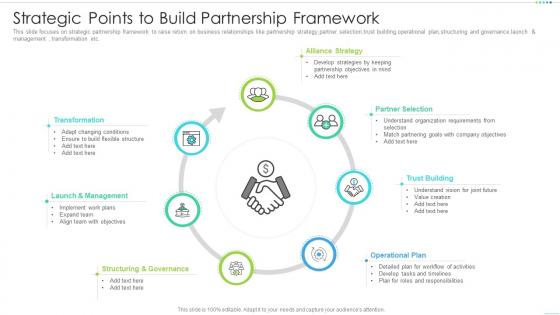
Strategic points to build partnership framework




Try Before you Buy Download Free Sample Product
 Impress Your
 Audience
 100%
100% Editable
 Save Hours
 of Time


This slide focuses on strategic partnership framework to raise return on business relationships like partnership strategy,partner selection,trust building,operational plan,structuring and governance,launch and management, transformation etc.
People who downloaded this PowerPoint presentation also viewed the following :
Strategic points to build partnership framework with all 6 slides:
Use our Strategic Points To Build Partnership Framework to effectively help you save your valuable time. They are readymade to fit into any presentation structure.





FAQs for Strategic points to
First thing - map out who's doing what and how you'll actually talk to each other. Clear roles are everything, trust me. You need shared goals everyone's bought into, plus some way to track if it's working. Oh, and definitely set up conflict resolution early because partnerships always hit bumps eventually. Resource agreements matter too - nobody likes surprises there. Regular check-ins keep things from going sideways. Honestly, the biggest thing is just making sure everyone knows what they're accountable for upfront. Build communication first, then layer on the rest.
Look for partners who share your core values but bring different strengths to the table - maybe they've got skills you lack or connections you need. I always dig into their past partnerships first because red flags show up pretty quickly if you look. Financial stability matters too, obviously. But honestly? The conversation piece is huge. Talk through expectations upfront, how you'll communicate, what happens when you disagree. It's awkward but way less awkward than fighting later when money's involved. Chemistry matters more than people think.
Trust is everything, honestly. Without it, you're just two companies making deals instead of actually building something together. I've watched partnerships with solid contracts completely implode because the trust wasn't there. You've got to prove you're reliable right away - nail those first small deliverables exactly when you promised. Be super transparent about problems when they come up. Don't oversell what you can do either. The whole thing comes down to doing what you say you'll do, when you said you'd do it. Sounds simple but most people screw this up somehow.
Okay so first thing - figure out what each partner *actually* wants, not just what they're telling you. Have those awkward conversations upfront about success metrics and who's bringing what to the table. Honestly, I've watched so many of these things crash because people just assumed they were on the same page without checking. Document everything - shared goals, individual wins, the whole deal. Set up regular check-ins too since things always shift. Oh and make sure there's a clear way for both sides to see how this partnership gets them closer to their targets. Simple framework beats complicated every time.
Honestly, the worst thing you can do is get too rigid right off the bat. Don't create some crazy complex process - I've literally watched companies spend months just trying to onboard one vendor because their framework was insane. Start simple instead. Also, figure out who's actually making decisions upfront or you'll hate your life later. Get legal involved early (boring but necessary), and don't just steal someone else's setup without tweaking it for your business. Oh, and definitely pilot it with like 2-3 partners first. Way easier than fixing a mess company-wide.
So you're gonna want to track the obvious stuff first - revenue, cost savings, how many new customers you're both bringing in. Market reach too. But honestly? The relationship side is where most partnerships actually fall apart. Send out partner satisfaction surveys, see if you're hitting those joint milestones you set up initially. I'd do quarterly check-ins where you sit down together and go through everything - gives you a chance to fix things before they get weird. Oh and definitely compare back to whatever goals you had when you started this whole thing. Some partnerships look great on paper but feel terrible day-to-day, so don't ignore that gut feeling.
Honestly, regular check-ins are everything - I'd do weekly calls plus monthly strategy stuff. Make sure you've got one point person from each side handling communication, otherwise things get messy fast. Slack or Teams work great for quick daily stuff, but video calls are still king for big decisions. Oh, and document everything somewhere you can both access it! The partnerships that actually work? They hammer out communication rules right in the initial agreement. Sounds boring but trust me, it prevents so many stupid fights later. Quarterly reviews help too.
Dude, cultural stuff will absolutely torpedo your partnership if you're not careful. Some cultures want everything decided yesterday, others need like 47 meetings first - I've watched deals completely fall apart over this. Communication styles are huge too. Americans love being direct, but that can come off as rude elsewhere. Before you do anything else, sit down with your partners and hash out how decisions get made, who needs to be involved, all that boring but crucial stuff. Oh and figure out their conflict resolution style early - saves so much drama later. Trust me on this one.
Honestly, start with liability stuff - figure out who's on the hook when shit hits the fan. Each person's role and decision-making power needs to be super clear from day one. Profit sharing is where most partnerships blow up, so spell that out exactly. Don't skip the boring stuff like IP ownership and confidentiality either. Exit strategies matter way more than you think right now (learned that the hard way). Dispute resolution is clutch too. Get a lawyer to look it over before signing - I know it's expensive but worth it.
Honestly, tech is what makes partnerships actually work these days. Shared docs and project management tools are lifesavers for tracking everything together. Video calls break down distance barriers - though we've all been there with the audio issues lol. Communication platforms keep everyone updated without constant email chains. AI analytics can show you where things are falling apart between teams, which is pretty useful. The trick is finding tools that play nice together instead of making everything more complicated. I'd start by figuring out where you're struggling to communicate, then pick solutions that fix those exact problems. Don't overthink it.
Honestly, visual frameworks are a game changer for mapping out partner relationships. Instead of trying to explain everything with paragraphs, you just draw it out - way clearer. Stakeholders get it immediately, and new people don't look confused in meetings anymore. The best part? You'll catch problems early, like when two partners might clash or there's a weird gap nobody noticed. I always tell people to start basic - just boxes and lines work fine. You can get fancy later if you want, but simple stuff usually does the trick.
Think of feedback loops as your partnership safety net - they catch problems before they blow up. Set up quick check-ins where you can both vent about what's annoying and celebrate what's actually working. Honestly, most people skip this part and wonder why things fall apart later. Make it structured but not corporate-y... maybe a 15-minute call every few months? The trick is actually doing something with what you hear, not just collecting complaints. Short surveys work too if calls feel like too much. Small tweaks based on real feedback can totally save partnerships from going sideways.
Honestly, you've gotta set up the boring stuff first - clear escalation paths and regular check-ins before anything goes sideways. Don't wait when problems start brewing because they just snowball into bigger messes. I always tell people to focus on what everyone actually wants, not just their initial positions. Document everything afterward too (learned that one the hard way). Oh, and quarterly reviews are clutch for catching issues early. Having a neutral person ready to jump in when things get heated? Total game-changer.
Make sure flexibility is built into your partnership thing from day one. I'd do quarterly check-ins to see what's actually working - use real data and partner feedback, not just gut feelings. Honestly, I've watched so many "perfect" frameworks completely crash when the market changed. You want clear paths for renegotiating terms and modular pieces you can swap without rebuilding everything. Oh, and treat it more like a Google Doc than something carved in stone - it needs to evolve or you'll get stuck.
Oh man, leadership makes or breaks this stuff. They've gotta actually walk the walk - you know, put real money behind it and jump in when things get messy. Can't just be empty cheerleading from the sidelines. I've watched partnerships crash because when the going got tough, leadership basically vanished. Your team needs to see WHY these partnerships matter for the bigger picture. Also, leaders need to clear out the bureaucratic nonsense that'll inevitably pop up. Honestly? Don't even bother starting if your leadership team isn't genuinely all-in from day one.
-
Thanks for all your great templates they have saved me lots of time and accelerate my presentations. Great product, keep them up!
-
Great designs, really helpful.