


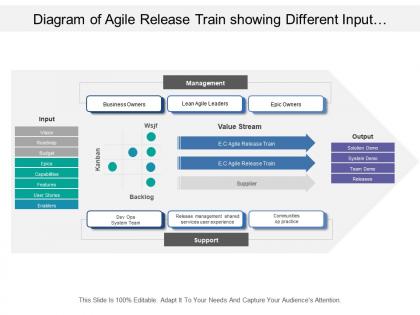
Diagram of agile release train showing different input output and management categories





Try Before you Buy Download Free Sample Product
 Impress Your
 Audience
 100%
100% Editable
 Save Hours
 of Time


Condemn bigotry with our Diagram Of Agile Release Train Showing Different Input Output And Management Categories. Enlighten folks about baseless intolerance.
People who downloaded this PowerPoint presentation also viewed the following :
Diagram of agile release train showing different input output and management categories with all 5 slides:
Give your competence an extra boost with our Diagram Of Agile Release Train Showing Different Input Output And Management Categories. You will derive a competitive advantage.
FAQs for Diagram of agile release train showing different input output
So basically, an ART keeps 5-12 agile teams synchronized so they can actually ship stuff together without everything falling apart. Picture it like a train schedule - everyone's moving toward the same goal on the same timeline (usually 10-week sprints). Without it, teams just build random features in their own bubbles that don't work together. Total nightmare. The ART handles all the messy coordination stuff - dependencies, shared resources, making sure everything integrates properly. If you're scaling beyond a handful of teams, you really need this structure or things get chaotic fast.
So basically you stay synced through regular meetings and planning sessions. PI Planning happens every 10-12 weeks - that's where all teams plan together and figure out dependencies. Honestly it's probably the most useful meeting you'll go to. Weekly ART syncs happen during sprints to share blockers and coordinate stuff. Everyone works off the same objectives for the increment, plus there are shared dashboards showing real-time progress which is pretty helpful. Oh and don't just sit there quietly - actually speak up about your roadblocks and dependencies. Other teams can usually help out if they know what's going on.
So the ART leadership team deals with the big picture strategy while your teams just worry about getting stuff done. Release Train Engineer runs the show - removes roadblocks, keeps things moving. Product Manager owns the vision and roadmap. System Architect makes the technical calls across teams. Business Owners are like executive sponsors but they actually get involved, handle funding and stakeholder stuff. Honestly, they're who you go to when cross-team coordination gets messy or priorities aren't clear. They plan the increments, manage dependencies between teams - basically make sure your ART actually delivers something useful each PI.
So basically, everyone works on the same 10-week cycle with synced sprints and shared goals. Every two weeks there's System Demos where teams actually show their stuff working together - not just random isolated features. The PI Planning sessions are where the real work happens though. Everyone gets in a room and maps out who depends on what between teams. Yeah, it's more meetings (ugh), but honestly? Way better than those awful integration disasters that pop up later. At the end you do this Inspect & Adapt thing to see the whole solution and figure out what to fix next time.
Honestly, start with PI predictability - that's your bread and butter for seeing if teams actually deliver what they promised during planning. Velocity trends are solid too, shows you if everyone's burning out or cruising at a good pace. Feature cycle time is clutch for understanding how fast stuff actually moves through your train. Don't sleep on the softer metrics either - team satisfaction scores can tell you more than you'd think. Quality stuff like defect rates matter but they're honestly a pain to measure consistently across different teams. Those two I mentioned first though? They'll give you the real picture of what's going on.
So ARTs can actually shift direction pretty fast because of how they're set up. Every 8-12 weeks you've got PI Planning where teams can totally reassess what matters most. Plus those System Demos happen regularly and give you real customer feedback to work with. Your backlog isn't set in stone either - Product Management can tweak features between iterations based on user reactions. Honestly, the Sprint reviews and retrospectives are clutch for catching issues early instead of waiting months for the next release. Just make sure your Product Owner actually has the authority to make changes when they spot problems.
A Program Increment is basically your ART's heartbeat - a fixed 8-12 week chunk where all teams march toward the same goals. Pretty cheesy analogy but it works! You kick things off with PI Planning where everyone coordinates their work together. Then there's about 10 weeks of actual execution, followed by an Inspect & Adapt workshop to wrap things up. Multiple ARTs can sync their PIs too, which honestly makes the whole organization feel way more coordinated. Just check your ART's PI calendar to see where you're at in the current cycle.
Honestly? ARTs are a game-changer for getting teams to actually work together instead of doing their own thing. You'll see way less chaos because everyone's planning on the same timeline with shared goals. Feedback comes faster too, which is clutch when leadership decides to flip everything upside down (which they always do). Regular PI planning sessions force those nasty cross-team dependencies out into the open early - trust me, way better than discovering them at crunch time. Speed's another huge win over old-school waterfall approaches. I'd start by looking at how your current teams depend on each other, then figure out where ART structure makes the most sense.
Honestly, diagrams are a game-changer for ART stuff. Executives eat up visual dashboards anyway, so this hits the same spot. Instead of rambling about team dependencies, you just point at the diagram and boom - they see how value flows from teams to features to releases. No more awkward "wait, who does what again?" moments in meetings. Non-tech folks get scope and timelines way quicker too. I always throw mine up on screen right when planning starts - saves like 20 minutes of explaining every single time.
Dependency conflicts will kill you - teams constantly blocking each other waiting for features. Resource fights get messy too when everyone needs the same engineers or infrastructure. Honestly, the communication overhead alone is insane. You'll have teams building stuff that doesn't work together, release schedules that make no sense, and people constantly confused about priorities. Oh, and don't get me started on inconsistent practices across different trains. Set up regular cross-team check-ins from day one and nail down who owns what. Otherwise you'll live in meetings trying to untangle messes instead of shipping anything useful.
Weekly works best for ART sync meetings - you don't want to lose momentum but also avoid meeting fatigue. Focus on cross-team blockers, dependencies, and PI objective risks. Basically the big stuff that can't wait until next quarter's planning (because honestly, that's forever in agile time). Scrum Masters should surface issues affecting multiple teams, not individual team drama. Oh, and definitely timebox these things. I've seen too many turn into rambling sessions where nothing gets resolved. Keep it tight and actually useful.
Honestly, just use whatever your team already has first - don't overthink it. Visio and Lucidchart are solid if you want something that looks professional and handles collaboration well. Miro's my personal favorite though, especially if your team's into the whole sticky note thing during planning. It just feels more natural for agile work somehow. PowerPoint works too if you're keeping it simple (though it's pretty clunky). Some teams go all-in with SAFe tools like Rally or Jira Align, but that's probably overkill unless you're already using them. Start basic, see what clicks.
Every two weeks your whole ART gets together for system demos - basically showing off how all the teams' work actually functions as one system. Stakeholders come watch you demo the integrated features, not just individual stuff. Honestly, they're pretty stressful but super useful for getting real feedback before the PI wraps up. Your Product Manager should coordinate what gets shown. Oh, and definitely invite actual business people, not just a bunch of engineers sitting around nodding at each other. It's your main inspect-and-adapt moment, so don't skip it.
So CI is like the glue holding your ART together - it automatically merges and tests everyone's code changes throughout each sprint. Multiple agile teams working at once? Yeah, without it you're screwed when they try combining their work later. Think of it as catching conflicts early instead of dealing with expensive fixes at the end. Daily commits are where you want to be, honestly. The automated testing means your ART can actually ship working stuff every Program Increment. Get that pipeline set up early or you'll regret it.
Yeah, so teams in your ART will tweak ceremonies based on what they actually need. Backend folks might do longer retros since they're drowning in tech debt, but frontend keeps theirs quick. Daily standups? Some teams love the detail, others wrap up in 3 minutes - which honestly works better half the time. The catch is sprint reviews and planning still gotta sync with the ART timeline or dependencies turn into total chaos. Just find your team's groove while hitting those shared touchpoints everyone depends on.
-
Excellent template with unique design.
-
Visually stunning presentation, love the content.