


Difference Between Traditional And Smart Grid Smart Grid Vs Conventional Grid




Try Before you Buy Download Free Sample Product
 Impress Your
 Audience
 100%
100% Editable
 Save Hours
 of Time


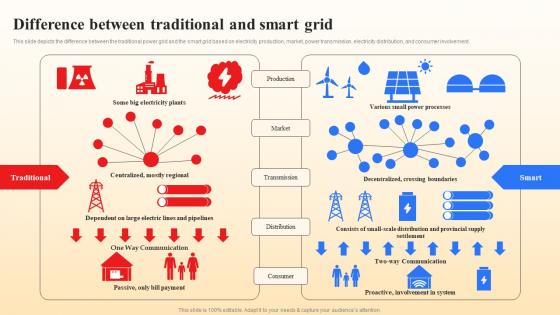
This slide depicts the difference between the traditional power grid and the smart grid based on electricity production, market, power transmission, electricity distribution, and consumer involvement.
People who downloaded this PowerPoint presentation also viewed the following :
Difference Between Traditional And Smart Grid Smart Grid Vs Conventional Grid with all 9 slides:
Use our Difference Between Traditional And Smart Grid Smart Grid Vs Conventional Grid to effectively help you save your valuable time. They are readymade to fit into any presentation structure.








FAQs for Difference Between Traditional And Smart Grid Smart Grid
So basically you're looking at smart meters, advanced metering infrastructure, and distribution automation systems as your core pieces. Two-way communication networks let everything actually talk to each other - way better than the old one-way setup we used to have. Demand response systems are pretty cool too, they'll automatically dial back power usage when things get crazy during peak hours. Oh, and don't forget the grid sensors and analytics stuff for real-time monitoring. Honestly though? I'd map out what you've got now before diving into any upgrades. Makes the whole process way less of a headache.
So smart grids are actually pretty sweet - they monitor everything in real-time and can automatically adjust stuff, which old grids totally can't do. Your devices talk back and forth with the utility company, so power gets distributed based on what's actually needed instead of guesswork. Way less waste during busy times, plus renewables work way better with the system. Oh, and your appliances can shift to cheaper hours on their own, which is honestly kind of lazy in the best way. Outages get rerouted automatically too. I'd start with just getting a smart meter first though - you'll see exactly how much you're using and when.
So smart grids are basically the grid getting an upgrade to handle renewables better. When your solar panels or wind turbines go crazy with production, the system can automatically store that extra juice in batteries or tell your smart water heater "hey, now's a good time to run." It balances everything in real-time instead of just hoping for the best. Pretty neat stuff. Plus you can actually sell power back if you've got rooftop solar - which honestly feels like the future we were promised. Worth looking into how your place could plug into all this.
Smart meters are basically how your house talks to the power company now. No more meter readers walking around once a month - these things send your usage data automatically in real time. Your utility can spot outages instantly and manage the grid way better. Plus they can do dynamic pricing, which honestly sounds kinda scary but whatever. The cool part is you get access to all that data too. You can actually see your energy patterns and figure out what's eating up power. Most utilities have customer portals now, so you might already have access and just not know it. Worth checking out.
Honestly, smart grids are a game changer for peak demand. They automatically shift power around from areas that aren't using much to wherever it's needed most. Picture a really good traffic controller but for electricity. Your local power plant doesn't have to stress when everyone's blasting AC at 3pm anymore - the system pulls from battery storage, solar panels, you name it. Everything balances out in real time. No more brownouts during heat waves (thank god). Oh, and if you're doing any energy stuff, make sure it works with smart grids. You'll thank me later.
Start with network segmentation and encryption - that's your base layer. Multi-factor authentication is non-negotiable for every single component, plus you'll need constant monitoring. The attack surface is honestly insane with all those IoT devices everywhere. Get intrusion detection systems running and have response plans mapped out beforehand. Regular pen testing is huge too - I can't stress that enough. Oh, and don't forget security audits every few months. Map out your current weak spots first, then tackle the most critical infrastructure pieces. It's a lot but you really can't half-ass this stuff.
So basically, smart grids have sensors everywhere - meters, transformers, all that stuff - constantly sending data back to central systems. AI analyzes it all in real-time to spot patterns and predict when demand's gonna spike. Way better than the old days when utilities just waited for angry customers to call about outages, honestly. Now they can reroute power automatically and even catch equipment problems before things break. Pretty cool tech. You should figure out which real-time metrics would actually save you money first though.
Ugh, cybersecurity is probably your worst nightmare here - digitizing the whole electrical grid basically paints a giant target for hackers. Infrastructure costs are brutal too since utilities have to rip out decades-old equipment. Then there's all the data privacy stuff customers freak out about, plus trying to integrate solar panels and wind farms creates this crazy two-way power flow situation. Honestly, the regulatory red tape alone could kill you. My advice? Start with rock-solid security first, then roll it out in phases so you don't blow your entire budget upfront. Makes the whole thing way less overwhelming.
Basically smart grids help cities cut emissions by automatically balancing energy supply and demand - no more power plants running "just in case." You'll get real-time data showing when to run your dishwasher during off-peak hours when there's more clean energy available. Solar panels and EV charging integrate way smoother too without frying the system. Most cities see around 10-15% emission drops just from better grid management, which honestly seems low but it's still solid progress. If your city's looking into this, definitely push for pilot programs in dense neighborhoods first - that's where you'll see the biggest impact.
Dude, the battery situation is getting crazy good for smart grids. Lithium-ion costs have absolutely tanked - like, insanely cheap now. Tesla's Megapacks let utilities store renewable energy and balance everything in real-time. Flow batteries are solid too, they handle the constant charging cycles way better. What's wild is you can actually rely on solar and wind now even when it's cloudy or whatever. Oh, and if you're planning any grid stuff, I'd bet storage costs drop another 50% by 2030. The math just keeps getting better.
You get real-time data on your energy use, which honestly changes everything. Instead of that shocking monthly bill, you can see exactly when rates spike. Most people end up doing laundry and dishes super late now - took me forever to remember at first, but the savings add up. Peak hours are brutal for pricing, so shifting to off-peak makes sense. There's also these demand response programs where they'll actually pay you to cut back when the grid's stressed. My advice? Track your usage for a month and you'll spot patterns you never noticed. Easy money right there.
So smart grids are actually pretty game-changing for EV owners. Your car can automatically charge when electricity's cheapest (usually overnight), which saves you real money if your utility has time-of-use rates. The grid won't crash when everyone plugs in after work because it balances everything out. Here's the wild part - your EV can even send power BACK to the grid during outages. It'll also sync with solar and wind when they're producing more. Honestly, the whole system just works way better than I expected. Definitely look into those utility rates if you're car shopping.
Look, interoperability is huge for smart grids - like seriously make-or-break stuff. When your systems can't communicate, you get bottlenecks everywhere and energy gets distributed terribly. It's like that multilingual team situation where nobody understands each other. Your components need to speak the same language so they can actually share real-time data about demand, supply changes, maintenance issues - all that critical stuff. Without it? You're looking at way higher costs and reliability problems. I'd start by checking what communication standards you've got now and figure out where the gaps are. Honestly sounds like a nightmare to fix but totally worth it.
Smart grid deployment? Yeah, you're gonna hit a wall of regulations pretty fast. FERC controls the interstate stuff, but state utility commissions run distribution and rates - which honestly can be more of a headache. Customer data privacy is massive here since you're collecting really detailed usage info. NERC CIP standards are mandatory if you touch bulk power systems at all. The rules shift around constantly too, which sucks for planning. Get legal involved from day one and actually talk to your local utility commission. I know it sounds boring, but they'll save you tons of time later.
So basically smart grids are game-changers for power outages. When disasters hit, they automatically reroute electricity around damaged areas instead of everything just going dark. The monitoring happens in real-time too - catches problems instantly rather than utilities playing guessing games about what's broken where. Honestly, watching it work is pretty wild. Your power stays on even when the next neighborhood over is dealing with issues. Recovery's way faster since repair crews know exactly where to go. Oh, and if you're doing any infrastructure stuff, definitely prioritize the disaster-prone spots first.
-
I want to express my gratitude to SlideTeam’s presentation design services team for helping me create the best presentation of my life!
-
I was able to find the right choice of PPT template for my thesis with SlideTeam. Thank you for existing.